


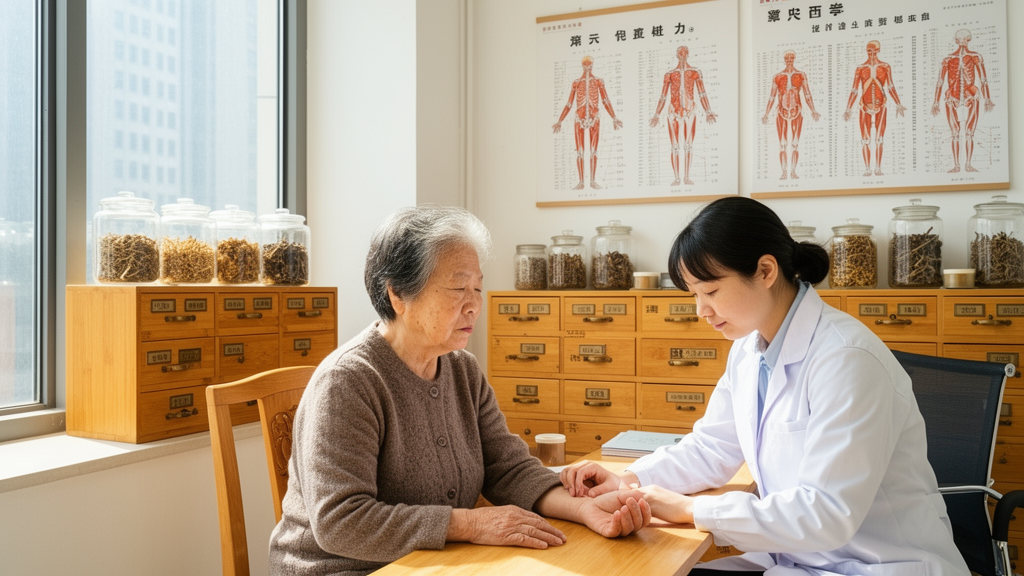
In an explanatory sequential mixed-methods study conducted in Wuhan, China, 729 of 1,195 older adults recruited at community health service centres—61.0% of the study sample—reported receiving at least one community-based traditional Chinese medicine (TCM) health service during the previous 12 months. A separate qualitative phase identified delivery barriers perceived by 11 primary care providers, including limitations in policy and institutional support, shortages of workforce and material resources, and barriers involving community awareness and acceptance.
The study was conducted from December 2024 to July 2025. Its quantitative phase used a structured survey of community-dwelling adults aged 60 or older who were recruited on site during designated sessions at seven selected community health service centres. Four centres were selected from central urban districts and three from outer urban districts using stratified site sampling. Individual participants were not randomly sampled from population registers, so the 61.0% result describes the site-recruited sample rather than all older adults in Wuhan.
In bivariate analyses, reported service use differed significantly by sex, education, medical insurance status, monthly household income, smoking, drinking, number of chronic conditions, awareness of community-based TCM services, perceived convenience of access and perceived complexity of the service process. Use was lower among participants reporting no chronic conditions than among those with one, two, or three or more conditions. No statistically significant differences were found by age group, marital status, living arrangement, perceived price or perceived policy support.
The primary multivariable binary logistic regression excluded awareness of community-based TCM services. Within the study sample, higher educational attainment, higher monthly household income and a greater number of chronic conditions were associated with higher odds of reporting service use. Compared with participants with no schooling, adjusted odds ratios were 1.96 for junior middle school education, 2.11 for senior high or technical secondary education and 3.48 for college education or above. Relative to monthly household income of 1,999 yuan or less, adjusted odds ratios for higher-income groups ranged from 2.40 to 3.62.
The number of chronic conditions also showed a graded association with reported use. Compared with participants reporting no chronic conditions, adjusted odds ratios were 5.38 for one condition, 7.63 for two and 9.72 for three or more. Participants without medical insurance had lower adjusted odds of reporting use than those covered by urban employee basic medical insurance, with an adjusted odds ratio of 0.30 and a 95% confidence interval of 0.11 to 0.77. This estimate came from a small uninsured subgroup of 28 participants, eight of whom reported using a service, so its precision and generalizability were limited.
A sensitivity analysis using Firth’s penalised likelihood produced a directionally consistent insurance estimate in the primary model: 0.32, with a 95% confidence interval of 0.13 to 0.81. An exploratory model that added awareness was reported separately because awareness and service use were measured concurrently. It improved statistical fit and was strongly associated with reported use, but its estimates could not establish temporal ordering or a causal effect of awareness. Estimates for chronic conditions also changed substantially between models, indicating sensitivity to model specification.
Among the 729 participants who reported using at least one service, oral Chinese herbal medicine was the most frequently reported type, received by 449 people, or 61.6% of that group. Tuina or massage was reported by 316 people, external TCM therapies by 312, acupuncture by 304 and cupping by 302. These percentages describe service types reported by users within the survey sample and do not measure frequency, continuity or intensity of use.
Interviews with 11 primary care providers identified three themes of perceived delivery barriers. Providers described incomplete policy frameworks and institutional support, including limited insurance coverage for some TCM items and weak coordination among relevant departments. They also reported shortages of trained personnel, insufficient systematic TCM training, outdated or inadequate equipment and constrained service venues. The third theme concerned communication and perceived acceptance: providers described limited varieties of community publicity and perceived cultural or cognitive resistance to TCM among some residents.
These provider accounts were not treated as direct explanations for older adults’ service choices because the interview participants were different from the survey participants. The study’s cross-sectional design could not determine whether insurance status, income, education, awareness or chronic disease burden preceded reported use, and self-reported 12-month use was vulnerable to recall bias. The qualitative sample was drawn from one city, centre identifiers were unavailable for adjustment of within-centre correlation, and residents’ own motivations, preferences, trust and reasons for non-use were not explored qualitatively. The findings therefore describe associations within the recruited sample and provider-perceived delivery conditions, rather than causal effects or population-level estimates for Wuhan.
Subject of Research: Mixed-methods study of community-based TCM service use among older adults and provider-reported delivery barriers in Wuhan
Article Title: Community-based traditional Chinese medicine health service use among older adults and provider-reported delivery barriers in Wuhan, China: an explanatory sequential mixed-methods study
Article References: Yue, Y., Fu, J., Gu, J., Tong, M., Qiu, Y., Liu, J., Du, J., & Yang, F. (2026). Community-based traditional Chinese medicine health service use among older adults and provider-reported delivery barriers in Wuhan, China: an explanatory sequential mixed-methods study. BMC Health Services Research, 26(1), Article 1439. https://doi.org/10.1186/s12913-026-15625-5
Image Credits: AI Generated
DOI: 10.1186/s12913-026-15625-5
Keywords: community-based TCM services, older adults, Wuhan, health services research, mixed methods, medical insurance, healthcare access, primary care providers, Community-based, traditional, Chinese, medicine
Cite Scienmag News
Ophelia Keating. (October 20, 2026). Community-based traditional Chinese medicine health service use among older adults and provider-reported delivery barriers in Wuhan, China: an explanatory sequential mixed-methods study. Scienmag. https://scienmag.com/community-based-traditional-chinese-medicine-health-service-use-among-older-adults-and-provider-reported-delivery-barriers-in-wuhan-china-an-explanatory-sequential-mixed-methods-study/
Ophelia Keating. "Community-based traditional Chinese medicine health service use among older adults and provider-reported delivery barriers in Wuhan, China: an explanatory sequential mixed-methods study." Scienmag, 20 October 2026, https://scienmag.com/community-based-traditional-chinese-medicine-health-service-use-among-older-adults-and-provider-reported-delivery-barriers-in-wuhan-china-an-explanatory-sequential-mixed-methods-study/. Accessed 20 October 2026.
Ophelia Keating. "Community-based traditional Chinese medicine health service use among older adults and provider-reported delivery barriers in Wuhan, China: an explanatory sequential mixed-methods study." Scienmag. October 20, 2026. https://scienmag.com/community-based-traditional-chinese-medicine-health-service-use-among-older-adults-and-provider-reported-delivery-barriers-in-wuhan-china-an-explanatory-sequential-mixed-methods-study/


