


A nationwide cross-sectional survey conducted across all 39 health districts in Togo from November 2023 through October 2024 identified 1,521 people with albinism, corresponding to an estimated prevalence of 18.79 cases per 100,000 inhabitants, or approximately 1 in 5,323 people. The 95% confidence interval ranged from 1 in 5,605 to 1 in 5,065. The researchers described the study as the first nationwide assessment of albinism prevalence in the country.
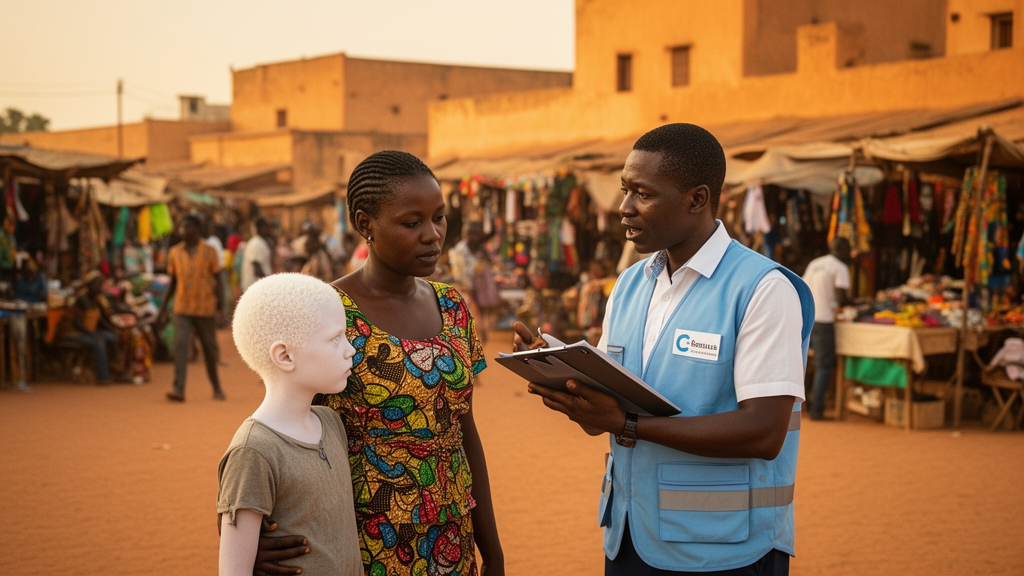
The active case-identification process involved community health workers and representatives of the national association of people with albinism in Togo. Investigators first contacted 7,500 active community health workers by telephone to establish whether people with albinism were present in their districts and obtain preliminary counts. Following cascade training, community health workers used the Kobocollect application and a study-specific questionnaire to identify people and collect individual information.
Regional and district association representatives subsequently compared the collected information with association registries and helped address missing data. Researchers used assigned pseudonyms and manually reviewed names, ages, districts of birth and districts of residence to identify and remove possible duplicates. The target population comprised people residing in Togo whose visible skin, hair and eye characteristics were considered consistent with oculocutaneous albinism.
The investigators analysed the data in R version 4.4.1, using population denominators from Togo’s 2022 national census, and mapped geographic patterns in QGIS 3.8.1. Of the 1,521 people identified, 88, or 5.78%, declined registration in the database. Analyses of sociodemographic, geographic, lifestyle, socioeconomic and health characteristics consequently covered 1,433 registered people with complete data.
Among the registered participants, the median age was 18 years, with an interquartile range of 9 to 34 years, and 62.7% were younger than 25. Females represented 52.2% of the group. Most, 98.4%, were Togolese, while 1.0% originated from Benin, Burkina Faso, Ghana or Côte d’Ivoire.
People with albinism were identified throughout Togo, with mapped concentrations in large cities and regional capitals. The Plateaux region contained 27.91% of identified cases and recorded the highest regional prevalence, at 40 people per 100,000 inhabitants. Savanes had the lowest regional prevalence, at 9 per 100,000. At district level, Kpélé and Danyi each had 40 people per 100,000, followed by Amou with 37, Mô with 34 and Kozah with 33 per 100,000. Avé and Akébou each recorded 1 person per 100,000.
The survey also documented reported health, lifestyle and economic conditions among the 1,433 registered participants. Overall, 70.6% reported activities involving more than two hours of daily sun exposure without adequate protection, and 54.8% belonged to an association for people with albinism. Health issues, particularly skin lesions associated with albinism, were reported by 30.7%, while 37% had a medical follow-up record. These figures describe reported conditions and recorded follow-up rather than disease incidence, severity or the effect of association membership.
Economically, 61.6% of participants had no income activity, primarily children, students and unemployed adolescents and young adults. Among employed respondents, 73.09% reported monthly income below 75 euros. Separately, the paper reported that 3.8% of the surveyed group lived modestly with income above 150 euros per month; the study text did not specify that this percentage was restricted to employed respondents. The findings show substantial reported income insecurity, but the cross-sectional design did not test its causes or changes over time.
The estimate has important measurement limitations. Although community health workers received training and were supported by physicians and association representatives, dermatologists did not confirm the case identifications. Some people identified as having albinism may instead have had other visible characteristics, such as naturally red hair. The authors also said stigma, reluctance to disclose albinism and difficulty reaching marginalized or geographically isolated people may have caused under-ascertainment, meaning prevalence could be underestimated. The study lacked a qualitative component examining people’s experiences, and its descriptive design characterized prevalence and spatial distribution during the study period rather than testing causal relationships. The results therefore provide a survey-based national baseline for further research and monitoring.
Subject of Research: National prevalence and geographic distribution of albinism in Togo
Article Title: Prevalence and geographical distribution of persons with albinism (PWA) in Togo in 2024
Article References: Bigma, M., Kota-Mamah, K., Konu, R. Y., Tchoupa Revegue, M. H. D., Przybylski, C., Our-Yendo, S., Pitche, P., Ekouevi, D., & Saka, B. (2026). Prevalence and geographical distribution of persons with albinism (PWA) in Togo in 2024. PLOS One, 21(10), e0360507. https://doi.org/10.1371/journal.pone.0360507
Image Credits: AI Generated
DOI: 10.1371/journal.pone.0360507
Keywords: albinism, Togo, prevalence, geographic distribution, cross-sectional survey, community health workers, sun exposure, skin lesions, socioeconomic conditions, geographical, distribution, persons
Cite Scienmag News
Phoebe Ingram. (October 20, 2026). Nationwide Togo survey estimates 18.79 albinism cases per 100,000 people. Scienmag. https://scienmag.com/nationwide-togo-survey-estimates-18-79-albinism-cases-per-100000-people/
Phoebe Ingram. "Nationwide Togo survey estimates 18.79 albinism cases per 100,000 people." Scienmag, 20 October 2026, https://scienmag.com/nationwide-togo-survey-estimates-18-79-albinism-cases-per-100000-people/. Accessed 20 October 2026.
Phoebe Ingram. "Nationwide Togo survey estimates 18.79 albinism cases per 100,000 people." Scienmag. October 20, 2026. https://scienmag.com/nationwide-togo-survey-estimates-18-79-albinism-cases-per-100000-people/


