

Tuesday, October 20, 2026
Science
No Result
View All Result
  • Login
  • HOME
  • SCIENCE NEWS
  • CONTACT US
  • HOME
  • SCIENCE NEWS
  • CONTACT US
No Result
View All Result
Scienmag
No Result
View All Result
Home Science News Technology and Engineering

Lab study links magnetic nanocomposite to divalent-ion removal and improved oil recovery in formulated flooding tests

October 20, 2026
in Technology and Engineering
Denise Maddox
By Denise Maddox Scienmag Editorial Profile - Mechanical Engineering
Reading Time: 2 mins read
0
Magnetic Nanocomposite Scrubs Ions From Oilfield Wastewater and Boosts Oil Recovery

Magnetic Nanocomposite Scrubs Ions From Oilfield Wastewater and Boosts Oil Recovery

65
SHARES
587
VIEWS
Share on FacebookShare on Twitter
ADVERTISEMENT

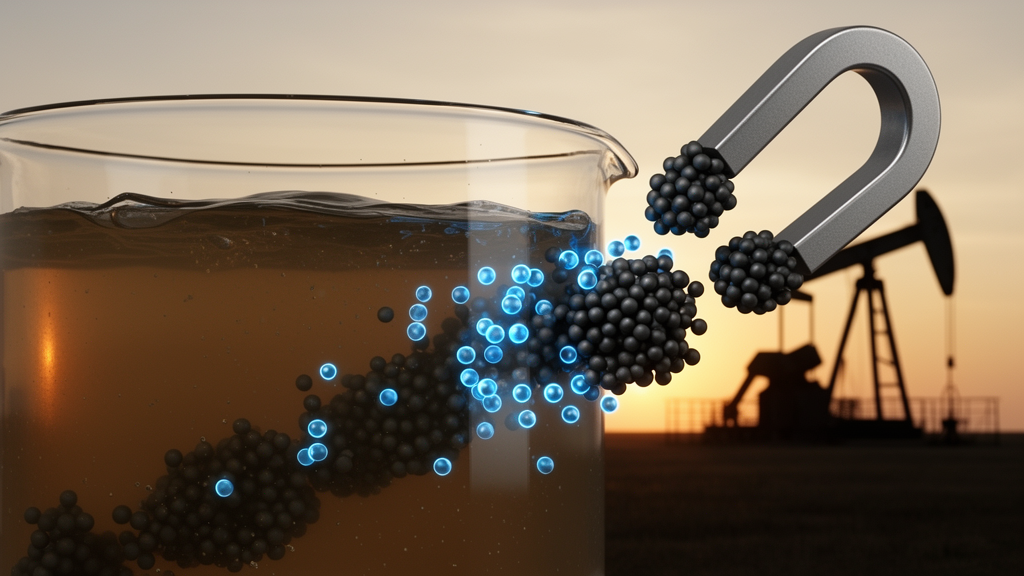
A laboratory study summarized in a published abstract reports that a magnetically recoverable nanocomposite removed Ca²⁺ and Mg²⁺ ions from oilfield wastewater and improved a formulated surfactant–polymer binary-flooding system during tests with crude oil. The material, designated BS@Fe₃O₄/MOF, consists of copper-based metal–organic framework-doped Fe₃O₄ magnetic nanoparticles functionalized with dodecyldimethyl betaine, or BS-12.

The researchers synthesized BS@Fe₃O₄/MOF and evaluated its ion-removal performance. Emulsification tests were also used to optimize and assess a binary flooding formulation containing the nonionic surfactant octylphenol ethoxylate (OP-10) and xanthan gum (XG). According to the abstract, these tests established the feasibility of constructing an SP-BS@Fe₃O₄/MOF system. The formulation showed strong tolerance to high temperatures, high salinity and varied pH environments, while substantially increasing viscosity and producing what the abstract describes as ultra-low interfacial tension with crude oil.

Measurements reported in the abstract included an adsorption loss of 14%. Separation rates were 8.28% for the nanocomposite and 17.86% for xanthan gum. In oil-recovery tests, the composite system delivered an 8.22% improvement, and magnetic recovery added a further 3.75%. These findings concern laboratory tests of the synthesized composite and the specified flooding formulation; they do not by themselves establish performance in other reservoirs or at field scale.

The available source provides the article abstract rather than the full experimental paper, limiting the available methodological detail. The abstract does not specify the reservoir model, crude-oil properties, test scale, replication or statistical uncertainty. It also provides no information about cost, long-term durability or environmental effects. Accordingly, the reported results support further evaluation of BS@Fe₃O₄/MOF for divalent-ion removal and use within the tested SP binary-flooding formulation, but they do not demonstrate field deployment or broader applicability.

Subject of Research: Laboratory evaluation of a magnetic nanocomposite for divalent-ion removal and enhanced oil recovery

Article Title: Magnetically recoverable functionalized Fe3O4/Cu-MOF reduces divalent ions in oilfield wastewater and synergizes with crude oil binary drive for enhanced recovery

Article References: Yang, L., Zhou, C., Zhang, F., Yang, J., He, L., & Zhang, J. (2026). Magnetically recoverable functionalized Fe3O4/Cu-MOF reduces divalent ions in oilfield wastewater and synergizes with crude oil binary drive for enhanced recovery. Journal of Materials Science, 61(42), 32799-32819. https://doi.org/10.1007/s10853-026-13706-8

Image Credits: AI Generated

DOI: 10.1007/s10853-026-13706-8

Keywords: enhanced oil recovery, oilfield wastewater, divalent ions, magnetic nanocomposite, metal–organic framework, surfactant–polymer flooding, crude oil, xanthan gum, Magnetically, recoverable, functionalized, Fe3O4

Cite Scienmag News

Denise Maddox. (October 20, 2026). Lab study links magnetic nanocomposite to divalent-ion removal and improved oil recovery in formulated flooding tests. Scienmag. https://scienmag.com/lab-study-links-magnetic-nanocomposite-to-divalent-ion-removal-and-improved-oil-recovery-in-formulated-flooding-tests/


Denise Maddox. "Lab study links magnetic nanocomposite to divalent-ion removal and improved oil recovery in formulated flooding tests." Scienmag, 20 October 2026, https://scienmag.com/lab-study-links-magnetic-nanocomposite-to-divalent-ion-removal-and-improved-oil-recovery-in-formulated-flooding-tests/. Accessed 20 October 2026.

Denise Maddox. "Lab study links magnetic nanocomposite to divalent-ion removal and improved oil recovery in formulated flooding tests." Scienmag. October 20, 2026. https://scienmag.com/lab-study-links-magnetic-nanocomposite-to-divalent-ion-removal-and-improved-oil-recovery-in-formulated-flooding-tests/

Tags: adsorption efficiencycrude oildivalent ion removal in enhanced oil recoverydivalent ionsemulsification and interfacial tension reduction in oil recoveryenhanced oil recoveryFe3O4functionalizedhigh salinity and temperature tolerance in oil recovery formulationslaboratory evaluation of nanocomposite performance in oilfield applicationsmagnetic nanocompositemagnetic nanocomposite for oilfield wastewater treatmentMagneticallymagnetically recoverable nanomaterials in petroleum engineeringmetal-organic frameworkmetal-organic framework-doped magnetic nanoparticlesoilfield wastewaterrecoverablesurfactant-polymer binary flooding system optimizationsurfactant–polymer floodingxanthan gumxanthan gum and surfactant formulation for enhanced oil extraction
Share26Tweet16
Previous Post

More flow and less objectification: Dual influence mechanisms of generative AI use on employees’ proactive behaviors

Next Post

Spousal ADL changes linked in Shanghai cohort of 3,425 older couples

Related Posts

Coffee Seeds Outperform Loquat in Lab Tests of Antioxidant and Antimicrobial Power
Technology and Engineering

In vitro study links coffee seed extract to broader activity, while loquat extract reduces Candida biofilm biomass

October 20, 2026
AI Checkout System Could Slash Grocery Emissions by Up to 24 Percent in Real Time
Technology and Engineering

Simulated grocery checkout system estimates 23.4% median emissions reduction, but consumer effects remain unvalidated

October 20, 2026
AI Model Combines Knowledge Maps and Memory Networks to Diagnose English Learning Difficulties
Technology and Engineering

KG-LSTM model diagnoses English learning behavior patterns with 92% accuracy in junior high school study

October 20, 2026
Hidden Breast Lymph Nodes Signal Higher Axillary Cancer Spread, Meta-Analysis Finds
Technology and Engineering

Review links intramammary lymph node metastasis with axillary involvement in primary breast cancer

October 20, 2026
Why Geopolymer Concrete Shrinks and How Scientists Are Learning to Stop It
Technology and Engineering

Review identifies shrinkage-control measures and prediction models for geopolymer composites

October 20, 2026
Sulfur-vacancy SnS2–MXene prototype reaches 58.33 Wh kg−1
Technology and Engineering

Sulfur-vacancy SnS2–MXene prototype reaches 58.33 Wh kg−1

October 20, 2026
Next Post
When One Spouse Slips, the Other Follows: Shanghai Study Reveals Coupled Decline in Daily Function

Spousal ADL changes linked in Shanghai cohort of 3,425 older couples

  • Mothers who receive childcare support from maternal grandparents show more optimized

    Mothers who receive childcare support from maternal grandparents show more parental warmth, finds NTU Singapore study

    27656 shares
    Share 11059 Tweet 6912
  • University of Seville Breaks 120-Year-Old Mystery, Revises a Key Einstein Concept

    1061 shares
    Share 424 Tweet 265
  • Bee body mass, pathogens and local climate influence heat tolerance

    682 shares
    Share 273 Tweet 171
  • Researchers record first-ever images and data of a shark experiencing a boat strike

    546 shares
    Share 218 Tweet 137
  • Groundbreaking Clinical Trial Reveals Lubiprostone Enhances Kidney Function

    531 shares
    Share 212 Tweet 133
Science

Embark on a thrilling journey of discovery with Scienmag.com—your ultimate source for cutting-edge breakthroughs. Immerse yourself in a world where curiosity knows no limits and tomorrow’s possibilities become today’s reality!

RECENT NEWS

  • Freshwater snail aquaporin 4 shows water-selective transport and temperature-dependent expression
  • Systematic review estimates 77.4% global prevalence of workplace violence against emergency nurses
  • Survey and focus groups find limited preparedness and role ambiguity in addressing vaccine hesitancy
  • AFAR funds eight junior faculty projects on mechanisms of aging

Categories

  • Agriculture
  • Anthropology
  • Archaeology
  • Athmospheric
  • Biology
  • Biotechnology
  • Blog
  • Bussines
  • Cancer
  • Chemistry
  • Climate
  • Earth Science
  • Editorial Policy
  • Marine
  • Mathematics
  • Medicine
  • Pediatry
  • Policy
  • Psychology & Psychiatry
  • Science Education
  • Science News
  • Social Science
  • Space
  • Technology and Engineering

Subscribe to Blog via Email

Enter your email address to subscribe to this blog and receive notifications of new posts by email.

Join 5,150 other subscribers

© 2025 Scienmag - Science Magazine

Welcome Back!

Login to your account below

Forgotten Password?

Retrieve your password

Please enter your username or email address to reset your password.

Log In
No Result
View All Result
  • HOME
  • SCIENCE NEWS
  • CONTACT US

© 2025 Scienmag - Science Magazine

Discover more from Science

Subscribe now to keep reading and get access to the full archive.

Continue reading