

Tuesday, October 20, 2026
Science
No Result
View All Result
  • Login
  • HOME
  • SCIENCE NEWS
  • CONTACT US
  • HOME
  • SCIENCE NEWS
  • CONTACT US
No Result
View All Result
Scienmag
No Result
View All Result
Home Science News Science Education

AI- and VR-supported learning configurations linked to higher feedback-literacy scores in randomized medical-student trial

October 20, 2026
in Science Education
Courtney Benton
By Courtney Benton Scienmag Editorial Profile - Science and Technology Policy
Reading Time: 2 mins read
0
AI and Virtual Reality Training Boosts Medical Students’ Feedback Skills, Trial Finds

AI and Virtual Reality Training Boosts Medical Students' Feedback Skills, Trial Finds

65
SHARES
587
VIEWS
Share on FacebookShare on Twitter
ADVERTISEMENT

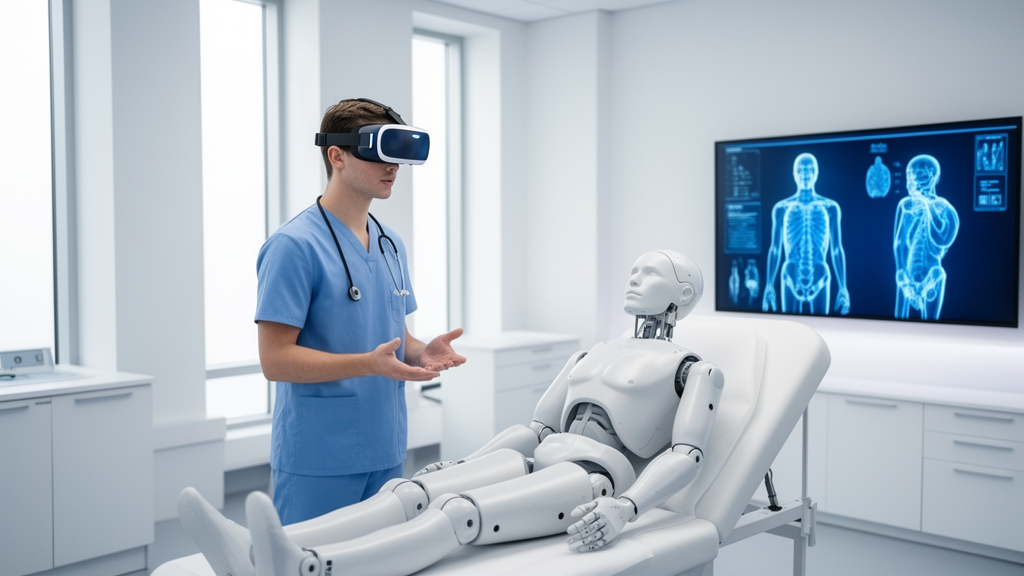
A randomized controlled study of 68 fourth-year medical students found that two multicomponent interventions combining artificial intelligence-supported reflective activities with virtual-reality clinical scenarios were associated with higher supervisor-rated feedback-literacy scores at post-test than usual clinical clerkship activities. The summary does not identify which individual intervention component was responsible or establish a specific causal mechanism.

Students were assigned to an AI–VR configuration, an AI–VR configuration that also included peer dialogue, or a control condition during their transition to clinical clerkships. Both intervention groups completed a preparatory workshop and mandatory AI-supported reflection within VR-based clinical scenarios. The configurations differed in the inclusion of peer dialogue and in the distribution of active VR participation. Supervisors assessed feedback-literacy behaviors before and after the study using the study-specific Supervisor Observational Checklist for Feedback Literacy, or SOC-FL. Quantitative comparisons of post-test scores across the three groups were adjusted for baseline SOC-FL scores.

After adjustment for baseline scores, the AI–VR group had an adjusted post-test score of 21.12 points, with a 95% confidence interval of 18.19 to 24.05, while the AI–VR-plus-peer group had an adjusted score of 23.45 points, with a 95% confidence interval of 20.59 to 26.31. Both comparisons with the control group had p-values below .001. The two intervention configurations did not differ significantly from one another: the reported difference was 2.33 points, with a 95% confidence interval of −0.53 to 5.19 and p = .149. Because peer dialogue was not the only feature distinguishing the configurations, the results do not show that adding dialogue produced the numerical difference between them.

The abstract also reports a thematic analysis of 36 student reflections, without specifying whether these came from 36 distinct participants. Students in the AI–VR-plus-peer group more frequently described collaborative sense-making, normalization of uncertainty and reduced emotional threat. Those in the AI–VR group reported varied experiences of independent AI use and individual reflection, while control-group reflections tended to characterize uncertainty as evidence of incompetence and AI as a confirmation tool. These qualitative accounts describe reported experiences rather than measured effects on learning outcomes.

This account is based on the published abstract rather than a full assessment of the study and its detailed protocol. The abstract does not report group sizes, allocation procedures, attrition, assessor masking, the characteristics of the SOC-FL scale or longer-term outcomes. The population was limited to 68 fourth-year medical students at the transition into clinical clerkships. Although random assignment was used, the reported results do not demonstrate a specific causal mechanism or broader clinical benefit.

Subject of Research: Randomized trial of AI- and VR-supported learning interventions and supervisor-rated feedback literacy in fourth-year medical students

Article Title: Effects of AI- and VR-supported multicomponent learning intervention configurations on supervisor-rated feedback-literacy behaviors in medical students: a randomized controlled trial

Article References: Sadegh, T., Mohammadi, M., Jahani, J., & Salimi, G. (2026). Effects of AI- and VR-supported multicomponent learning intervention configurations on supervisor-rated feedback-literacy behaviors in medical students: a randomized controlled trial. BMC Medical Education. https://doi.org/10.1186/s12909-026-10500-7

Image Credits: AI Generated

DOI: 10.1186/s12909-026-10500-7

Keywords: medical education, feedback literacy, artificial intelligence, virtual reality, medical students, randomized controlled trial, clinical clerkships, reflective learning, peer dialogue, Effects, VR-supported, multicomponent

Cite Scienmag News

Courtney Benton. (October 20, 2026). AI- and VR-supported learning configurations linked to higher feedback-literacy scores in randomized medical-student trial. Scienmag. https://scienmag.com/ai-and-vr-supported-learning-configurations-linked-to-higher-feedback-literacy-scores-in-randomized-medical-student-trial/


Courtney Benton. "AI- and VR-supported learning configurations linked to higher feedback-literacy scores in randomized medical-student trial." Scienmag, 20 October 2026, https://scienmag.com/ai-and-vr-supported-learning-configurations-linked-to-higher-feedback-literacy-scores-in-randomized-medical-student-trial/. Accessed 20 October 2026.

Courtney Benton. "AI- and VR-supported learning configurations linked to higher feedback-literacy scores in randomized medical-student trial." Scienmag. October 20, 2026. https://scienmag.com/ai-and-vr-supported-learning-configurations-linked-to-higher-feedback-literacy-scores-in-randomized-medical-student-trial/

Tags: AI-supported medical educationArtificial Intelligenceartificial intelligence in medical trainingclinical clerkship learning interventionsclinical clerkshipsEffectsfeedback literacyfeedback literacy in medical studentsimpact of VR on feedback literacyinnovative medical education methodologiesMedical Educationmedical studentsmulticomponentpeer dialoguepeer dialogue in clinical trainingRandomized Controlled Trialrandomized controlled trial in medical educationreflective activities in healthcare educationreflective learningsupervisor assessment of feedback skillstechnology-enhanced learning in medicinevirtual realityvirtual reality clinical trainingVR-supported
Share26Tweet16
Previous Post

Solar storm measurements reveal variable aviation radiation risks

Next Post

MAPK1 variant linked to cervical disease in 300-person study; simulations predict stronger SCH772984 binding to mutant

Related Posts

Accounting Students Rate Their Skills Highly, But Gaps in Tech and Conflict Resolution Persist
Science Education

Ghanaian accounting students report acceptable but uneven technical and professional skills

October 20, 2026
When the Operating Rooms Went Quiet: Neurosurgery Trainees in Malaysia Confront a Pandemic
Science Education

Experiences and challenges of neurosurgical residents during the COVID 19 pandemic in Sabah Malaysia

October 20, 2026
3D-Printed Organs Give Medical Students a Sharper Edge in Anatomy Learning
Science Education

CT plus 3D-printed abdominal models linked to larger anatomy learning gains in comparative medical-student study

October 20, 2026
Medical Students in Sudan Show Sharp AI Ethics Instincts but Gaps in Fairness and Transparency
Science Education

Cross-sectional survey links informal AI exposure with ethical awareness among Khartoum medical students

October 20, 2026
Agentic AI Tutors May Boost Learning Through Motivation and Social Presence
Science Education

Cross-sectional survey links agentic AI learning perceptions with engagement and perceived performance

October 20, 2026
AI Tutor With Guardrails Helps Students Practice Programming, but Final Grades Barely Budge
Science Education

Teacher-governed LLM scaffolding associated with stronger formative support, not significant post-test gain, in quasi-experimental study of 357 online programming learners

October 20, 2026
Next Post
Gene Variant Doubles as Risk Marker and Drug Target in HPV-Linked Cervical Cancer

MAPK1 variant linked to cervical disease in 300-person study; simulations predict stronger SCH772984 binding to mutant

  • Mothers who receive childcare support from maternal grandparents show more optimized

    Mothers who receive childcare support from maternal grandparents show more parental warmth, finds NTU Singapore study

    27656 shares
    Share 11059 Tweet 6912
  • University of Seville Breaks 120-Year-Old Mystery, Revises a Key Einstein Concept

    1061 shares
    Share 424 Tweet 265
  • Bee body mass, pathogens and local climate influence heat tolerance

    682 shares
    Share 273 Tweet 171
  • Researchers record first-ever images and data of a shark experiencing a boat strike

    546 shares
    Share 218 Tweet 137
  • Groundbreaking Clinical Trial Reveals Lubiprostone Enhances Kidney Function

    531 shares
    Share 212 Tweet 133
Science

Embark on a thrilling journey of discovery with Scienmag.com—your ultimate source for cutting-edge breakthroughs. Immerse yourself in a world where curiosity knows no limits and tomorrow’s possibilities become today’s reality!

RECENT NEWS

  • Systematic review maps nurse educator challenges in nursing student attrition
  • MAPK1 variant linked to cervical disease in 300-person study; simulations predict stronger SCH772984 binding to mutant
  • AI- and VR-supported learning configurations linked to higher feedback-literacy scores in randomized medical-student trial
  • Solar storm measurements reveal variable aviation radiation risks

Categories

  • Agriculture
  • Anthropology
  • Archaeology
  • Athmospheric
  • Biology
  • Biotechnology
  • Blog
  • Bussines
  • Cancer
  • Chemistry
  • Climate
  • Earth Science
  • Editorial Policy
  • Marine
  • Mathematics
  • Medicine
  • Pediatry
  • Policy
  • Psychology & Psychiatry
  • Science Education
  • Science News
  • Social Science
  • Space
  • Technology and Engineering

Subscribe to Blog via Email

Enter your email address to subscribe to this blog and receive notifications of new posts by email.

Join 5,150 other subscribers

© 2025 Scienmag - Science Magazine

Welcome Back!

Login to your account below

Forgotten Password?

Retrieve your password

Please enter your username or email address to reset your password.

Log In
No Result
View All Result
  • HOME
  • SCIENCE NEWS
  • CONTACT US

© 2025 Scienmag - Science Magazine

Discover more from Science

Subscribe now to keep reading and get access to the full archive.

Continue reading