


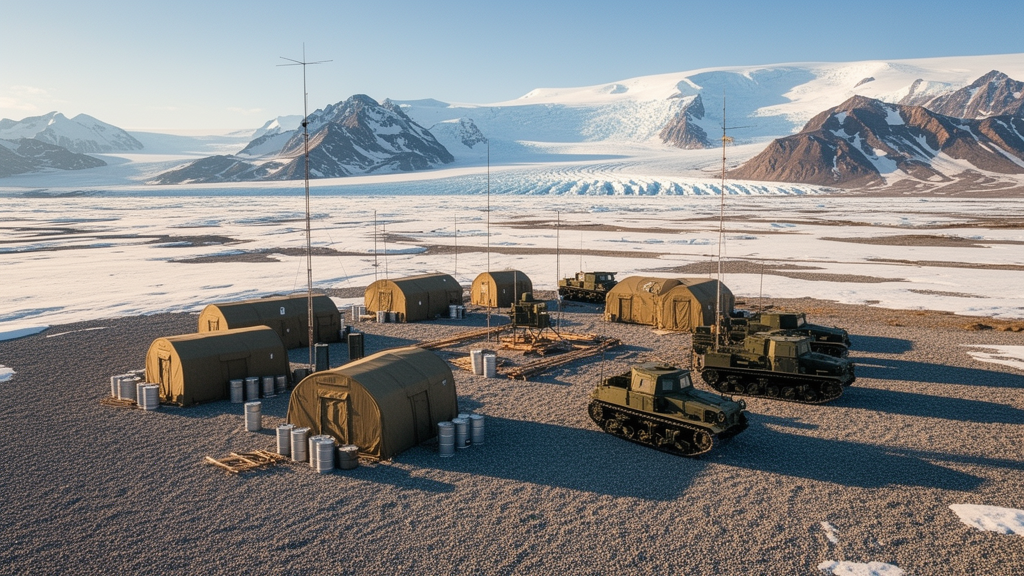
The former Camp Century military site in northwestern Greenland was ice-free about 416,000 years ago, when summer temperatures were estimated to have been 4.7 degrees Celsius, or 8.5 degrees Fahrenheit, warmer than today, according to a University at Buffalo-led study. Analysis of ancient sediment recovered beneath the ice sheet indicates that the Greenland Ice Sheet had retreated more than 60 miles from its present edge in the region. The findings provide a rare land-based measure of temperatures during an exceptionally warm interval, when later advancing ice erased most comparable sediments.
The study, published Sept. 28 in Climate of the Past, focused on material recovered during the failed U.S. Project Iceworm. The Cold War project sought to drill through Greenland’s ice sheet and create a network of missile-storage chambers where nuclear weapons could be concealed beneath the surface. Drilling stopped before completion, but cores raised during the effort included sediments from beneath the ice. At Camp Century, the deepest sediments contain a distinctive record: the last time they were exposed to sunlight was during an ice-free period approximately 416,000 years ago, known in the geological record as Marine Isotope Stage 11.
Researchers used the buried sediment to reconstruct summer temperatures at the site, a task that had previously been limited by the scarcity of suitable land archives from that period. As ice sheets later expanded, they eroded much of the sediment that had accumulated on the exposed land surface. The Camp Century material survives because it was subsequently buried and preserved, allowing scientists to examine biological molecules that had formed while the area was free of glacier ice. The authors describe the result as the first quantitative estimate of land-based summer temperatures anywhere in Greenland for this ancient warm period.
The temperature reconstruction depended on fatty molecules produced by bacteria and preserved in the sediment. The kinds and relative proportions of these molecules vary with temperature. Aguilar and his collaborators compared the molecules in the Camp Century samples with similar compounds from modern Arctic lakes, then developed an estimate for the temperature under which the ancient sediment formed. This molecular proxy made it possible to infer that summers at Camp Century were substantially warmer during the ice-free interval than modern local summers.
The magnitude of the inferred difference is not presented as a direct measurement of atmospheric temperature. It is a model-based reconstruction derived from biological compounds whose composition changes with temperature, using modern Arctic lakes as a comparison. Interpreting the estimate also required the researchers to account for changes in the elevation of the land surface as the ice sheet grew and melted. Because temperature conditions can differ across elevation, those shifts complicate direct comparisons among Camp Century and modern settings. The study therefore provides a quantitative paleotemperature estimate rather than a series of direct instrumental observations.
The reconstructed warmth coincided with a major change in the ice sheet’s configuration. For Camp Century to have been ice-free, the Greenland Ice Sheet’s margin in northwestern Greenland must have retreated more than 60 miles from its present-day position. This geographic evidence of retreat offers a land-based counterpart to the molecular temperature reconstruction. It also demonstrates that the site’s ice-free state was not an isolated local anomaly: sustaining an ice-free landscape required the ice sheet to withdraw across a considerable area.
One of the study’s most striking comparisons concerns duration. Greenland also experienced similarly warm summers roughly 5,000 to 10,000 years ago, following the last Ice Age, yet Camp Century remained covered by ice during that Holocene warm period. The contrast suggests that the amount of warming alone may not determine whether an area becomes ice-free. The authors believe conditions during the older warm period may have persisted for much longer—potentially tens of thousands of years—giving the ice sheet more time to retreat and melt than it had during the younger warm interval.
That difference is especially relevant because the researchers do not regard the 416,000-year-old climate as a reassuring analogue for the present. The study indicates that Greenland’s ice sheet can retreat substantially during sustained warmth, but the authors warn that today’s human-caused warming is more intense than the conditions reconstructed for the ancient warm period. Climate projections cited in the news release also indicate that Arctic warming could persist for hundreds or thousands of years. In their interpretation, both the magnitude and the duration of future warmth matter when assessing the ice sheet’s potential response.
The project also illustrates the scientific value of material preserved through an unusual chain of events. Sediment first brought to the University at Buffalo in 1975 remained in its Central Ice Core Storage Facility and Information Exchange after the drilling leader, Chester Langway, retired in the mid-1990s. The samples then spent more than two decades largely forgotten at the University of Copenhagen until a freezer cleanout brought them back to researchers’ attention in 2018. Elizabeth Thomas, corresponding author and an associate professor in UB’s Department of Earth Sciences, had worked with University of Vermont collaborators on the sediment since then. The new reconstruction represents the first use of the Camp Century sediment to quantify summer temperatures during the ice-free period.
For Aguilar, now a postdoctoral fellow at the UB RENEW Institute, the analysis depended on established laboratory methods but required difficult interpretation. He said the researchers had to account for how elevation changed as the ice sheet advanced and retreated, affecting comparisons of temperature through time. The study therefore links a molecular biological signal in ancient sediment with physical evidence from the ice sheet’s former extent. Together, the records indicate that Camp Century stood on an ice-free landscape during a substantially warmer interval and that the Greenland Ice Sheet had retreated more than 60 miles to expose the site. The result gives scientists a rare terrestrial reference point for assessing how prolonged Arctic warmth can reshape an ice sheet, while the authors stress that the magnitude and persistence of present-day warming make the ancient interval an imperfect guide to the future.
Subject of Research: Reconstruction of summer temperatures and ice-sheet retreat at Camp Century during Marine Isotope Stage 11
Article Title: Greenland’s Camp Century was ice-free when summers were a few degrees warmer
Article References: Greenland’s Camp Century was ice-free when summers were a few degrees warmer. Original publication (Bibliographic details unavailable.)
Image Credits: AI Generated
DOI: Not provided
Keywords: Greenland Ice Sheet, Camp Century, Marine Isotope Stage 11, paleotemperature reconstruction, Arctic climate change, bacterial fatty acids, ice-sheet retreat, ancient sediment, Holocene warm period, Greenland, Camp, Century
Cite Scienmag News
Russell Cooper. (October 20, 2026). Camp Century was ice-free 416,000 years ago during warmer summers. Scienmag. https://scienmag.com/camp-century-was-ice-free-416000-years-ago-during-warmer-summers/
Russell Cooper. "Camp Century was ice-free 416,000 years ago during warmer summers." Scienmag, 20 October 2026, https://scienmag.com/camp-century-was-ice-free-416000-years-ago-during-warmer-summers/. Accessed 20 October 2026.
Russell Cooper. "Camp Century was ice-free 416,000 years ago during warmer summers." Scienmag. October 20, 2026. https://scienmag.com/camp-century-was-ice-free-416000-years-ago-during-warmer-summers/


