


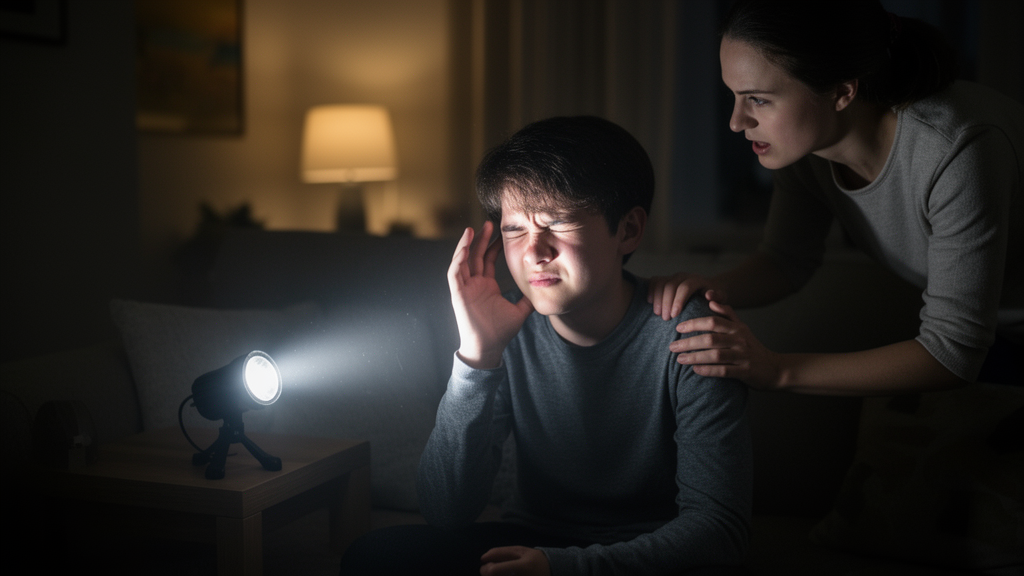
A retrospective synthesis of laboratory and commercial stroboscopic light stimulation data found no reported seizures or syncopal episodes among participants in four research laboratories, while commercial providers separately documented several medically important or otherwise notable events. Because the contributing studies used heterogeneous protocols, surveillance systems and exposure measures, the findings cannot establish incidence, absolute risk, causal attribution or the effectiveness of safety screening.
The study combined a retrospective safety survey of four laboratories, aggregate operational reports from two commercial stroboscopic light stimulation providers and a focused review of photosensitivity and sensory intolerance. The laboratory records covered studies conducted from 2020 to 2025 in the United Kingdom, Germany, the Netherlands and Australia. Most participants were young adults recruited from university or student populations, with two studies also including broader samples of adults reporting depressive symptoms. The commercial providers supplied session counts and event reports rather than research cohorts or equivalent participant information.
Across the laboratories, contributors described 20 non-serious events that interrupted or modified participation and no seizures or syncopal episodes. Post hoc classification grouped five events as anxiety or distress, five as ocular discomfort or photophobia, three as dizziness or vertigo, three as headache or migraine and four as non-specific unpleasantness or early withdrawal. No medical transfers were reported. The accounts were supplied by the contributing teams and were not independently checked against medical records, while event definitions, monitoring and follow-up differed among sites.
Commercial reporting produced a different picture. One provider, which reported approximately 3.8 million closed-eye sessions and approximately one million users between 2021 and 2025, recorded nine events classified by the provider as medically important and probably or certainly related to stimulation. The provider classified all nine as seizures, but non-serious reactions were not systematically recorded. A second provider reported five notable events across more than 400,000 professional closed-eye sessions: one episode of transient memory loss after repeated use, one seizure at a public event, one prolonged trance-like unresponsive state and two further seizures assessed by emergency services.
These commercial counts cannot be converted into event rates. Session totals were not unique-user denominators, passive reporting may have missed events and follow-up was not consistently available. Provider A did not establish whether reported events received independent follow-up, while Provider B lacked systematic ascertainment, consistent causal assessment and complete exposure records. The absence of a reported laboratory event therefore does not establish that no event occurred, and the provider reports do not prove that the commercial sessions were intrinsically less safe than laboratory exposures.
The laboratory protocols varied in stimulation parameters. Most used fixed-frequency square-wave signals, with reported frequencies spanning 1–80 Hz; nine protocols used alpha-range frequencies of 8–12 Hz, and three protocols involving 95 participants used shifts between 3 and 15 Hz. Duty cycles ranged from 25% to 75%, and exposure durations ranged from eight seconds to no more than 25 minutes. Brightness was reported using different measures, including luminous flux for stroboscopes and luminance for projectors and monitors, so those values could not be compared directly.
Screening practices also differed. All four laboratories imposed a minimum age of 18 or 21 and excluded people with a personal history of epilepsy, particularly photosensitive epilepsy. Two screened for a first-degree family history of photosensitive epilepsy. All assessed sensitivity to bright or flashing light, and pregnancy was a common exclusion. Other precautions varied, including recent substance use, sleep deprivation, active psychiatric conditions, unexplained loss of consciousness, heart disease or pacemakers, traumatic brain injury and current psychoactive medication use. All laboratories used graded exposure, generally including a brief taster session, and most ensured first-aid readiness. Two Laboratory D studies used EEG with intermittent photic stimulation for first-time participants, but the observational data did not compare screening strategies.
Based on the synthesis, the authors developed the provisional Sussex Strobe Safety Screening Questionnaire, or 4SQ. It is a plain-language, non-diagnostic checklist covering neurological and psychiatric history, sensory tolerance, medical conditions, pregnancy, substance use, sleep and medication context. A “yes” response prompts further assessment and a context-specific decision to exclude, defer, seek clinical advice or add accommodations; it does not automatically mean that a person is ineligible. The questionnaire has not been validated for sensitivity, specificity, predictive value, acceptability or reduction in adverse events.
The proposed risk-management framework combines participant information, an explicit opt-out, context-specific screening, conservative monitored familiarisation, an immediately available stopping procedure, trained staff and systematic event documentation. For unsupervised app-based or home use, the authors also describe adjustable brightness, clear termination controls, incident reporting and direction toward medical attention after major events. The authors caution that closed-eye presentation is not generally protective and can be more provocative in some photosensitive individuals. They also advise documenting frequency, luminance, contrast, colour, visual-field area, eye state and exposure duration rather than treating a frequency threshold alone as a guarantee of safety.
This observational synthesis identifies recurring safety considerations across research and commercial settings, but its design cannot support conclusions about absolute risk or show that any screening or exposure-control measure prevents harm. Heterogeneous devices and protocols, retrospective reporting, passive commercial surveillance, non-comparable denominators and limited independent adjudication constrain interpretation. The researchers state that formal evaluation should use harmonised event definitions, unique-person and session denominators, systematic follow-up and independent medical assessment. Until then, the 4SQ and layered precautions provide a proposed framework for organized review rather than validated assurance of safety.
Subject of Research: Safety reporting and screening practices for stroboscopic light stimulation in laboratory and commercial settings
Article Title: Stroboscopic light stimulation safety within and beyond laboratory settings: Observational evidence and practical guidance
Article References: Schwartzman, D. J., Hewitt, T., Schmidt, T. T., Sander, J. W., Nacker, D., Thurbon, J., Polito, V., Funk, X., Macpherson, F., Galea, T., Lawson, G., Simpson, J., Beauté, R., & Seth, A. K. (2026). Stroboscopic light stimulation safety within and beyond laboratory settings: Observational evidence and practical guidance. PLOS One, 21(10), e0359958. https://doi.org/10.1371/journal.pone.0359958
Image Credits: AI Generated
DOI: 10.1371/journal.pone.0359958
Keywords: stroboscopic light stimulation, photosensitive epilepsy, visual safety, observational evidence, adverse events, screening questionnaire, risk management, commercial platforms, sensory intolerance, photosensitivity, Stroboscopic, light
Cite Scienmag News
Phoebe Ingram. (October 20, 2026). Retrospective synthesis finds no seizures in four SLS laboratories but cannot estimate absolute risk. Scienmag. https://scienmag.com/retrospective-synthesis-finds-no-seizures-in-four-sls-laboratories-but-cannot-estimate-absolute-risk/
Phoebe Ingram. "Retrospective synthesis finds no seizures in four SLS laboratories but cannot estimate absolute risk." Scienmag, 20 October 2026, https://scienmag.com/retrospective-synthesis-finds-no-seizures-in-four-sls-laboratories-but-cannot-estimate-absolute-risk/. Accessed 20 October 2026.
Phoebe Ingram. "Retrospective synthesis finds no seizures in four SLS laboratories but cannot estimate absolute risk." Scienmag. October 20, 2026. https://scienmag.com/retrospective-synthesis-finds-no-seizures-in-four-sls-laboratories-but-cannot-estimate-absolute-risk/


