


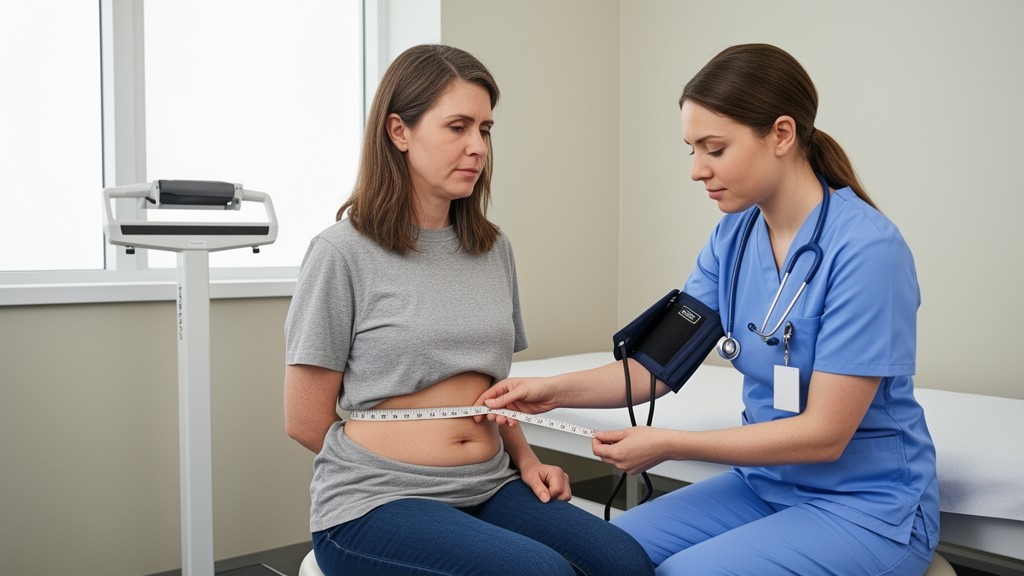
Metabolic syndrome was present in 51.5% of 375 outpatients with anxiety disorders assessed in a cross-sectional clinical study in Rasht, Iran. The participants attended two psychiatric clinics during 2024–2025, and the findings provide a snapshot of cardiometabolic health within this clinical population rather than evidence that anxiety disorders caused the metabolic abnormalities. The study also found that the cardiometabolic index, or CMI, had good ability to distinguish participants who met the study’s criteria for metabolic syndrome from those who did not.
Participants had a mean age of 49.0 years with a standard deviation of 13.5 years, and 79.2% were female. Researchers defined metabolic syndrome according to the National Cholesterol Education Program Adult Treatment Panel III criteria. They calculated CMI using the ratio of triglycerides to high-density lipoprotein cholesterol together with the ratio of waist circumference to height. Sleep quality was assessed with the Pittsburgh Sleep Quality Index, and physical activity was measured with the International Physical Activity Questionnaire. Hierarchical logistic regression examined factors associated with metabolic syndrome, hierarchical linear regression examined factors associated with CMI, and receiver operating characteristic analysis evaluated CMI’s ability to discriminate metabolic syndrome.
Older age was associated with higher odds of metabolic syndrome. For each additional year of age, the reported odds ratio was 1.061, with a 95% confidence interval of 1.034–1.088. Poorer sleep quality was also associated with greater odds, with an odds ratio of 1.250 and a 95% confidence interval of 1.152–1.356. Higher education was associated with lower odds of metabolic syndrome, producing an odds ratio of 0.408 and a 95% confidence interval of 0.204–0.818. These results describe associations observed at one point in time. They do not show that age, sleep quality or education directly produced metabolic syndrome, and the cross-sectional design cannot establish the duration of the condition or whether metabolic status changed over time.
For the continuous CMI measure, higher fasting blood glucose was associated with a higher index, with a regression coefficient of 0.190 and a p-value of 0.001. Poorer sleep quality was associated with a higher CMI as well, with a coefficient of 0.122 and a p-value of 0.028. CMI achieved an area under the receiver operating characteristic curve of 0.839, with a 95% confidence interval of 0.798–0.881, indicating good discrimination between participants with and without metabolic syndrome in this sample. A CMI cutoff of 0.845 derived using the Youden index produced 82.4% sensitivity and 75.8% specificity. That performance requires caution because CMI contains components that overlap with the criteria used to define metabolic syndrome, which may increase its apparent classification ability.
The scope of the results is limited by the cross-sectional design, the recruitment of participants from two clinics in a single Iranian city, and the predominantly female sample. The findings therefore may not represent all people with anxiety disorders, particularly those who do not attend psychiatric outpatient services. The observed associations and the CMI cutoff also require evaluation in longitudinal cohorts and independent external populations before they can be generalized. The authors called for further longitudinal and external validation studies rather than presenting the results as evidence of a causal relationship or as a tested clinical strategy.
Subject of Research: Metabolic syndrome and cardiometabolic index among outpatients with anxiety disorders
Article Title: Metabolic syndrome and cardiometabolic index among patients with anxiety disorders: a cross-sectional clinical study
Article References: Khalkhali Sharifi, P., Khalkhali, M., Farrahi, H., Mehrdad, S. M., & Atrkarroushan, Z. (2026). Metabolic syndrome and cardiometabolic index among patients with anxiety disorders: a cross-sectional clinical study. BMC Psychiatry. https://doi.org/10.1186/s12888-026-08769-5
Image Credits: AI Generated
DOI: 10.1186/s12888-026-08769-5
Keywords: anxiety disorders, metabolic syndrome, cardiometabolic index, sleep quality, outpatient psychiatry, fasting blood glucose, cross-sectional study, Iran, Metabolic, syndrome, cardiometabolic, index
Cite Scienmag News
Glenn Wilkins. (October 20, 2026). Metabolic syndrome found in 51.5% of anxiety-disorder outpatients. Scienmag. https://scienmag.com/metabolic-syndrome-found-in-51-5-of-anxiety-disorder-outpatients/
Glenn Wilkins. "Metabolic syndrome found in 51.5% of anxiety-disorder outpatients." Scienmag, 20 October 2026, https://scienmag.com/metabolic-syndrome-found-in-51-5-of-anxiety-disorder-outpatients/. Accessed 20 October 2026.
Glenn Wilkins. "Metabolic syndrome found in 51.5% of anxiety-disorder outpatients." Scienmag. October 20, 2026. https://scienmag.com/metabolic-syndrome-found-in-51-5-of-anxiety-disorder-outpatients/


