


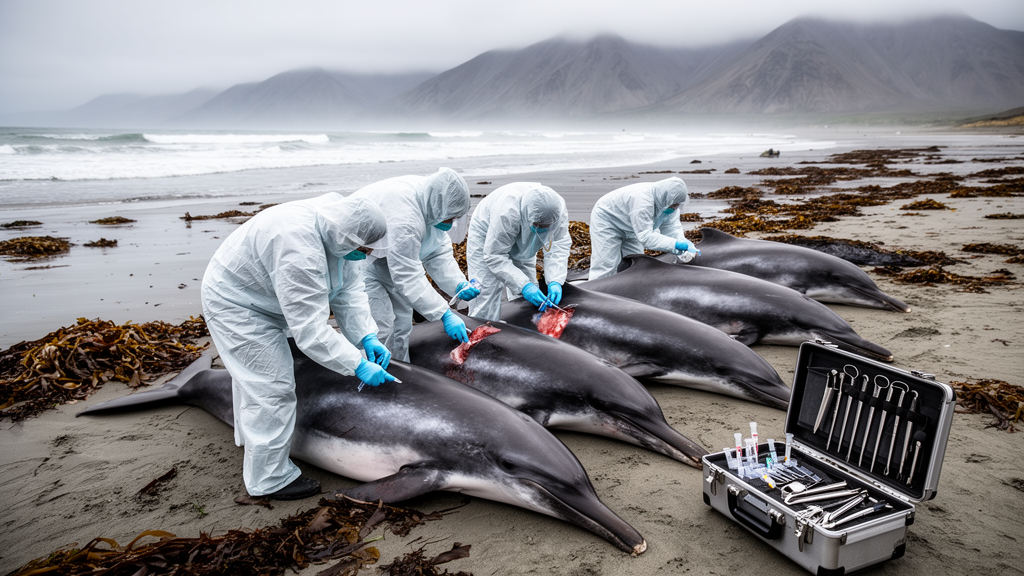
Researchers detected highly pathogenic avian influenza H5N1 in five cetaceans found stranded along Chile’s Pacific coast in 2023, according to a field investigation that combined stranding surveillance, molecular testing, necropsy, pathology and spatial analysis. The detections comprised two Burmeister’s porpoises and two Chilean dolphins that tested positive in external swabs, plus a long-beaked common dolphin whose lung and brain samples contained viral RNA. The results establish that the clade 2.3.4.4b virus was present in several cetacean species, but they do not demonstrate that influenza caused all of the strandings or explain the exact cause of death in the necropsied dolphin.
The study documented 205 cetacean stranding events involving 281 animals during 2023. This was more than 15 times the average of approximately 18.5 stranded cetaceans recorded annually in Chile between 2014 and 2022, when two unusually large events involving 373 sei whales in 2015 and 124 pilot whales in 2016 were excluded. The animals represented at least 19 species, with long-beaked common dolphins the most frequently recorded at 56, followed by Burmeister’s porpoises at 40, dusky dolphins at 33, Chilean dolphins at 18, bottlenose dolphins at 17 and sei whales at 16. Most events involved one animal: 171 were single strandings, while 34 involved between two and nine animals.
Of the 281 stranded animals, 271 were found dead and 10 were alive when reported. Eight of the live animals subsequently died, while two were successfully released from entanglement. Most carcasses, 248, were described as being in normal body condition, whereas 33 showed clear emaciation. Sixty-six were in an advanced state of decay and could not be classified to species level. Cases occurred in 14 of Chile’s 15 administrative coastal regions, with Arica, the northernmost region, accounting for 152 cases. The study’s spatial analysis identified two high-risk clusters in northern Chile, where cetacean strandings and HPAIV-positive wild birds overlapped in time and geography, but neither cluster was statistically significant at p greater than 0.05.
Investigators sampled 27 stranded cetaceans from 13 species at 26 locations across 11 administrative regions. Selection was constrained by carcass freshness, location, logistical capacity and, in some cases, concerns about human health risk; it was not a random or population-representative sample. Swabs were collected from the spiracle, genital area and/or rectum, pooled for each animal in viral transport medium and initially tested for generic influenza A virus with a commercial diagnostic kit. Investigated results were then examined through real-time reverse-transcription PCR assays designed to detect H5 viruses of clade 2.3.4.4, determine their pathogenic classification and identify the N1 subtype. The sample represented less than one-tenth of all 281 animals recorded during the year.
Four of the 27 sampled cetaceans, or 18.5%, were positive for HPAIV H5N1 in swabs. They were two of five Burmeister’s porpoises sampled in northern Chile and two of five Chilean dolphins sampled in south-central Chile, with each positive animal coming from a different location. This amounted to a positivity rate of approximately 40% within each of those two species groups. The other swabbed animals were negative. Cycle-threshold values for generic influenza A detection ranged from 17.9 to 25, while the clade-specific, pathotyping and N1-subtyping assays produced values in the ranges of 18–27, 21–24 and 17–30, respectively. These findings represented the first reported detections of HPAIV H5N1 in Burmeister’s porpoises and Chilean dolphins.
The fifth infected cetacean was a long-beaked common dolphin initially found alive but which died shortly after stranding. Its carcass was recovered two days later because of logistical limitations and was moderately decomposed. Gross examination showed trauma associated with the stranding, including subcutaneous hemorrhages, as well as lung congestion and alveolar edema. No parasites or other major abnormalities were found in the thorax or abdomen, and no viral RNA was detected in the available swabs. After H5N1 was detected in tissue, investigators examined formalin-fixed, paraffin-embedded sections by histology and immunohistochemistry and used PCR and sequencing to examine archived tissue. The animal’s exact cause of death was not established.
PCR detected HPAIV H5N1 in two of eight tissue samples from the common dolphin: one lung section, with a cycle threshold of 37, and a brain section, with a value of 29. Sequencing of an approximately 150-base-pair amplicon identified the H5 subtype of clade 2.3.4.4b. The resulting partial consensus sequence showed 96.05% identity with avian sequences from Chile, Peru, Brazil and Texas, and 95.39% identity with avian sequences and South American sea lion sequences from Chile and Brazil. The researchers emphasized that this limited sequence was obtained to confirm viral presence and was not a comprehensive genetic analysis of the virus circulating in cetaceans. The available evidence therefore did not resolve how the virus reached individual animals or whether cetaceans played a broader role in transmission.
Histology revealed mild, multifocal leptomeningitis in the dolphin’s brain, with lymphoplasmacytic and histiocytic inflammation, occasional neutrophils and leukocytosis. The pattern was considered compatible with a leptomeningoencephalitis, but common alternative infectious causes—including cetacean morbillivirus, Toxoplasma gondii and Brucella species—were excluded by molecular testing. The observed infiltrates were therefore judged more likely to be related to HPAIV H5N1 in conjunction with the positive tissue PCR results, but they were nonspecific. The authors also noted the absence of perivascular cuffing and neuronal necrosis in the gray matter of the cerebral hemispheres, two pathological features commonly associated with avian influenza infection of the central nervous system. More severe lesions might also have been present in regions that were not sampled.
Immunohistochemistry found no influenza A viral antigen in the examined tissues. The investigators said this could reflect the sensitivity limits of the method in formalin-fixed material, a viral load below its detection threshold, severe lesions in unsampled regions or differences between molecular and antigen-based testing. The brain inflammation might be compatible with neurological impairment that contributed to the dolphin’s live stranding, and video evidence suggested possible neurological involvement, but the pathological findings were too mild to establish the cause of death. The authors therefore retained an inconclusive interpretation for both the stranding and death, emphasizing that the dolphin also had trauma and that histopathology could not directly connect H5N1 infection with neurological signs.
Spatial analysis found two nonsignificant high-risk clusters in northern Chile where cetacean strandings overlapped geographically and temporally with HPAIV-positive wild birds. Because both clusters had p values greater than 0.05, the analysis did not demonstrate a causal relationship or a statistically robust concentration of mortality. The correspondence nevertheless supports the possibility that the virus circulated in coastal marine ecosystems while cetaceans were stranding at an elevated rate. Wild birds are considered a plausible infection source because large numbers of seabirds tested positive during the outbreak, while surface feeding and shared coastal habitats could provide opportunities for environmental exposure. The available evidence did not directly establish transmission from birds to any of the cetaceans. HPAIV H5N1 had previously been reported in a bottlenose dolphin in Florida, a long-beaked common dolphin in Peru and a harbor porpoise in Sweden, but the Chilean findings extended detection to two additional species and provided the first evidence in this outbreak across several cetacean taxa.
The investigation had important constraints. Restrictions on access to stranding sites, concerns about the virus’s zoonotic potential, shortages of personnel and the scale of the seabird mortality emergency sharply curtailed sampling. In addition, necropsies were prohibited during the outbreak except when performed through public services, leaving only one cetacean available for detailed pathological investigation. The 18.5% positivity rate among the constrained sample cannot represent infection prevalence among all stranded cetaceans, nor does it show that H5N1 was responsible for the overall increase in strandings. Environmental contamination, unusual mortality events associated with harmful algal blooms, vessel collisions, fishing or aquaculture gear and other known causes of cetacean mortality also remained relevant. The study was therefore an epidemiological field report rather than a controlled test of viral pathogenicity, and its findings document an emerging cross-species exposure while leaving the causes of Chile’s unusual 2023 stranding increase unresolved.
Subject of Research: Epidemiological detection of HPAIV H5N1 in stranded cetaceans during Chile’s 2023 outbreak
Article Title: Highly pathogenic avian influenza virus H5N1 infection in stranded porpoises and dolphins in Chile
Article References: Ulloa, M., Neira, V., Sierra, E., Colom-Rivero, A., Muñoz, G., Johow, M., Lillo, F., Rojas, D., Ortega, R., Alegría-Morán, R., & Fernández, A. (2026). Highly pathogenic avian influenza virus H5N1 infection in stranded porpoises and dolphins in Chile. Frontiers in Veterinary Science, 13, 1969182. https://doi.org/10.3389/fvets.2026.1969182
Image Credits: AI Generated
DOI: 10.3389/fvets.2026.1969182
Keywords: HPAIV H5N1, Chile, cetacean strandings, Burmeister’s porpoises, Chilean dolphins, common dolphins, avian influenza, wildlife surveillance, marine mammals, viral pathogenesis, Highly, pathogenic
Cite Scienmag News
Kristina Jarvis. (October 20, 2026). H5N1 detected in five stranded cetaceans along Chile’s coast. Scienmag. https://scienmag.com/h5n1-detected-in-five-stranded-cetaceans-along-chiles-coast/
Kristina Jarvis. "H5N1 detected in five stranded cetaceans along Chile’s coast." Scienmag, 20 October 2026, https://scienmag.com/h5n1-detected-in-five-stranded-cetaceans-along-chiles-coast/. Accessed 20 October 2026.
Kristina Jarvis. "H5N1 detected in five stranded cetaceans along Chile’s coast." Scienmag. October 20, 2026. https://scienmag.com/h5n1-detected-in-five-stranded-cetaceans-along-chiles-coast/


