


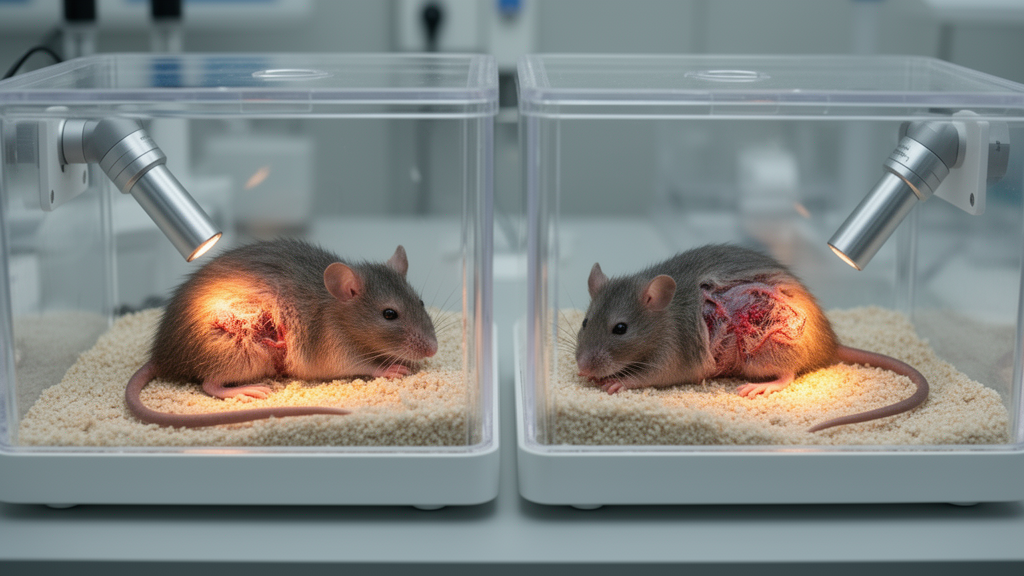
Optogenetic stimulation delivered below a cervical spinal cord injury produced better forelimb recovery and more axonal growth than stimulation applied immediately above the lesion, according to a brief research report in female Long-Evans rats. Six weeks after stimulation began, animals receiving caudal stimulation reached normalized success rates of 45% ±8% on a skilled forelimb-reaching task, compared with 0% ±5% for animals receiving rostral stimulation. The investigators used a cervical hemicontusion model to compare light-based stimulation at two positions relative to the injury.
A new experiment included 10 rats, with five assigned to rostral stimulation and five to a rostral sham condition. All animals received a C4 hemicontusion, injections of an adeno-associated viral vector carrying channelrhodopsin-2 and yellow fluorescent protein at the injured-side C3 segment, and a miniature light-emitting diode implant over that level. The rostral conditions were compared with results from the researchers’ previous experiment, in which an identical paradigm placed the viral injections and implant at C6, two segments below the C4 injury.
The investigators examined the distribution of yellow fluorescent protein labeling to assess where the vector had transduced neurons. Most animals in both the rostral and caudal groups had labeling in spinal laminae III–X, and differences in the prevalence of transduction in individual laminae were not statistically significant. This similarity provided an anatomical check on the comparison, although the rostral and caudal data still came from separate experimental series rather than from randomized assignment of the same animals to both sites.
Stimulation began six weeks after injury and continued for six weeks alongside forelimb-reaching rehabilitation. The light was delivered at 4 Hz using pulses 5 milliseconds wide, with trains consisting of 5 seconds on and 15 seconds off for one hour per session. During the first week of stimulation, sessions occurred four times per week; during the remaining five weeks, they occurred once per week.
Some stimulation was delivered while the rats performed the reaching task, and the stimulation and rehabilitation parameters matched those used in the earlier caudal experiment. Sham animals were connected to the same cable and rehabilitation setup but did not receive light stimulation. The behavioral protocol consisted of 15 minutes of reaching practice per day, five days per week, with weekly videos used to calculate the percentage of successful reaches.
Performance five weeks after injury, immediately before stimulation, was the pre-stimulation reference used for subsequent comparisons. All four groups—rostral stimulation, rostral sham, caudal stimulation and caudal sham—had similar reaching success before injury and during the pre-stimulation period. Group differences emerged after treatment, with significant overall differences reported after four weeks of stimulation, at p=0.031, and after six weeks, at p=0.007.
After four weeks, caudally stimulated rats had normalized reaching success of 38% ±9%, significantly higher than the 5% ±3% recorded in the rostrally stimulated group, for which p=0.007. At six weeks, caudal stimulation was associated with 45% ±8% success, while the rostral group measured 0% ±5%; the difference between them had p<0.001. Caudally stimulated animals also performed significantly better than their corresponding sham group after both four and six weeks, with p<0.025 in each comparison.
The rostrally stimulated group did not significantly outperform its sham at either time point, with p=0.372 and p=0.707, respectively. Histological checks found that differences in the behavioral results were unlikely to be explained simply by unequal injury severity. The average percentage of tissue spared at the lesion epicenter was 81% ±5% for the rostral sham group, 88% ±3% for the caudal sham group, 82% ±3% for the rostral stimulation group and 86% ±3% for the caudal stimulation group.
The differences among groups were not significant, at p=0.501. Thus, the measured lesion tissue-sparing values did not mirror the large separation in reaching performance. Growth-associated protein 43, or GAP43, a marker associated with axonal growth, provided a second outcome that broadly matched the behavioral findings.
Investigators quantified the percentage area of GAP43 immunoreactivity above, at and below the injury, analyzing tissue from both sides of the spinal cord. Caudally stimulated animals had a significantly greater percentage area of GAP43 than rostrally stimulated animals in all three regions and on both sides. At the level of the injury, for example, the caudal-versus-rostral difference had p=0.006 on the ipsilateral side and p=0.004 on the contralateral side.
Rostral stimulation did not significantly increase GAP43 area relative to rostral sham in any assessed region, whereas caudal stimulation produced significantly more contralateral GAP43 in tissue below the lesion than caudal sham, with p=0.033. The result was surprising because previous work cited by the authors suggested that spinal tissue above a lesion may retain conditions favorable for plasticity. The segment immediately rostral to an injury can show less gray-matter loss and less upregulation of perineuronal-net proteins that constrain plasticity, while neuronal activation can increase regenerative and growth-related factors.
The current experiment did not produce corresponding functional or histological benefits from stimulation at C3. The researchers proposed several possible reasons, but did not directly measure neuroinflammation, neural stem or progenitor-cell proliferation, mitochondrial function, or oxidative stress above and below the lesion. The proposed mechanisms therefore remain explanations rather than tested causes in this study.
Implant placement may have limited the comparison. Technical constraints on anchoring the device near C2 meant that the rostral stimulation site was only one segment above the C4 injury, where tissue disruption related to the injury could still have been present. The caudal implant was farther from the lesion at C6, and sites two or more segments above the injury or in the motor cortex were not tested.
Pathway direction offers another possible explanation: if light stimulation attracts growing axons, a rostral source could draw descending motor axons away from their downstream targets, while a caudal source may direct spared motor pathways toward targets below the injury. The study therefore supports a narrower conclusion than a universal rule about stimulation location: under this rat protocol, optogenetic stimulation immediately above the lesion did not improve reaching recovery or GAP43 expression, whereas stimulation below the lesion did.
Subject of Research: Rostral versus caudal optogenetic spinal stimulation after cervical injury in rats
Article Title: Caudal optogenetic spinal stimulation promotes better therapeutic outcomes than rostral optogenetic stimulation following a cervical spinal cord injury
Article References: Myers, R. J., Dang, V., McGiffin, M. N., Trinh, M. L., & Mondello, S. E. (2026). Caudal optogenetic spinal stimulation promotes better therapeutic outcomes than rostral optogenetic stimulation following a cervical spinal cord injury. Frontiers in Neuroscience, 20, Article 1939104. https://doi.org/10.3389/fnins.2026.1939104
Image Credits: AI Generated
DOI: 10.3389/fnins.2026.1939104
Keywords: optogenetics, spinal cord injury, cervical hemicontusion, forelimb recovery, axonal growth, GAP43, neural stimulation, rehabilitation, rat model, Caudal, optogenetic, spinal
Cite Scienmag News
Cassandra Pierce. (October 20, 2026). Caudal light stimulation outperforms rostral treatment in injured rats. Scienmag. https://scienmag.com/caudal-light-stimulation-outperforms-rostral-treatment-in-injured-rats/
Cassandra Pierce. "Caudal light stimulation outperforms rostral treatment in injured rats." Scienmag, 20 October 2026, https://scienmag.com/caudal-light-stimulation-outperforms-rostral-treatment-in-injured-rats/. Accessed 20 October 2026.
Cassandra Pierce. "Caudal light stimulation outperforms rostral treatment in injured rats." Scienmag. October 20, 2026. https://scienmag.com/caudal-light-stimulation-outperforms-rostral-treatment-in-injured-rats/


