


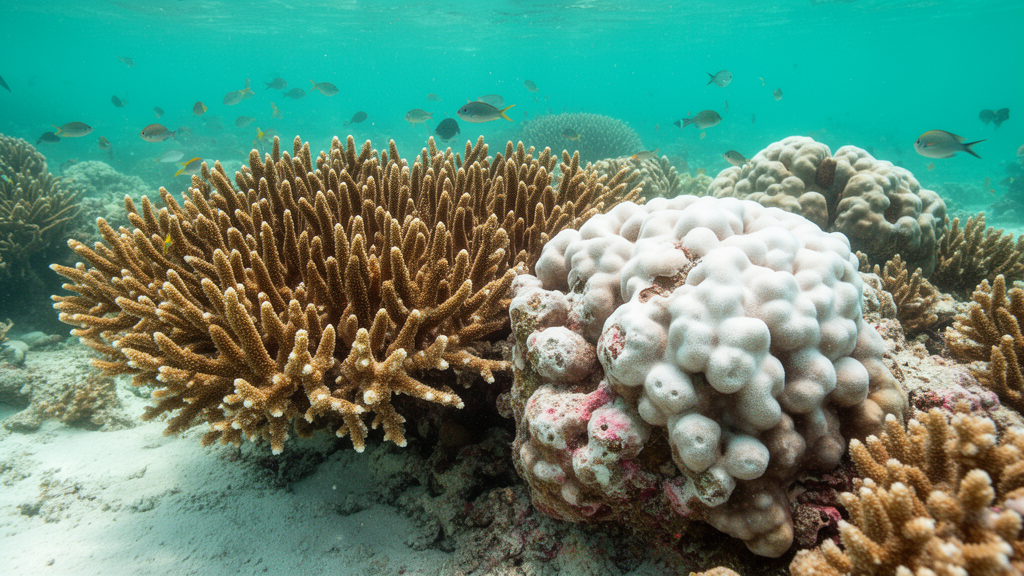
Coral disease prevalence at nine sites around Carrie Bow Cay on the Belize Barrier Reef rose more than tenfold after stony coral tissue loss disease emerged, then shifted again as a newly described chronic tissue-loss disease became dominant. Surveys conducted in 2019, 2022 and 2024 found average disease prevalence increasing from 0.5% at the pre-outbreak baseline to 6.2% in 2022, before declining to 4.2% in 2024. The decline did not signal broad reef recovery: stony coral tissue loss disease, or SCTLD, became less prevalent, but 90.4% of colonies with lesions in 2024 carried chronic tissue loss disease with bleached or purple discoloration in the massive starlet coral Siderastrea siderea. Colony density fell 73.4% across the study period, species richness declined by 33%, and coral assemblages changed substantially as disease and the 2023 Caribbean bleaching event acted on different groups of species.
The study combined permanent monitoring sites with reef-wide surveys to distinguish changes associated with SCTLD from those following the Caribbean marine heatwave. The nine permanent sites consisted of one lagoon reef and eight locations along the Belize Barrier Reef surrounding the Smithsonian field station on Carrie Bow Cay. At each site, researchers laid two 20-metre transect lines, measured benthic cover by point intercept, counted and identified coral colonies within 1-metre-wide belt transects, and examined a wider 4-metre belt for disease lesions. The permanent surveys took place in June 2019, before SCTLD had been reported locally, in August 2022 after the disease’s 2021 emergence in the central barrier reef, and in June 2024 following the 2023 bleaching event. Because the study spans only three observation periods, it documents a temporal sequence rather than continuous annual change.
The 2019 baseline depicted reefs with low disease prevalence and numerous established-looking conditions. Investigators recorded 19 disease types affecting eight coral species, including white syndromes, black band disease, growth anomalies, focal bleaching, dark spot disease and yellow band disease. No lesions met the field case definition for SCTLD, which requires subacute or acute tissue loss affecting multiple species on a reef, with highly susceptible species often showing signs first. Average disease prevalence was 0.5%, with site values ranging from 0.17% to 0.8%. One unusual baseline condition was black discoloration in S. siderea, which accounted for 45.2% of all diseased colonies. Histological analysis found tissue-layer hypertrophy and necrosis associated with mixed filamentous algae and fungi, a cellular pattern that differed from dark spot disease described elsewhere in the Caribbean.
By 2022, lesions consistent with SCTLD occurred at all nine permanent sites and affected 12 coral species. Average prevalence across all diseases reached 6.2%, with site ranges of 4.5% to 8.8%, while 6.2% represented a more than tenfold increase from the baseline. SCTLD accounted for 183 of 813 diseased colonies, or 22.5%. The leading disease was a distinct chronic tissue-loss condition in S. siderea, which affected 467 colonies, or 57.4% of the total. This cTLD lesion left less than 1 centimetre of exposed white skeleton and included bleached or purple discoloration, unlike the broader tissue-loss patterns used to identify SCTLD. Disease composition therefore changed substantially rather than simply increasing: the proportion of colonies displaying different lesion types differed significantly among the three survey years.
By 2024, SCTLD had subsided at the permanent sites. It remained present at six sites and affected three species, but only nine of the 219 colonies with lesions carried it. In contrast, S. siderea cTLD accounted for 90.4% of diseased colonies and occurred at all nine sites. The authors described this as an epidemiologic transition, with the main disease driving observed losses changing from SCTLD to a potentially new condition affecting a coral that has become increasingly prominent as formerly dominant reef-building species disappear. Average disease prevalence in S. siderea was about 33% in 2022 and 20% in 2024, indicating that cTLD remained a substantial and persistent threat even as overall prevalence declined.
Belt-transect counts showed that the community changes extended beyond visible lesions. Average hard-coral colony density declined from 13.9 colonies per square metre in 2019 to 9.4 in 2022, a 32.4% reduction, and then to 3.7 in 2024, a further 60.6% decline. The total decrease between 2019 and 2024 was 73.4%. Species richness fell from 27 coral species in 2019 to 19 in 2022 and 18 in 2024, while overall community composition changed significantly through time. SCTLD-susceptible species including Meandrina meandrites, Eusmilia fastigiata, Dichocoenia stokesii and Pseudodiploria strigosa were among those declining sharply by 2022. After the bleaching event, the largest losses instead involved Agaricia tenuifolia, A. agaricites and Porites porites, which had lower SCTLD susceptibility but greater sensitivity to thermal stress.
Roving diver surveys extended the observations north and south along the barrier reef. In 2022, three one-hour surveys beginning about four miles north of Carrie Bow Cay found SCTLD at every transect, affecting seven species, with mean prevalence of 25.4%. Repeated at the same coordinates in 2023, the surveys found disease in three species and mean prevalence of 1.8%. A broader 2023 effort covered an estimated 4.4 kilometres of reef with 18 additional one-hour surveys, including Glover’s Reef. All 18 transects contained colonies with signs consistent with SCTLD. Divers examined 2,988 colonies of susceptible species and recorded mean SCTLD prevalence of 5.9%. These observations confirmed that the disease was widespread along the barrier reef rather than confined to the permanent study sites, including a reef inside a marine reserve protected since 1993.
Histological examination supported the field identification of several Belizean SCTLD lesions. Samples collected in 2023 showed mucus-cell hypertrophy and necrosis as the dominant host responses, mainly in the gastrodermis of the surface body wall. This pattern resembled SCTLD lesions previously described from the US Virgin Islands, although it differed from the lytic necrosis of basal body wall and mesoglea reported as a hallmark in Florida. Bleached lesions on Orbicella annularis shared the same underlying pathology as overt tissue-loss lesions, supporting their classification as manifestations of SCTLD. Pathology was also detected in apparently healthy tissue sampled away from visible lesions on diseased colonies. The authors said this could indicate a colony-wide response or infection without outward signs, but noted that samples from colonies lacking any lesions were not collected, leaving that possibility unresolved.
Measures of benthic cover showed a less statistically decisive pattern than the colony counts. Average hard-coral cover declined from 15.3% in 2019 to 11.6% in 2024, while soft-coral cover fell from 14.5% to 9.3%; neither change was statistically significant. Sponge cover increased significantly, from 1.3% to 4.5%, while macroalgae peaked in 2022 before returning near its 2019 level in 2024. The authors cautioned that point-intercept sampling collected relatively sparse data and that the 2022 survey occurred in August, unlike the June surveys in 2019 and 2024, so seasonal variation may have influenced the macroalgal peak. Even so, the substantial losses in colony density, richness and community composition were consistent with coral assemblages being reshaped as disturbances accumulated.
Taken together, the observations show that SCTLD and bleaching produced different ecological patterns while leaving overlapping effects on reef structure. Disease was already a major source of coral loss before the 2023 heatwave, and the subsequent shift toward bleaching-sensitive species was superimposed on losses among disease-susceptible taxa. The spread of SCTLD along the barrier reef and the emergence of cTLD in S. siderea also demonstrate why disease cannot be treated as a single, uniform threat: lesion appearance, host specificity and temporal persistence differ among conditions. The study supports continued disease surveillance, investigation of newly emerging conditions and integrated monitoring of bleaching and disease, while its three survey periods and uneven disease-sampling design limit the precision with which individual events can be separated from longer-term reef change.
Subject of Research: Long-term monitoring of coral disease, bleaching and community change on the Belize Barrier Reef
Article Title: Changing coral disease dynamics with the emergence of stony coral tissue loss disease on reefs at Carrie Bow Cay, Belize Barrier Reef
Article References: Aeby, G. S., Work, T. M., Jones, S., Houk, L. J., Harper, L. M., Altman-Kurosaki, N. T., Toth, K., Shortal, C., & Paul, V. J. (2026). Changing coral disease dynamics with the emergence of stony coral tissue loss disease on reefs at Carrie Bow Cay, Belize Barrier Reef. Frontiers in Marine Science, 13, Article 1948029. https://doi.org/10.3389/fmars.2026.1948029
Image Credits: AI Generated
DOI: 10.3389/fmars.2026.1948029
Keywords: Belize Barrier Reef, coral disease, stony coral tissue loss disease, coral bleaching, Siderastrea siderea, chronic tissue loss disease, Carrie Bow Cay, reef monitoring, Caribbean heatwave, Changing, coral, disease
Cite Scienmag News
Violet Maxwell. (October 20, 2026). Belize reef disease patterns shifted as SCTLD and bleaching reshaped corals. Scienmag. https://scienmag.com/belize-reef-disease-patterns-shifted-as-sctld-and-bleaching-reshaped-corals/
Violet Maxwell. "Belize reef disease patterns shifted as SCTLD and bleaching reshaped corals." Scienmag, 20 October 2026, https://scienmag.com/belize-reef-disease-patterns-shifted-as-sctld-and-bleaching-reshaped-corals/. Accessed 20 October 2026.
Violet Maxwell. "Belize reef disease patterns shifted as SCTLD and bleaching reshaped corals." Scienmag. October 20, 2026. https://scienmag.com/belize-reef-disease-patterns-shifted-as-sctld-and-bleaching-reshaped-corals/


