


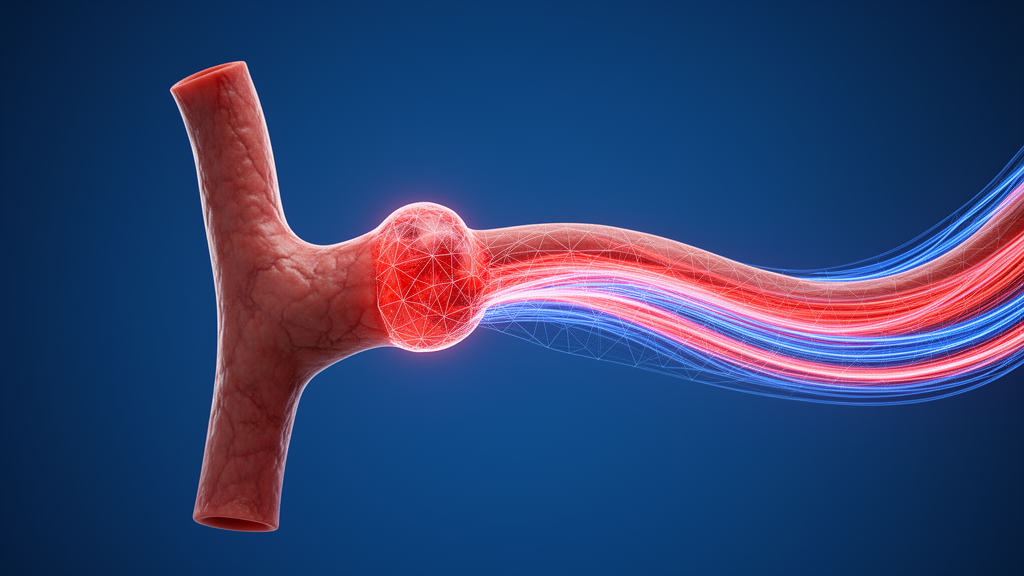
A physics-informed neural network that embeds fluid-conservation laws into its training produced more accurate and physically consistent reconstructions of blood flow inside intracranial aneurysm models than a standard physics-informed network or a purely supervised model. The method, called PIReN, achieved an aggregate relative L2 error of 11.34% ± 0.65% in a pointwise-random, in-domain test, compared with 16.57% ± 1.04% for a conventional physics-informed neural network and 14.74% ± 0.72% for a supervised multilayer perceptron of comparable size. PIReN also produced smaller violations of the continuity and momentum equations, suggesting that its advantage came not simply from fitting more data, but from combining data supervision with explicit constraints on the governing physics.
The work targets a computationally demanding part of cerebrovascular analysis. Patient-specific computational fluid dynamics can estimate three-dimensional velocity, pressure and wall-shear-stress fields from medical images, but each analysis requires segmentation, geometry repair, mesh generation and an iterative numerical solution. Repeating that process across many aneurysm shapes or inlet-flow conditions can become prohibitively expensive. A reusable surrogate could accelerate parametric studies and potentially provide rapid hemodynamic estimates during vascular interventions, although the study did not test clinical use or robot navigation. Its results concern steady, incompressible Newtonian flow in idealized vessel models derived from a computational dataset.
PIReN represents a flow field as the sum of a learnable baseline and a residual correction. Its inputs are a point’s three-dimensional coordinates, the local equivalent vessel diameter and the inlet mass flow rate; its outputs are three velocity components and pressure. A compact baseline branch with two fully connected hidden layers supplies the overall flow pattern. A dual-branch decoder then adds localized corrections. One branch processes the baseline together with the input variables, while a second, “prior-aware” branch extracts flow-conditioning features independently of the baseline. Both use residual multilayer perceptron blocks with 128 features in the default configuration, and a channel-wise gate adaptively combines their outputs.
Training combined a supervised mean-squared-error loss with dimensionless residuals from mass continuity and the steady Navier–Stokes momentum equation. The continuity term penalizes violations of incompressibility, while the momentum term measures the consistency of velocity gradients and pressure gradients with fluid motion. Automatic differentiation calculated the required spatial derivatives in physical units, and characteristic scales estimated from the training subset made the two residual terms numerically comparable. Their weights rose gradually: continuity was inactive for the first 15 epochs and reached its final value after epoch 40, while momentum began at epoch 40 and reached its final value after epoch 90. This staged activation was intended to prevent the physics terms from overwhelming data fitting early in optimization.
The dataset was assembled from the open Aneumo intracranial-aneurysm computational fluid dynamics collection. Seven deformable models derived from one patient anatomy formed geometry set A, while 16 models from a second anatomy formed set B. Each model was evaluated at five inlet mass flow rates from 0.0025 to 0.0040 kilograms per second, corresponding to Reynolds numbers of approximately 250 to 720. Points where all velocity components vanished were removed as no-slip wall locations, and 20,000 interior points were sampled from each file. The researchers used a blood density of 1,060 kilograms per cubic meter and dynamic viscosity of 3.45 × 10⁻³ pascal-seconds, matching the original simulations.
The main in-domain experiment was an optimistic interpolation test rather than a test of extrapolation. Geometry set A was divided into training, validation and test subsets at an 8:1:1 ratio, allowing a held-out point to have nearby training neighbors. Under that protocol, PIReN used 186,472 trainable parameters, compared with 199,940 for the standard physics-informed network and 173,956 for the supervised model. Its mean normalized absolute error was 1.11%, versus 1.61% for the standard network and 1.84% for the supervised model. Its continuity residual, DIV, was 0.0113, compared with 0.0858 and 4.7996, respectively, while its momentum residual, MOM, was also lower. On representative sections, 72.1% of PIReN test points met the predefined continuity criterion |DIV| < 0.01, against 28.3% for the standard network and 4.8% for the supervised model.
Ablation experiments separated the effects of architecture from those of the physics losses. Removing the residual decoder was the most damaging architectural change: aggregate relative error rose from 11.34% to 30.89%, and DIV increased to 1.2314. Removing the baseline field produced a smaller accuracy penalty, with error reaching 12.16%, but DIV rose to 0.0442. Replacing channel-wise gating with simple concatenation and linear projection yielded 12.69% error and a DIV of 0.0514. The physics constraints produced a different trade-off. Removing both governing-equation losses actually lowered in-domain pointwise error to 9.64%, but DIV surged to 3.0351, about 269 times the full model’s value, and MOM increased to 26.4607. Their principal role was therefore to suppress physically inconsistent solutions rather than minimize interpolation error in this setup.
In a zero-shot test, a model trained only on geometry set A was evaluated without adaptation on all 16 models in set B. PIReN’s aggregate error increased from 11.34% on set A to 42.71% on set B, whereas the standard physics-informed network rose from 16.57% to 121.92%. On the unseen geometry, PIReN reduced error by 65.0% relative to the standard network; it also produced 82.1% lower mean normalized absolute error, 93.1% lower DIV and 82.2% lower MOM. This was nevertheless a compound distribution shift: the two sets came from different anatomies, had different morphologies and occupied nonoverlapping coordinate frames about 29.7 millimeters apart. Their characteristic physical diameters differed by only 1.2%, so the result cannot isolate generalization to morphology alone.
Five-fold leave-one-flow-rate-out testing produced a similar pattern. In each fold, one of the five flow rates was entirely withheld while the model was trained on the other four. Across the folds, PIReN’s average aggregate error on the held-out conditions was 36.83%, compared with 106.11% for the standard physics-informed network, a 65.3% relative reduction. PIReN also had lower mean normalized absolute error, DIV and MOM in all five held-out conditions. A stricter spatial-block test then removed neighboring-point leakage by holding out one of five contiguous regions along the vessel axis. Averaged over the five flow conditions, PIReN achieved an aggregate relative L2 error of 0.3035 ± 0.0255 under this protocol, versus 0.3927 ± 0.0285 for the standard network. PIReN performed better in all 40 combinations of four metrics, two partition schemes and five flow configurations, and its absolute error margin widened when the test became spatially stricter.
Several limitations define what the experiments do—and do not—establish. The models assumed steady flow, rigid walls, incompressible Newtonian fluid and no explicit boundary penalties; physics losses were evaluated only at sampled interior points. The continuity formulation also omitted an additional geometric contribution where local diameter changes rapidly, particularly near bifurcations and aneurysm necks, so reported DIV values may underestimate local mass-conservation errors there. The study used synthetic CFD reference data, rigid-wall models and two related anatomy groups rather than independent patient cohorts. It did not evaluate pulsatile flow, compliant vessels, fluid–structure interaction or clinical decision-making. The researchers also note that simply enlarging either model did not guarantee better performance: both architectures worsened at their largest tested sizes, underscoring that the favorable result came from a specific combination of architecture, data protocol and physics-based regularization rather than from raw model capacity alone.
Subject of Research: Physics-informed neural-network reconstruction of cerebrovascular flow fields in intracranial aneurysm models
Article Title: Cerebrovascular flow field reconstruction method based on residual network of physical information
Article References: Teng, Z., Hou, Y., Liu, J., & Wang, Q. (2026). Cerebrovascular flow field reconstruction method based on residual network of physical information. Frontiers in Bioengineering and Biotechnology, 14, Article 1970931. https://doi.org/10.3389/fbioe.2026.1970931
Image Credits: AI Generated
DOI: 10.3389/fbioe.2026.1970931
Keywords: physics-informed neural networks, intracranial aneurysms, cerebrovascular flow, surrogate modeling, Navier–Stokes equations, computational fluid dynamics, out-of-distribution generalization, hemodynamics, Cerebrovascular, flow, field, reconstruction
Cite Scienmag News
Katie Riggs. (October 20, 2026). Physics-informed AI reduces errors in aneurysm flow reconstructions. Scienmag. https://scienmag.com/physics-informed-ai-reduces-errors-in-aneurysm-flow-reconstructions/
Katie Riggs. "Physics-informed AI reduces errors in aneurysm flow reconstructions." Scienmag, 20 October 2026, https://scienmag.com/physics-informed-ai-reduces-errors-in-aneurysm-flow-reconstructions/. Accessed 20 October 2026.
Katie Riggs. "Physics-informed AI reduces errors in aneurysm flow reconstructions." Scienmag. October 20, 2026. https://scienmag.com/physics-informed-ai-reduces-errors-in-aneurysm-flow-reconstructions/


