


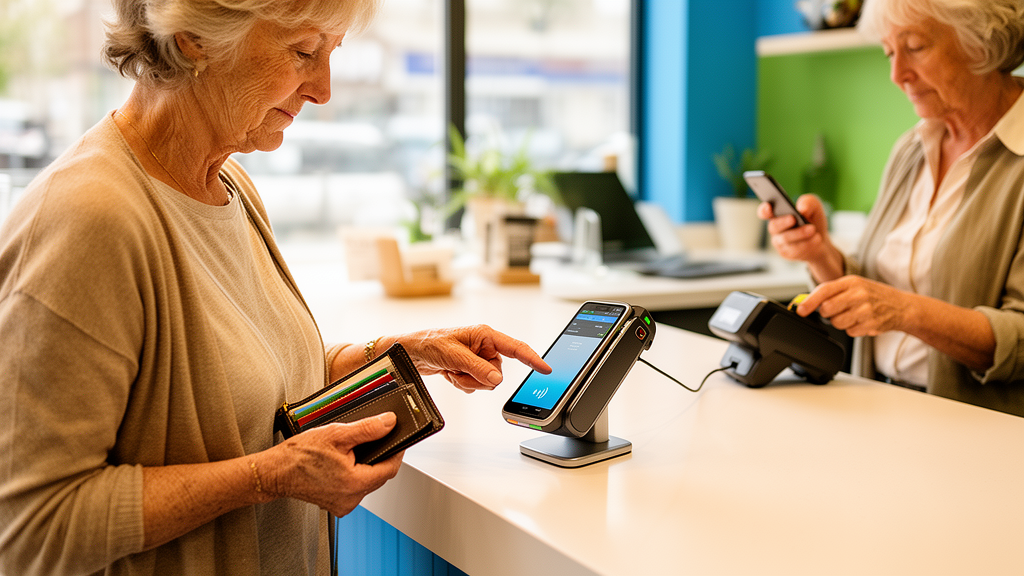
Community-dwelling older adults with moderate or high smartphone proficiency showed a higher prevalence of electronic money use than people without smartphones in a cross-sectional study of 474 adults aged 65 or older in Japan. After statistical adjustment, the prevalence ratio was 2.54 (95% CI 1.31–4.93) for people with moderate proficiency and 3.65 (95% CI 1.89–7.06) for those with high proficiency, compared with smartphone nonowners. Low proficiency was not significantly associated with electronic money use. The findings indicate that smartphone ownership alone does not fully describe older adults’ participation in cashless transactions, although the study cannot establish whether proficiency causes electronic money use or develops as a result of it.
The research used a community-based health check-up program conducted in 2025 in Tarumizu City, Kagoshima Prefecture. Participants were community residents aged at least 40, but the analysis focused on those aged 65 or older. People younger than 65, those reporting a dementia diagnosis, those requiring assistance with daily self-care, those certified as needing care under Japan’s Long-Term Care Insurance system, and those with missing data for key variables were excluded. The final sample included 474 community-dwelling older adults. The study followed STROBE reporting guidance, received ethics approval from the Faculty of Medicine at Kagoshima University, and obtained written informed consent from participants.
Electronic money use was measured through a face-to-face, assessor-administered assessment based on the “Use electronic money” subitem in the managing finances domain of the Process Analysis of Daily Activity for Dementia. The PADA-D divides daily activities into processes and specific actions. For electronic money, participants were asked whether they performed three actions: holding an electronic money card or device over a reader, adding funds to the balance, and understanding the remaining balance. Only participants who performed all three actions were classified as electronic money users. Of the 474 participants, 200, or 42.2%, met this definition, while 274 were classified as nonusers. Most people who did not meet the threshold reported none of the actions: 262 participants reported zero, five reported one, seven reported two, and 200 reported all three.
The researchers used “electronic money” as a practical umbrella term for electronic cashless payments in everyday life rather than restricting it to prepaid stored-value instruments or smartphone applications. The assessment captured transportation IC cards such as Suica and PASMO, credit cards, and device- or QR-code-based services such as PayPay. This distinction allowed the study to examine card-based as well as device-based behavior. Eight of the 62 smartphone nonowners were classified as electronic money users, showing that this payment activity does not necessarily require a smartphone. Card-based systems can be used independently of smartphone ownership, so access to a device and practical participation in electronic payments are distinct constructs.
Smartphone ownership was assessed through a self-administered questionnaire. Among the 412 owners, researchers measured mobile-device proficiency with the Japanese short version of the Mobile Device Proficiency Questionnaire, or MDPQ-16. Its 16 tasks cover mobile-device basics, communication, data and file storage, internet use, calendars, entertainment, privacy, and troubleshooting and software management. Participants rated each task on a five-point scale, and domain means were summed to produce scores ranging from 8 to 40, with higher scores indicating greater proficiency. The researchers divided owners into tertiles: low proficiency at 8.0–16.5 points, moderate proficiency at 17.0–25.5, and high proficiency at 26.0–40.0. These groups contained 138, 137, and 137 participants, respectively, while 62 people were smartphone nonowners.
Modified Poisson regression with robust error variance was used to estimate prevalence ratios and 95% confidence intervals. The first model adjusted for social factors including age, sex, years of education, living alone, marital status, employment status, and current driving habit. A second model added physical impairment, lower cognitive status, and depressive symptoms. The fully adjusted model also accounted for general financial management ability, which was assessed through 12 actions involving cash, household finances, and banks or post offices. This additional variable was intended to distinguish electronic money use from broader capacity to manage finances conventionally. In the fully adjusted model, low smartphone proficiency was not significantly associated with electronic money use relative to nonownership, whereas moderate and high proficiency remained associated with higher prevalence.
An analysis restricted to the 412 smartphone owners produced a similar pattern, with low proficiency as the reference category. In the fully adjusted model, moderate proficiency was associated with 2.15 times the prevalence of electronic money use (95% CI 1.46–3.16), and high proficiency with 2.98 times the prevalence (95% CI 2.04–4.37). A sensitivity analysis treated the proficiency score as a continuous variable rather than relying on the sample’s tertile boundaries. Each one-standard-deviation increase in the MDPQ-16 score was associated with a prevalence ratio of 1.44 (95% CI 1.30–1.60) in the fully adjusted model. The results therefore did not depend solely on the selected categories.
Participants classified as electronic money users were younger, had more years of education, and had lower prevalences of physical impairment and lower cognitive status than nonusers. Their median age was 70.5 years, compared with 75.0 years among nonusers, and current driving was more common in the user group. Most smartphone nonowners and people with low proficiency were nonusers, whereas high proficiency was substantially more common among users. The models accounted for many measured differences between the groups. They also found that the association with smartphone proficiency remained after adjustment for conventional financial management ability, suggesting that the relationship was not fully explained by general capacity to handle cash, household finances, or banking activities.
The authors interpret electronic money use as a digitally mediated instrumental activity of daily living: a contemporary financial task that can combine conventional monetary knowledge and judgment with the practical ability to operate payment devices, add funds, check balances, and follow digital payment procedures. Their broader digital financial literacy framework treats financial competence as including knowledge and skills needed for digitally delivered services, digital tools, and transaction risks. The results are consistent with practical device proficiency being relevant to electronic money use beyond smartphone access alone. They do not show that learning to use electronic money improves smartphone proficiency, or that a particular training intervention would increase electronic money use, because neither direction of effect nor an intervention was tested.
Several limitations constrain interpretation and generalizability. The cross-sectional design cannot establish causation, and the voluntary health check-up sample may be healthier or more health-conscious than the broader older population. The assessment did not distinguish among transportation cards, credit cards, QR-code services, and applications linked to stored credit balances, even though their operational demands differ. For example, an automatically topped-up transportation card may not require active fund addition, so the three-action rule could classify some regular users as nonusers. Only 12 participants, or 2.5% of the sample, reported one or two actions without meeting the threshold. Income, wealth, and financial assets were not directly measured and could confound the association, while perceived usefulness, ease of use, trust, perceived risk, payment attitudes, and technology-related anxiety were also not assessed. Smartphone proficiency was measured only among owners, including no equivalent assessment for the four nonowners who owned tablets. Recruitment through postcards, local publicity, and newspapers rather than online recruitment may nevertheless have helped include older adults with a broader range of digital experience.
Overall, the study provides observational evidence that practical smartphone proficiency is associated with electronic money use among community-dwelling older adults, while merely owning a smartphone does not guarantee participation. The measured pattern was concentrated among owners with moderate or high proficiency, including when nonowners were excluded and when proficiency was analyzed continuously. These results frame electronic money use as a real-world financial activity involving both conventional money management and digital procedural skills. They do not identify a causal pathway, establish a universal proficiency cutoff, or determine the effectiveness of any particular educational or support program. The research instead points to a distinction for further study and assessment: in an increasingly cashless environment, evaluating only whether an older person owns a smartphone misses much of the variation in their ability to perform everyday electronic payment tasks.
Subject of Research: Associations between smartphone ownership, smartphone proficiency, and electronic money use among community-dwelling older adults in Japan
Article Title: Association between smartphone ownership, proficiency, and electronic money use among community-dwelling older adults: a cross-sectional study
Article References: Shimokihara, S., Tabira, T., Maruta, M., Makizako, H., Han, G., Kamasaki, T., Akasaki, Y., Hidaka, Y., Kumura, Y., Kukizaki, W., Kojima, M., Kubozono, T., & Ohishi, M. (2026). Association between smartphone ownership, proficiency, and electronic money use among community-dwelling older adults: a cross-sectional study. Frontiers in Digital Health, 8, Article 1947033. https://doi.org/10.3389/fdgth.2026.1947033
Image Credits: AI Generated
DOI: 10.3389/fdgth.2026.1947033
Keywords: smartphone proficiency, electronic money, older adults, digital payments, cross-sectional study, Japan, aging in place, financial independence, mobile devices, digital financial literacy, Association, between
Cite Scienmag News
Ophelia Keating. (October 20, 2026). Smartphone proficiency linked to electronic money use among older adults. Scienmag. https://scienmag.com/smartphone-proficiency-linked-to-electronic-money-use-among-older-adults/
Ophelia Keating. "Smartphone proficiency linked to electronic money use among older adults." Scienmag, 20 October 2026, https://scienmag.com/smartphone-proficiency-linked-to-electronic-money-use-among-older-adults/. Accessed 20 October 2026.
Ophelia Keating. "Smartphone proficiency linked to electronic money use among older adults." Scienmag. October 20, 2026. https://scienmag.com/smartphone-proficiency-linked-to-electronic-money-use-among-older-adults/


