


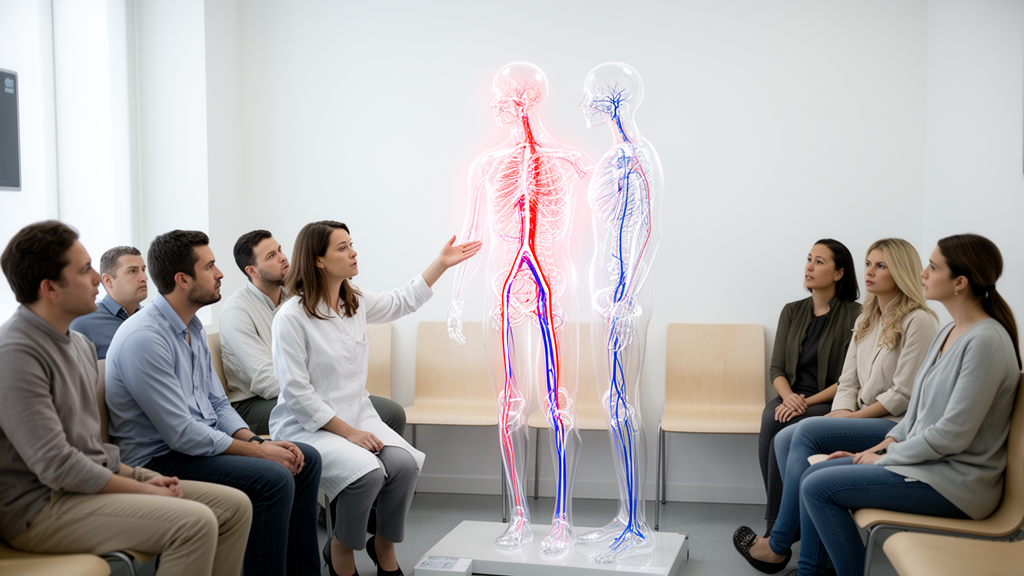
In a qualitative study of 28 adults in southern Italy, patients living with peripheral arterial disease (PAD) or chronic venous disease (CVD) described sharply different forms of vascular risk. People with PAD generally treated their condition as potentially life-threatening, reporting constant vigilance, anxiety and repeated checking of their legs. Patients with CVD more often treated swelling, discomfort and varicose veins as familiar, manageable or cosmetic problems. The contrast was not simply a difference in symptoms: it reflected a social hierarchy in which arterial disease was associated with sudden catastrophe, while venous disease was normalized as part of aging, work or family history. The interviews, conducted between 2023 and 2025, also showed recurring gender patterns, with men more likely to minimize symptoms and delay care, while women more often described attentive monitoring of bodily changes, although the researchers emphasized substantial variation within both groups.
The study recruited participants through a vascular clinic in Calabria, South Italy. The final sample included 14 men and 14 women, aged 42 to 78, with 14 participants diagnosed with PAD and 14 with CVD. Everyone had lived with a confirmed vascular condition for at least six months and could communicate in Italian. Individuals were eligible after expressing interest, and each participated in a semi-structured interview lasting about 40 to 50 minutes, usually in their home or a quiet healthcare setting; two interviews were conducted digitally because of geographic constraints. The researchers asked about symptoms, bodily awareness, perceived severity, emotional responses, self-care, healthcare engagement, normalization, gender and social context. Gender-related questions were introduced near the end of each interview so that participants could first describe their experiences without being prompted to frame them through gender.
All interviews were recorded, transcribed verbatim and anonymized with pseudonyms. The researchers used reflexive thematic analysis, beginning with familiarization and coding before consolidating roughly 60 descriptive and interpretive codes into four broader themes: hierarchies of vascular risk, embodied anxiety and anticipation, trivialization and normalization of venous disease, and gendered interpretations. Coding was treated as an interpretive process rather than a test of statistical agreement between coders. The researchers compared arterial and venous accounts, examined how participants described their bodies and care decisions, and refined the thematic structure through an abductive process in which interview patterns were considered alongside theories of risk, chronic illness and embodied experience. They considered thematic sufficiency reached when later interviews elaborated existing patterns rather than introducing substantively new ones.
The central distinction emerged in the consequences participants imagined. PAD was linked with myocardial infarction, stroke, limb loss and sudden deterioration, giving ordinary sensations a potentially diagnostic significance. “Every twinge in my leg makes me think, could it be a blockage? I try to stay calm, but it’s always there in the back of my mind,” said Paolo, 62, who had PAD. This interpretation made the body an object of continuous scrutiny. Luigi, 59, also living with PAD, described a daily inspection of his legs: “Every morning I check my legs. It has become almost automatic now. I look at the color of the skin, I touch them to see if they feel cold, and sometimes I press on my feet to see if there is any swelling.” Small sensations were no longer experienced simply as sensations; they became possible signs of worsening circulation.
For many arterial patients, this monitoring generated anticipatory anxiety. They imagined not only present discomfort but possible future complications, creating tension between the need to remain alert and the desire to live normally. Alessia, 54, with arterial disease, said, “Sometimes I wake up in the middle of the night and start checking my pulse or touching my feet to make sure everything feels normal. It’s not that something has necessarily happened, but my mind goes straight to the worst possibilities. It’s exhausting because you know you should relax, but you also feel that you have to pay attention.” Patients also learned through experience to distinguish sensations that seemed important from those they considered manageable, often drawing on previous illness and medical consultations.
Patients with CVD described a different relationship with their bodies. Swelling, heaviness, aching and visible veins were generally framed as manageable discomforts rather than warning signs. Giulia, 65, said, “My legs hurt sometimes, especially at the end of the day, but I just put on my stockings and keep going. It’s not like it could kill me, so I don’t worry too much.” Sara, 61, similarly treated swelling after prolonged standing as something she had learned to live with and manage with compression stockings. Roberto, 67, said his varicose veins were “mostly annoying rather than worrying,” and that he sat down, raised his legs and continued his activities. These accounts showed how practical coping could integrate a condition into everyday routines without generating sustained concern about serious outcomes.
Normalization was supported by comparisons with other illnesses and with the aging body. Some participants regarded CVD as less serious because they knew people with heart problems or cancer. Caterina, 72, connected her symptoms to a family pattern: “My legs swell sometimes, especially at the end of the day, but it doesn’t really worry me. My mother had the same problem, and my sisters too. In our family it’s something quite common.” Marco, 70, said that after living with varicose veins for years, the condition felt like part of getting older and did not seem like “a big issue” compared with heart disease or cancer. Occupational strain also supplied an ordinary explanation. Lucia, 62, initially did not seek care because she believed her swelling resulted from standing all day at work and from similarities among her colleagues; she sought advice only after the swelling became substantially worse.
Gender modified these patterns without determining them. Women with arterial disease frequently described vigilance in emotional and relational terms, including concern about losing mobility, independence or the ability to care for family. Elena, 58, said, “I check my legs constantly because I’m afraid of missing something important,” while linking this attention to preventing a serious event. Men with arterial disease also monitored symptoms, but often presented their response as control, discipline and self-reliance. Luca, 60, said: “I know my arteries are blocked, and of course the doctors told me to be careful. But I try not to think about it too much. If you keep worrying about every little thing you can’t live your life.” His account acknowledged danger while limiting the apparent emotional impact of the diagnosis.
Gender was especially visible in how participants with venous disease discussed visible changes. Women frequently mentioned swelling, skin appearance, the visibility of varicose veins, comfort with clothing and shoes, and the effect of symptoms on social presentation. Anna, 63, said she noticed swelling when she wanted to wear particular clothes or shoes and also thought about how her legs looked in summer. Daniela, 55, linked visible veins and heaviness to her appearance while using compression stockings for relief. Men were more likely to dismiss discomfort as a feature of aging, work or family predisposition and to consult a doctor only if symptoms became severe. Matteo, 68, said, “The veins hurt a little sometimes, especially after walking a lot, but it’s nothing serious… I’ll go to the doctor if it gets really bad, but otherwise you just carry on.”
The findings suggest that delayed care should not automatically be read as indifference or non-compliance, while intense monitoring should not automatically be reduced to anxiety. Both responses can arise from culturally shaped understandings of seriousness, vulnerability and responsibility. The researchers identified men with venous disease as especially likely to trivialize symptoms and postpone consultations, and women with arterial disease as often showing the greatest vigilance and anticipatory concern. Women with venous disease frequently focused on comfort, mobility and appearance, while men with arterial disease combined precaution with restrained emotional expression. These were recurring tendencies in this sample, not fixed profiles: age, prior illness, family history, occupation, social roles, symptom severity and previous healthcare experiences also shaped how participants interpreted risk.
The study has important limits. It was exploratory and interpretive, based on retrospective self-reports rather than direct measures of behavior or objective vascular risk, and the 28 participants came from one clinic and regional healthcare context. The researchers did not systematically analyze socioeconomic position, age, disease duration or severity as independent categories, and they did not establish that the perceived hierarchy caused delayed care or better self-management. Transferability to other populations, regions and healthcare systems therefore requires caution, and the gendered patterns cannot be generalized as universal or binary. Nevertheless, the interviews show how biomedical diagnoses are translated through personal experience, family narratives, cultural ideas about aging and gender expectations. In that setting, vascular risk is not only a physiological fact; it is a lived interpretation of which bodily changes deserve attention, which illnesses are allowed to disrupt daily life and whose discomfort is treated as medically significant.
Subject of Research: Gendered perceptions of vascular risk among Italian patients with arterial or venous disease
Article Title: Hierarchies of vascular risk: gendered perceptions of arterial and venous disease
Article References: Costa, D., & Serra, R. (2026). Hierarchies of vascular risk: gendered perceptions of arterial and venous disease. Frontiers in Sociology, 11, Article 1923281. https://doi.org/10.3389/fsoc.2026.1923281
Image Credits: AI Generated
DOI: 10.3389/fsoc.2026.1923281
Keywords: peripheral arterial disease, chronic venous disease, vascular risk, gender, healthcare engagement, risk perception, chronic illness, qualitative interviews, medical sociology, embodiment, Hierarchies, vascular
Cite Scienmag News
Cassandra Pierce. (October 20, 2026). Patients perceive arterial and venous disease through a gendered hierarchy of risk. Scienmag. https://scienmag.com/patients-perceive-arterial-and-venous-disease-through-a-gendered-hierarchy-of-risk/
Cassandra Pierce. "Patients perceive arterial and venous disease through a gendered hierarchy of risk." Scienmag, 20 October 2026, https://scienmag.com/patients-perceive-arterial-and-venous-disease-through-a-gendered-hierarchy-of-risk/. Accessed 20 October 2026.
Cassandra Pierce. "Patients perceive arterial and venous disease through a gendered hierarchy of risk." Scienmag. October 20, 2026. https://scienmag.com/patients-perceive-arterial-and-venous-disease-through-a-gendered-hierarchy-of-risk/


