


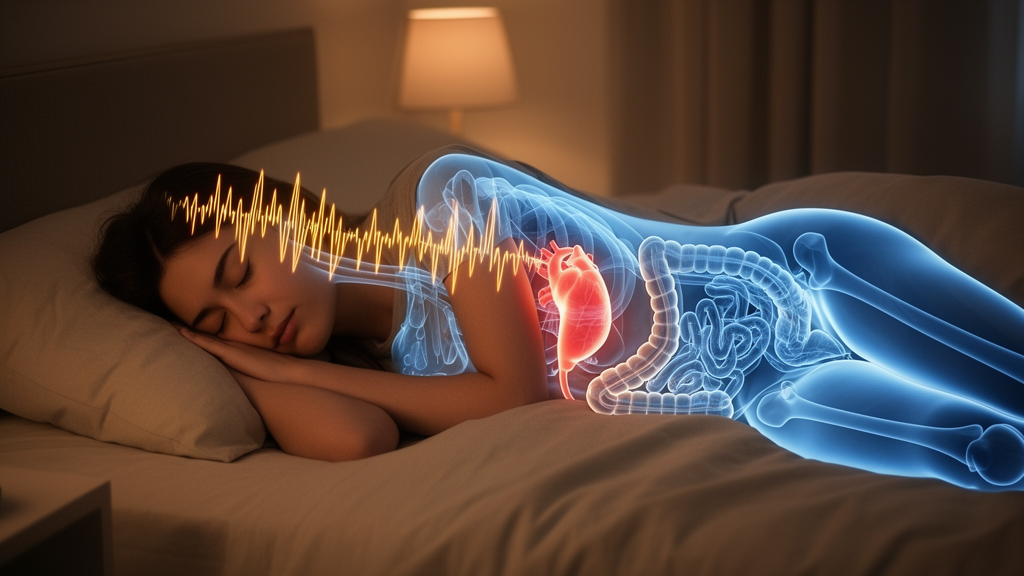
Overnight recordings from 24 healthy young adults revealed a consistent asymmetry in slow power-envelope associations among the brain, heart, and gut: statistical transfer estimates were stronger from heart to brain, brain to gut, and heart to gut than in the corresponding reverse directions. The exploratory study synchronously recorded occipital electroencephalography, electrocardiography, and abdominal bowel sounds, then compared these associations during light sleep, deep sleep, and REM sleep. The results show that sleep stages reorganize statistical relationships among the three systems, but they do not establish anatomical pathways, causal regulation, or clinical biomarkers.
The researchers assessed 32 people for eligibility and excluded eight: five did not meet the criteria for good sleepers, and three had incomplete data. The final group included 12 men and 12 women with a mean age of 29 years and a mean body mass index of 22.89. Participants had no history of insomnia, other sleep disorders, or cardiovascular, neurological, or gastrointestinal disease. Those with an apnea-hypopnea index of at least 5 events per hour were also excluded. Polysomnography captured EEG, ECG, respiration, eye movements, muscle activity, oxygen saturation, snoring, body position, and movement, while a separate dual-microphone device recorded bowel sounds and a reference channel for noise reduction.
Because the polysomnography and bowel-sound recorders were independent systems, their signals were synchronized with tapping markers at the beginning and end of each night. The closing markers also allowed correction for clock drift. Six EEG channels were recorded, but the researchers selected the O2 occipital lead to represent cortical activity, reduce redundant dimensions, and avoid greater susceptibility of some other channels to eye and muscle artifacts. ECG was transformed into heart-rate variability power measures covering low-frequency and high-frequency bands. Bowel sounds were filtered into five bands from 100 to 1,000 hertz, and segments affected by body rollovers were removed. Trained technicians manually assigned sleep stages in 30-second epochs under American Academy of Sleep Medicine criteria.
The analysis used multivariate transfer entropy, a model-free information-theoretic method that measures how much a source adds to the prediction of a target beyond the target’s own history and the history of the conditioning system. The system comprised 11 frequency-band nodes: four occipital EEG bands, two heart-rate variability bands, and five bowel-sound bands. For each target, lagged variables were selected through conditional mutual information with k-nearest-neighbor entropy estimation, then evaluated against 500 block-shuffled surrogates. Non-overlapping five-minute windows were analyzed separately for light sleep, deep sleep, and REM sleep, and the candidate histories were restricted to a maximum delay of 10 seconds. Linear mixed models accounted for repeated windows from each participant, and Benjamini-Hochberg procedures controlled the false discovery rate across prespecified comparison families.
At the network level, the directional asymmetry persisted across all three sleep states. Heart-to-brain transfer estimates increased from light to deep sleep, while heart-to-gut and brain-to-gut estimates weakened in deep sleep. Heart-to-brain and heart-to-gut associations recovered during REM sleep, whereas brain-to-gut transfer showed no significant rebound. The pattern differed from that within individual systems: transfer among occipital EEG bands and among bowel-sound bands generally strengthened from light to deep sleep and weakened during REM, while no statistically significant stage difference was found within the heart. The analysis therefore distinguished internal changes in each signal system from stage-dependent relationships between systems.
Frequency-resolved results showed that the bands contributing to the associations changed their statistical source and receiver roles across sleep stages. In light sleep, alpha was the strongest outgoing occipital band, while delta and theta were primarily receivers. In deep sleep, delta and alpha became sources and theta became a receiver; in REM, no EEG band showed a significant imbalance between incoming and outgoing transfer. Within the heart-rate variability measures, low frequency acted as a source and high frequency as a receiver in deep sleep, but their roles reversed in REM. These spectral measures are not direct indicators of particular autonomic branches: low-frequency heart-rate variability reflects mixed sympathetic and parasympathetic influences, while high-frequency power is strongly modulated by respiration.
The leading inter-system pathways also carried distinct band-level signatures. In the heart-to-brain association, high-frequency heart-rate variability contributed more outgoing information than low frequency during light sleep, although the difference was not significant in deep sleep or REM. Theta received the strongest EEG transfer in light sleep; delta, theta, and alpha exceeded beta in deep sleep; and beta received the most in REM. In the brain-to-gut association, beta was the leading outgoing EEG band in light sleep, delta in deep sleep, and alpha in REM. On the bowel-sound side, the 200–300 hertz band was more sensitive during light sleep and REM, whereas the 400–500 hertz band was more sensitive during deep sleep.
Heart-to-gut transfer showed another set of stage-specific patterns. High-frequency heart-rate variability was the predominant outgoing band in both light and deep sleep, but low frequency became stronger than high frequency in REM. The 500–1,000 hertz bowel-sound band received the most information in deep sleep, while the 200–300 hertz band was strongest in REM; the 200–300, 300–400, and 400–500 hertz bands were all relatively active in light sleep. As sleep deepened, outgoing low- and high-frequency cardiac estimates and incoming estimates for four bowel-sound bands weakened. These results describe statistical relationships among acoustic power envelopes. They cannot yet be assigned to specific intestinal contractions, enteric neural activity, vagal routes, sympathetic routes, or other branches of the autonomic nervous system.
Several limitations constrain interpretation. Bowel sounds are indirect acoustic surrogates of gastrointestinal motility, and the five frequency boundaries were selected from empirical literature rather than validated against simultaneous manometry or imaging. Sensor placement, abdominal transmission, body position, ambient noise, and intra-abdominal pressure can affect the acoustic spectrum, although comparisons within each participant reduce the effect of factors that remain constant overnight. The study used one occipital EEG electrode rather than the whole brain, imposed a uniform 10-second search limit that could miss slower gastrointestinal cycles, and concatenated non-contiguous windows from the same sleep stage without formal stationarity screening or micro-arousal exclusion. Sleep stage, respiration, movement, and differences in filtering and response latency could also modulate all three signals together and create apparent directional relationships.
Control analyses using time-shifted surrogates and sleep-stage conditioning supported the interpretation that the envelope estimates reflected co-modulation beyond simple autocorrelation or sleep-state effects. The principal between-system pattern also persisted when absolute rather than relative band powers were used, although some within-system band-role assignments were sensitive to relative-power normalization. Overall, the study provides a non-invasive statistical view of sleep in which the brain, heart, and gut signals form an asymmetric network. The stable predominance of heart-to-brain, brain-to-gut, and heart-to-gut estimates is consistent with established ideas about autonomic and vagal influences, but the method cannot identify the neural circuits responsible. With a small sample of healthy young adults studied for one night, the results remain hypothesis-generating. Independent work using multi-lead EEG, respiratory correction, uninterrupted sleep segments, direct gut-motility measurements, and experimental pathway tests would be needed to determine whether the observed associations reflect directed physiological regulation or carry clinical significance.
Subject of Research: Exploratory analysis of slow power-envelope associations among brain, cardiac, and bowel-sound signals during sleep
Article Title: Slow power-envelope associations among brain, heart, and gut signals during sleep: an exploratory multivariate transfer entropy study
Article References: Wang, G., Liu, H., Wu, S., Yu, X., & Wang, W. (2026). Slow power-envelope associations among brain, heart, and gut signals during sleep: an exploratory multivariate transfer entropy study. Frontiers in Physiology, 17, Article 1924709. https://doi.org/10.3389/fphys.2026.1924709
Image Credits: AI Generated
DOI: 10.3389/fphys.2026.1924709
Keywords: sleep staging, brain-heart-gut interactions, multivariate transfer entropy, power envelopes, EEG, heart-rate variability, bowel sounds, information flow, physiological coupling, autonomic nervous system, Slow, power-envelope
Cite Scienmag News
Cassandra Pierce. (October 20, 2026). Sleep stages show asymmetric slow signal associations across brain, heart, gut. Scienmag. https://scienmag.com/sleep-stages-show-asymmetric-slow-signal-associations-across-brain-heart-gut/
Cassandra Pierce. "Sleep stages show asymmetric slow signal associations across brain, heart, gut." Scienmag, 20 October 2026, https://scienmag.com/sleep-stages-show-asymmetric-slow-signal-associations-across-brain-heart-gut/. Accessed 20 October 2026.
Cassandra Pierce. "Sleep stages show asymmetric slow signal associations across brain, heart, gut." Scienmag. October 20, 2026. https://scienmag.com/sleep-stages-show-asymmetric-slow-signal-associations-across-brain-heart-gut/


