


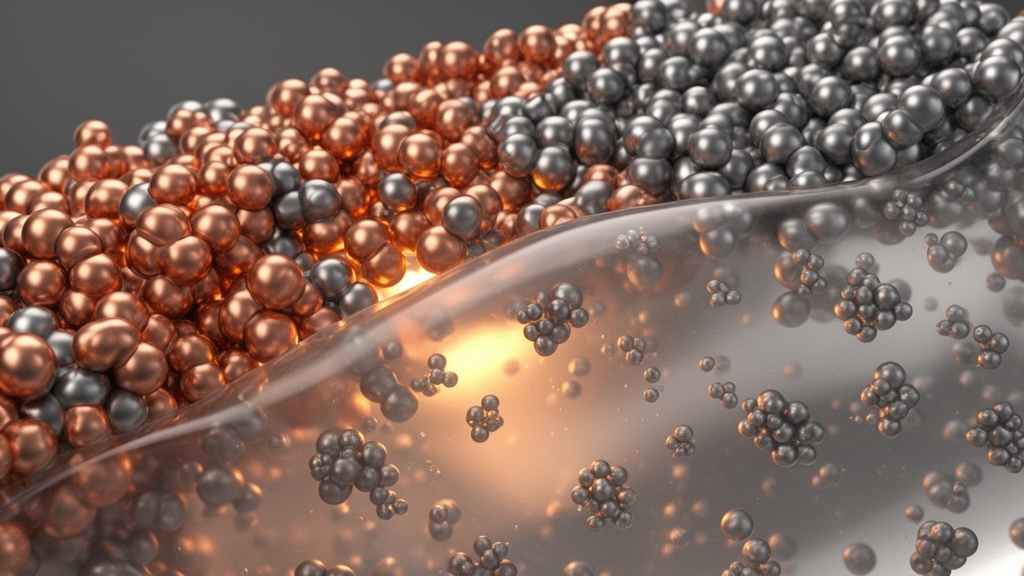
A high-melting titanium–copper alloy formed a metallic glass more readily than the system’s low-melting eutectic in a study that directly examined the atomic structure of their molten precursors. The counterintuitive result challenges the long-standing practice of treating eutectic compositions as automatic favorites for glass formation. Experiments and atom-scale modeling indicate that the congruent-melting composition Ti50Cu50 resisted crystallization because its liquid contained a more diverse assortment of atomic clusters connected into a more stable network. This network was inherited and further strengthened during cooling, creating both kinetic and energetic barriers to crystal nucleation. The researchers propose that this melt structural complexity, rather than eutectic position or the abundance of icosahedral order alone, explains the alloy’s exceptional glass-forming ability.
Metallic glasses are amorphous alloys produced by cooling melts quickly enough to avoid crystallization. Their disordered structures can provide high strength, a large elastic limit and soft magnetic behavior, making them useful in applications such as flexible-device hinges, energy-conversion equipment and transformer cores. Glass-forming ability is therefore important for determining the size, quality and cost of components. For more than half a century, alloy design has largely followed the eutectic rule: because eutectics melt at relatively low temperatures, they can retain a larger interval between the glass-transition and crystallization temperatures and are expected to form glasses more easily. A related criterion expresses this expectation as the reduced glass-transition temperature, Trg, the ratio of glass-transition temperature to liquidus temperature.
That rule has notable exceptions. Binary systems including zirconium–copper, hafnium–copper, titanium–copper and nickel–niobium contain compositions that outperform neighboring eutectics. Explanations based on metastable phase diagrams or eutectic-coupled zones have not been universal, and they focus mainly on which crystalline phases compete with glass formation. The new study instead asks what properties of the liquid itself make crystallization difficult. It examines Ti50Cu50, a congruent-melting alloy, and Ti27Cu73, the nearby eutectic, at the level of individual atomic clusters and the connections among them. The choice of titanium–copper is significant because extending the liquidus lines of its terminal solid solutions creates an especially clean comparison with only two simple crystalline competitors.
The experimental comparison confirmed that the eutectic was not the superior glass former. X-ray diffraction showed that Ti50Cu50 ribbons were fully amorphous after melt spinning at a wheel speed of 35 meters per second, whereas Ti27Cu73 required at least 43 meters per second to eliminate detectable crystalline peaks. Differential scanning calorimetry measured a distinct glass transition in Ti50Cu50 at 654.8 kelvin and crystallization at 683.7 kelvin, but found no distinct glass transition in the eutectic. Kissinger analysis estimated a crystallization activation energy of 376.1 kilojoules per mole for Ti50Cu50, compared with 205.3 kilojoules per mole for Ti27Cu73. These measurements establish stronger resistance to crystallization in the congruent alloy, even though its liquidus temperature was higher: 1274.3 kelvin versus 1190.9 kelvin.
To see the liquid structures directly, the team laser-heated small alloy spheres while suspending them in an aerodynamic levitator and measured them with in situ high-energy synchrotron X-ray diffraction. The experimental pair-distribution functions were then used as constraints in a newly developed energy-minimization-enhanced reverse Monte Carlo method. Unlike conventional reverse Monte Carlo reconstruction, the new method adds an energy constraint, encouraging configurations that fit the measured structure while also having low potential energy. Voronoi tessellation then divided the reconstructed three-dimensional atomic arrangements into coordination polyhedra. The researchers introduced two diversity measures, the variance in cluster fractions and Shannon entropy, alongside a new cluster-correlation variance for quantifying the strength of selective connections among local structures.
The congruent melt was not simpler than the eutectic melt. Ti50Cu50 had a more uniform distribution of cluster types, lower cluster-fraction variance and higher Shannon entropy across the measured temperature range. Its broader local environments included more Ti-centered clusters with coordination numbers between 12 and 14. In the eutectic, a few configurations dominated: Ti-centered clusters with five Ti and 12 Cu neighbors, and Cu-centered clusters with five Ti and 10 Cu neighbors. By contrast, the congruent alloy had no similarly overwhelming cluster type. Its greater Ti content also promoted stronger chemical short-range order and more unlike Ti–Cu bonds. An ideal-mixture estimate places the configurational entropy of the equiatomic composition at 0.693 times the gas constant, compared with 0.583 times that constant for the eutectic composition, providing an entropic basis for the observed diversity.
That diversity was accompanied by stronger medium-range organization. Clusters were grouped according to their degree of fivefold symmetry, and their nearest-neighbor connections were compared with those expected under random mixing. Similar clusters tended to connect, whereas groups with intermediate symmetry tended to avoid one another. In Ti50Cu50, highly fivefold-symmetric clusters formed particularly persistent connections, and the new correlation-variance measure remained consistently higher than in Ti27Cu73. A graph-theoretic analysis also found more one- and two-neighbor connections among selected icosahedral and icosahedral-like clusters. These unlike atomic bonds and cluster links lower the enthalpy of the melt, creating a stabilizing network that can impede single-atom diffusion and make structural rearrangement more collective. The study therefore interprets the better glass former as the product of competition between high configurational diversity and enthalpically favored local connections.
The advantage became stronger during the glass transition. The melts contained roughly 1,100 to 1,400 distinct cluster types, whereas the corresponding glasses contained about 600 to 800, indicating extensive structural transformation during cooling. In both alloys, many low-fivefold-symmetry clusters disappeared while highly symmetric clusters increased in abundance. Ti50Cu50 retained high-symmetry clusters particularly well: 90.2 percent of its vanished cluster types had fivefold symmetry no greater than 0.5, compared with 88.2 percent for the eutectic. Detailed reconstructions showed several routes by which lower-symmetry coordination polyhedra became icosahedral-like structures, either through distortion without a change in neighbor count or through the addition or removal of neighbors. In the glass, new connections with node degrees of two and three further strengthened the cluster network in Ti50Cu50.
The transformations reveal that a glass is not simply an unchanged snapshot of its liquid. Instead, undercooling can reorganize local motifs before they become trapped in an amorphous structure. In the congruent alloy, diverse low-symmetry clusters are preferentially converted into strongly geometrically frustrated, high-symmetry motifs. Fivefold symmetry is incompatible with periodic translational order in a crystal, and the newly formed connections make it difficult for atomic groups to rearrange into a crystalline embryo. Cluster diversity thus creates geometric frustration, while correlated connections stabilize the resulting network and raise the energetic cost of crystallization. The findings do not imply that icosahedral order is unimportant: the eutectic melt actually contained more such clusters, yet it still formed glass less readily. The decisive feature was not the presence of icosahedral motifs alone, but their integration into a diverse and persistent structural network.
A reverse comparison with nickel–niobium supported the proposed rule. In that system, the eutectic Ni58.5Nb41.5 is the better glass former, while congruent Ni75Nb25 is not. When the same structural measures were applied to their melts, the eutectic liquid was the more complex one, showing higher Shannon entropy, lower cluster-fraction variance and stronger inter-cluster correlations. Across two systems with opposite relationships between phase-diagram position and glass formation, the better glass former was consistently the composition whose melt displayed greater structural diversity and connectivity. The study therefore suggests that alloy designers could search for compositions that create complex liquids, including certain congruently melting intermetallics, rather than relying exclusively on eutectic minima or maximizing icosahedral order. The evidence is mechanistic and model-based, however: the principal experiments concerned binary titanium–copper alloys, while the broader nickel–niobium calculations support generality but do not establish performance for every alloy family.
Subject of Research: Atomic melt structure and anomalous glass-forming ability in titanium–copper and nickel–niobium alloys
Article Title: To Be or Not to Be Eutectic: Anomalous Glass Forming Ability Governed by Melt Structural Complexity
Article References: Chen, W., Wei, X., Wang, C., Lu, Z., Zhang, F., Huang, Y., Zhang, Y., Wang, L., Cao, S., Zhou, C., Yang, K., Fu, Z., Zhao, J., Sun, D., Meng, F., Zhou, Z., Wang, X.-L., Wang, W., & Ma, D. (2026). To Be or Not to Be Eutectic: Anomalous Glass Forming Ability Governed by Melt Structural Complexity. Advanced Science, Article e78359. https://doi.org/10.1002/advs.78359
Image Credits: AI Generated
DOI: 10.1002/advs.78359
Keywords: metallic glasses, glass-forming ability, melt structure, titanium–copper, cluster diversity, cluster correlations, atomic ordering, crystallization kinetics, synchrotron diffraction, inverse design, Eutectic, Anomalous
Cite Scienmag News
Denise Maddox. (October 20, 2026). Melt Structure Explains Why Non-Eutectic Titanium-Copper Forms Better Glass. Scienmag. https://scienmag.com/melt-structure-explains-why-non-eutectic-titanium-copper-forms-better-glass/
Denise Maddox. "Melt Structure Explains Why Non-Eutectic Titanium-Copper Forms Better Glass." Scienmag, 20 October 2026, https://scienmag.com/melt-structure-explains-why-non-eutectic-titanium-copper-forms-better-glass/. Accessed 20 October 2026.
Denise Maddox. "Melt Structure Explains Why Non-Eutectic Titanium-Copper Forms Better Glass." Scienmag. October 20, 2026. https://scienmag.com/melt-structure-explains-why-non-eutectic-titanium-copper-forms-better-glass/


