


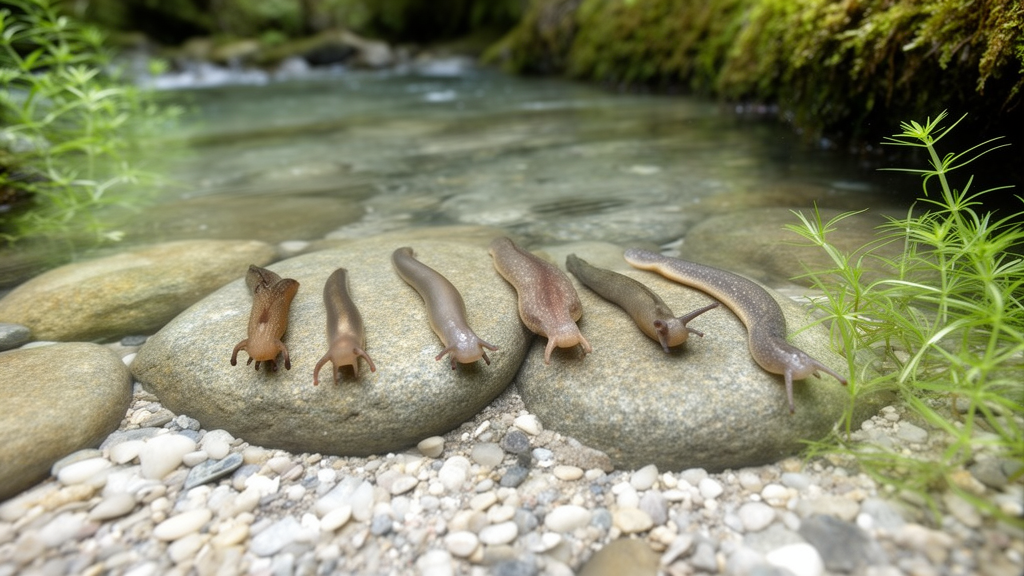
A review of historical records, taxonomic databases, museum holdings and original species descriptions confirms that only seven freshwater planarian species have been described from Chile, but the authors conclude that this figure probably represents a substantial underestimate of the country’s triclad diversity. The recognized species belong to three genera, Dugesia, Girardia and Romankenkius, with most documented localities concentrated in central and southern Chile. Several taxa remain taxonomically unresolved because their mature reproductive anatomy, which is central to reliable identification, was never described adequately.
The state-of-knowledge assessment is a synthesis rather than a new nationwide field survey. Researchers searched the World Register of Marine Species and the Turbellarian Taxonomic Database, consulted major checklists and original publications in several languages, and reconstructed collection localities, external features and copulatory anatomy from the available literature. Their map records 26 localities, while accompanying tables summarize coordinates, sampling dates and collectors, morphological variation and the status of reproductive structures.
Most underlying collections were made by visiting European and North American scientists during expeditions, with records extending from 1892 to 1991 rather than from a continuous modern survey. Chile’s freshwater fauna belongs to a restricted biogeographic pattern within Dugesiidae, a family of free-living triclads reported in the Southern Hemisphere. These animals range from a few millimetres to several centimetres in length and may be brown, gray, yellow or nearly black, sometimes with paler midlines or spotty patterns within a species.
Head form provides an initial clue: Dugesia and Girardia generally have pointed or triangular anterior ends with auricles, while Girardia auricles tend to be more protuberant, whereas Romankenkius has a more rounded head. Pigmentation of the outer pharyngeal wall is considered characteristic of Girardia, but external appearance alone cannot establish a species identification. The reproductive system supplies the decisive characters.
Sexual triclads are hermaphrodites, each possessing male and female organs and mating through cross-fertilization. Their testes occur as discrete follicles distributed ventrally, dorsally or through the dorsoventral axis, while paired ovaries usually lie close behind the brain. Taxonomists also examine vitellarian or yolk follicles, the penis papilla, muscle layers, seminal and ovovitelline ducts, glands and the copulatory bursa.
Two species explicitly retain the status species inquirenda. Dugesia ambigua was described in 1902 from specimens collected in 1893 in a lake near Punta Arenas, Magallanes. The largest fixed animal measured about 7 millimetres long and 3 millimetres wide and displayed deep brown, blackish or dirty olive-green dorsal coloration with whitish or yellowish margins and midline.
Its genital organs were immature, so the definitive arrangement of the copulatory apparatus could not be determined. Later workers proposed placements in Cura or Dugesia, and a 1984 comparison noted its similarity to Romankenkius patagonicus, but the review treats that possible equivalence as unresolved. Dugesia similis, described from Salto brook near Valparaíso, had no mature reproductive organs either.
Its dark dorsal spotting, slender body and clearly defined conical auricles were recorded, as were signs of fission, but those observations did not provide a conclusive identification. Girardia canai is among the more thoroughly characterized Chilean taxa. It was described in 1993 from 16 mature specimens gathered beneath stones in Mapocho River backwaters near Talagante and at the mouth of the Reñaca Estuary in Valparaíso.
Fixed specimens measured 9–10 millimetres long and 2–4 millimetres wide. They had a triangular head, rounded auricles, a pair of eye cups and light-brown dorsal pigmentation with dark spots that could form a longitudinal median stripe. The reproductive description included paired false seminal vesicles containing sperm, a notably long penis papilla, ovoid ovaries, separately opening ovovitelline ducts and an angled bursal canal with two muscle layers.
The enlarged cavity in the penial bulb of G. chilla helps distinguish the two species. Girardia chilla was described by Ernst Marcus in 1954 after the analysis of 49 specimens collected during a 1948–1949 expedition, and it was later redescribed using material from Chile and Argentina. It occurs in Chile’s Valparaíso, Los Lagos and Magallanes regions and has also been reported from Argentina and Brazil.
Animals are slender, approximately 9–25 millimetres long, with a large pointed head, flexible auricles, dense dark dorsal pigmentation and a much paler bluish-gray underside. Its diagnostic reproductive features include a stubby cone- or ball-shaped penis papilla, dorsal or dorsoventral testes and a globose copulatory bursa. The bursal canal can be constricted, and such differences among samples were attributed to animal age.
Hyman reported asexual fission behind the pharynx and seasonal sexual reproduction, with pedunculate egg cocoons attached to stones and juveniles hatching three to five weeks later. Girardia festae has the broadest documented distribution among the seven Chilean species and has accumulated numerous synonyms through successive historical treatments. It occurs in Chile’s Valparaíso, Metropolitana, Biobío and Los Ríos regions and has been reported across much of Latin America, including Argentina, Peru, Ecuador, Bolivia, Venezuela, Colombia, Curaçao, Brazil, Uruguay and Paraguay.
Chilean specimens reach 10–20 millimetres in length and 1.5–4 millimetres in width, with a triangular head, pointed auricles and variable brown, grayish or yellow dorsal pigmentation. Its reproductive anatomy includes two anterior ovaries, numerous testes and a distinctive two-lobed penis papilla. The species reproduces both sexually and asexually by fission, and cited cytological work reports eight pairs of chromosomes.
Romankenkius patagonicus is the principal planarian documented in cold waters of southern Patagonia. Chilean records extend through Magallanes from Torres del Paine and Punta Arenas to islands in the Cape Horn archipelago, while specimens have also been reported from Argentina. A redescription examined 65 specimens: sexually mature animals were approximately 6 millimetres long and 2–3 millimetres wide, whereas immature individuals measured about 3 millimetres long and 1 millimetre wide.
The animal has a broad, moderately rounded head with short white blunt auricular organs, a large unpigmented pharynx and dorsal pigmentation interrupted by a pale median line. Its small ovaries lie between the second and third intestinal diverticula, while the testes are mainly dorsal and prepharyngeal. A short conical penis papilla and large copulatory bursa form part of the reproductive diagnosis.
Reported habitats had water temperatures of 6–11 °C. Although fragments were observed, the authors did not establish that they resulted from asexual reproduction. The review also identifies substantial weaknesses in digital records and institutional preservation.
World Register of Marine Species returned five matching Dugesiidae entries for Chile, but two referred to the same species, and records for D. ambigua, D. similis and G. canai were missing. Only a few specimens are held in major foreign museums: G. festae in the American Museum of Natural History, G. canai in Buenos Aires and New York, G. chilla in Amsterdam, and R. patagonicus in London. None of the reported specimens was deposited in a Chilean museum, limiting direct national access to reference material.
A further, uncharacterized triclad was reported from springs at the Ascotán salt pan, 3,800 metres above sea level in the Atacama Desert, but the available record did not permit identification. The uneven distribution of described species—many in central and southern Chile, with only one formally described for the northern region—also means that the mapped localities cannot be treated as a complete account of present distribution or change over time. The authors therefore call for renewed sampling of type localities and broader collection across Chile.
They recommend combining classical morphological, anatomical and reproductive-system descriptions with nuclear and mitochondrial markers, including 18S and 28S ribosomal subunits, cytochrome c oxidase subunit 1, elongation factor 1α and internal transcribed spacer 1. Additional nuclear markers and next-generation sequencing profiles incorporated into planarian identification pipelines may improve specimen identification and phylogenetic analysis. They also note broader opportunities to investigate planarians in Chile’s unusual environments, including cold Patagonian waters and the Atacama salt pans, and to clarify shared Chilean, Argentine and Brazilian distributions such as those of G. chilla and G. festae.
The review does not determine how many species Chile actually contains; instead, it presents seven described taxa as a firmly documented core surrounded by major gaps in field coverage, mature-anatomy observations, molecular sampling and accessible voucher collections.
Subject of Research: Taxonomic diversity, distribution and identification of Chile’s seven known freshwater planarian species
Article Title: Current state of knowledge on freshwater planarians ( Platyhelminthes , Tricladida , Dugesiidae ) from Chile
Article References: Vásquez-Doorman, C., Escobedo, J., & Allende, M. L. (2022). Current state of knowledge on freshwater planarians (Platyhelminthes, Tricladida, Dugesiidae) from Chile. Neotropical Biology and Conservation, 17(3), 185-203. https://doi.org/10.3897/neotropical.17.e82779
Image Credits: AI Generated
DOI: 10.3897/neotropical.17.e82779
Keywords: freshwater planarians, Chile, Dugesiidae, Dugesia, Girardia, Romankenkius, taxonomic diversity, morphological identification, biodiversity records, planarian biogeography, Current, state
Cite Scienmag News
Margaret Porter. (October 20, 2026). Chile’s seven freshwater planarian species reveal a major biodiversity gap. Scienmag. https://scienmag.com/chiles-seven-freshwater-planarian-species-reveal-a-major-biodiversity-gap/
Margaret Porter. "Chile’s seven freshwater planarian species reveal a major biodiversity gap." Scienmag, 20 October 2026, https://scienmag.com/chiles-seven-freshwater-planarian-species-reveal-a-major-biodiversity-gap/. Accessed 20 October 2026.
Margaret Porter. "Chile’s seven freshwater planarian species reveal a major biodiversity gap." Scienmag. October 20, 2026. https://scienmag.com/chiles-seven-freshwater-planarian-species-reveal-a-major-biodiversity-gap/


