


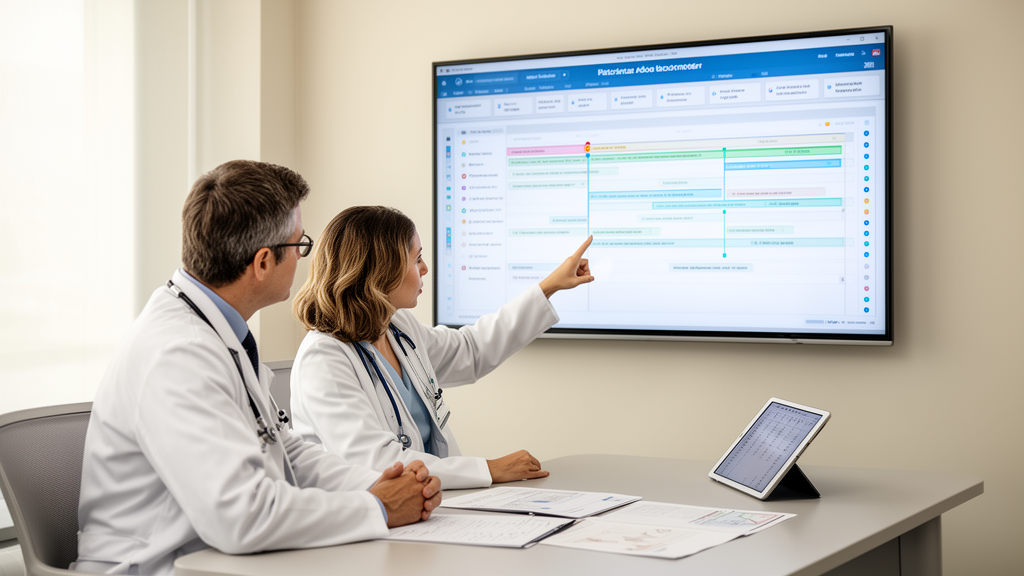
Physicians reviewing complex patient cases spent the most time in a digital tool’s view of the patient’s social context, followed by its clinical-note list and summaries of individual health problems, according to an exploratory descriptive analysis of logged interactions. The study included 29 physicians using DigiTeam to review the same three cases, producing 87 chart reviews with a mean duration of 24 minutes 20 seconds. By measuring the views actually opened, the analysis documented how participants combined summarized information with original clinical records during a demanding review task.
DigiTeam was designed to bring information from several parts of the care record into 10 information views. Its opening Overview combined what mattered to the patient, a summarized medical history and a timeline of health problems. Other views presented information about family and social circumstances, medical history, clinical notes, involved professionals, medications, municipal services, diagnoses recorded in general practice and hospitals, and summaries of specific health problems.
Information elements took the form of textual summaries or visualizations showing developments over time. Hyperlinks, clickable elements and timeline controls let users move from a summary to underlying details. Summaries were prepared before the trial, primarily by a physician involved in the tool’s development, and had not been validated by the patients.
The three patient cases were selected for variation in medical complexity and care history. Their files contained 997, 1,863 and 3,050 PDF pages of clinical notes spanning as many as 27 years and drawing on general practice, specialist care and, for the first two cases, municipal health and social care. Case 1 involved a 74-year-old man with advanced multimorbidity, multiple acute hospital admissions, chronic hypotension linked to heart-failure treatment and nutritional decline; he received daily municipal services.
Case 2 involved a 44-year-old man with complete quadriplegia following a cervical spinal-cord injury in adolescence, multisystem involvement, supported housing and 24-hour personal assistance. Case 3 involved an 82-year-old man with multiple chronic conditions who had no municipal services and was the primary caregiver for his wife with Alzheimer’s disease. Participants were medical doctors who had graduated within the previous five years or had experience working as a general practitioner.
Of the 29 participants, 19 were female, the mean age was 34 years, and mean clinical experience was 7.1 years; eight were general-practice specialists. All participated in the intervention arm of a randomized controlled trial. In a test environment outside clinical hours, each physician reviewed the three cases in the same order and wrote a summary of the patient’s medical status, social and personal factors, what mattered to the patient and a follow-up plan identifying who should be involved.
The session was allocated two hours but individual reviews had no time limit. Automated log files recorded timestamps for each interaction, enabling the researchers to analyze review time, view use, transitions, switching frequency and access to notes and hyperlinks. About the Patient received 24% of total review time, averaging 5 minutes 30 seconds.
The Clinical Notes List accounted for 20%, or 5 minutes 3 seconds, while Health Problem Summaries received 18%, or 4 minutes 32 seconds. The Overview page took 17%, and Medical History accounted for 12%. The remaining views received smaller shares: Medication List 5%, Municipality 1.2%, hospital diagnoses 1.0%, general-practice diagnoses 0.9% and Involved Health Professionals 0.8%.
Review times ranged from 9 minutes 26 seconds to 56 minutes 38 seconds. Case 1 took longest on average, at 33 minutes 36 seconds, compared with 19 minutes 46 seconds for Case 2 and 19 minutes 38 seconds for Case 3. The researchers reported no noteworthy overall differences in the distribution of time among views across the cases, although Case 3 had no municipal services, which was consistent with its low use of the Municipality view.
Initial navigation followed a broadly similar pattern. Every review began on the Overview page, and physicians spent an average of 2 minutes 11 seconds there before moving elsewhere. About the Patient was the first view selected after the Overview in 71% of chart reviews.
Medical History was opened in 41% of reviews at the second step, while 24% returned to the Overview. From the third step onward, navigation became more varied, although use of Health Problem Summaries and the Clinical Notes List increased relative to the earliest steps. The first five steps occupied an average of 10 minutes 43 seconds, equal to 44% of total review time.
Across the 87 reviews, participants made 1,311 transitions among views, or 15.1 per review on average. The most common were Overview to About the Patient, representing 8.8% of transitions, and About the Patient to Medical History, representing 8.0%. Switching between information views remained relatively stable as reviews progressed.
Physicians made an average of 0.75 switches per 5% of review time, with a standard deviation of 0.42. The final 5% segment contained a slight increase to an average of 1.5 switches, with a standard deviation of 2.3. On average, 37.6% of chart reviews contained at least one switch within each 5% segment, with a standard deviation of 13.6 percentage points.
These measurements show a broadly even pattern of movement among views rather than one concentrated entirely at the beginning or end. They do not, however, reveal whether each switch was intentional, whether a physician was actively reading a page or what information the physician was considering. Original documentation remained important alongside the summaries.
Physicians opened an average of 8.3 clinical notes per review, with 721 notes displayed for at least five seconds across all three cases. General-practice notes were opened most frequently as a note type, averaging 1.7 per review, followed by discharge or outpatient summaries and nursing notes at 1.3 each. When grouped by source, specialist-care notes were accessed most often, averaging 4.8 per review, compared with 2.4 notes from general practice.
Physicians clicked an average of 2.9 hyperlinks per review, most often those in Health Problem Summaries, at 1.7 clicks. Hyperlink use differed among cases: Case 1 produced an average of 5.8 clicks, compared with 2.0 for Case 2 and 0.9 for Case 3. Across cases, the combined number of opened clinical notes and hyperlinks averaged 11.2, with the highest value in Case 1 at 16.8.
The results do not establish that DigiTeam improved clinical decisions, reduced cognitive load, shortened chart review or outperformed standard electronic health records. The present analysis described use of the intervention tool rather than measuring patient outcomes or comparing the tool’s clinical performance with a control. The work was conducted in an experimental setting rather than during routine care.
Participants received a short instruction video, and DigiTeam lacked functions commonly found in operational electronic health records, including order entry, medication prescribing, documentation and secure messaging. Logged time represented the interval during which a view remained open and could not distinguish reading, writing, thinking or temporary distraction. The logs also could not identify why a physician opened a page or which elements attracted attention.
With 29 physicians, three cases and a relatively narrow participant profile, the findings may not generalize to other specialties, more experienced clinicians or routine clinical workflows. Within those limits, the interaction data offer a concrete account of how clinicians used a tool built around summaries, visualizations and direct links to source records. Physicians commonly began with a broad overview, moved toward information about the patient and medical history, and subsequently combined problem-specific summaries with clinical notes.
Subject of Research: Physicians’ logged use of DigiTeam information views during reviews of three complex patient cases
Article Title: Physicians’ use of a digital tool with information views to support chart review of complex patient cases
Article References: Emén, A., Torsvik, T., Berntsen, G. R., Broks, M., & Steinsbekk, A. (2026). Physicians’ use of a digital tool with information views to support chart review of complex patient cases. Frontiers in Digital Health, 8, Article 1954602. https://doi.org/10.3389/fdgth.2026.1954602
Image Credits: AI Generated
DOI: 10.3389/fdgth.2026.1954602
Keywords: digital health, electronic health records, chart review, complex care, physician workflow, DigiTeam, navigation logs, clinical notes, patient context, usability, Physicians, digital
Cite Scienmag News
Ophelia Keating. (October 20, 2026). Research report: Physicians’ use of a digital tool with information views to support chart review of complex patient cases. Scienmag. https://scienmag.com/research-report-physicians-use-of-a-digital-tool-with-information-views-to-support-chart-review-of-complex-patient-cases/
Ophelia Keating. "Research report: Physicians’ use of a digital tool with information views to support chart review of complex patient cases." Scienmag, 20 October 2026, https://scienmag.com/research-report-physicians-use-of-a-digital-tool-with-information-views-to-support-chart-review-of-complex-patient-cases/. Accessed 20 October 2026.
Ophelia Keating. "Research report: Physicians’ use of a digital tool with information views to support chart review of complex patient cases." Scienmag. October 20, 2026. https://scienmag.com/research-report-physicians-use-of-a-digital-tool-with-information-views-to-support-chart-review-of-complex-patient-cases/


