


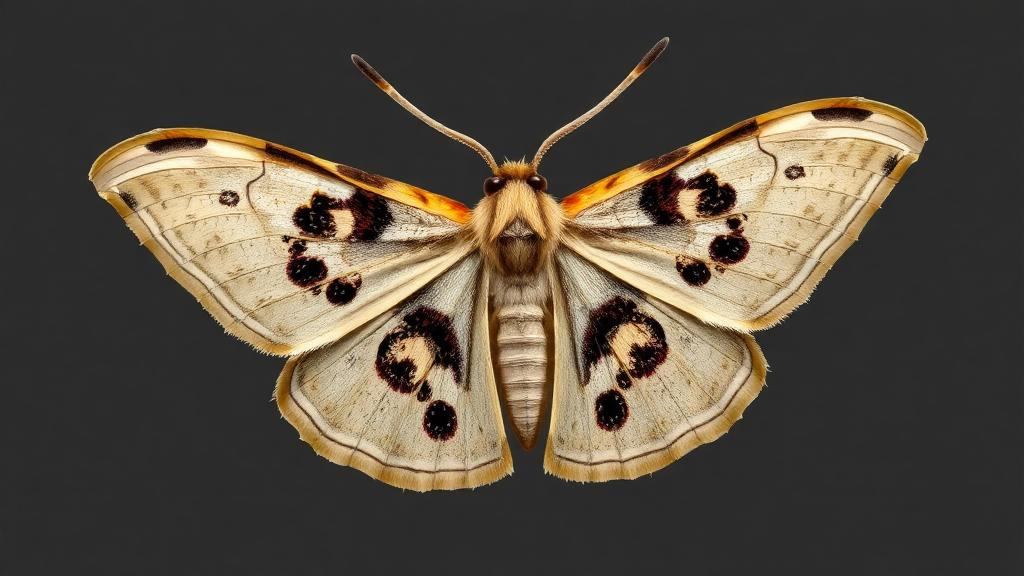
A new limacodid moth species, Striogyia simianshana , has been formally described from two male specimens collected at Simian Mountain in Chongqing Municipality, southwestern China. The species is distinguished from its Chinese relatives by a black, broken postmedial line on the forewing, differences in the antennae and abdominal coloration, and characteristic features of the male genitalia. The holotype and paratype were collected on 13 July 2019 and deposited in the collection of Northeast Forestry University in Harbin.
The description places S. simianshana in Striogyia , a genus erected by Holloway in 1986 with S. snelleni as its type species. Holloway also transferred S. foliola , originally described in Heterogenea , into the genus. He added S. spinosa in 1990, and Wu later described S. obatera from Guizhou in 2011 and S. acuta from Shaanxi in 2020.
Both specimens of the new species were collected at 28°34′55″N, 106°21′03″E using a 220-volt, 450-watt mercury light and a direct-current black light near a subtropical mixed forest. Only males were obtained, and the female remains unknown. The authors treated the two specimens as a new species because their external appearance, particularly the male genitalia, differed from other members of the genus.
The available material does not establish the species’ larval host plant because no immature specimens were collected, nor does it provide direct observations of female morphology. The adult S. simianshana has a forewing length of 10 millimetres and a wingspan of 22 millimetres. Its head is densely covered with greyish-white scales, its labial palpi are pale brown, and its filiform antennae are yellowish-brown.
The thorax is mainly grey, with a few greyish-brown scales and pale tegulae. The forewing has a greyish-brown base colour, with the base, costal margin and terminal areas darker and mixed with black spots. Its terminal line is dark brown, while the fringe ranges from greyish-white to dark brown.
The most conspicuous feature of the forewing is an oblique black postmedial line that is broken and runs from the apex to approximately one-third of the distance from the wing base along the posterior margin. This differs from S. obatera , which has an obvious pale-grey postmedial line extending from the apex to about three-quarters of the distance along the posterior margin. The male antenna of S. simianshana is long and slightly thicker than that of S. obatera , whose antenna is described as thin.
The new species also has a dark-brown posterior abdomen, whereas the posterior abdomen of S. obatera is yellow. Members of the genus are generally characterized by adult males with filiform antennae and an oblique postmedial line running almost from the forewing apex to the posterior margin. In the male genitalia, the uncus and gnathos are weak or absent, while the transtilla is well developed and strongly sclerotized.
These general characteristics are consistent with the placement of the Chongqing specimens in Striogyia . Its new-species diagnosis rests on the combination of its forewing pattern, antennae, abdominal coloration and detailed genital anatomy. In the male genitalia of S. simianshana , the uncus and gnathos are absent.
The tegumen is narrow and weakly sclerotized, and the valva is long, extremely narrow at its base and rounded at its apex. Part of the costa, extending halfway from the base of the valva, is weakly sclerotized and nearly transparent. The base of the sacculus is slightly raised and bears a small triangular process.
The transtilla is strongly sclerotized and carries a pair of long, ox-horn-shaped processes that curve outward and have broad bases. The juxta consists of a ring-shaped basal part that is wider than it is high and an apical part with three prongs. The vinculum is ring-shaped, the saccus is inconspicuous, and the phallus is slender and longer than the valva.
One side of the phallus apex forms a nearly triangular plate edged with small saw-toothed spines. The eighth sternite is slightly sclerotized, concave along its distal margin and covered with dense spines. These features provide the anatomical basis for the formal description and the comparison with other species of the genus.
The new species is most similar in external appearance to S. obatera , but the genital differences are also clear. The apical process of the juxta in S. obatera is chimney-shaped, whereas the corresponding structures in S. simianshana and S. acuta are pointed. The new moth also differs from S. acuta in having a broader, rounded valva apex, a pair of strongly outward-curved horn-shaped processes with broad bases, and a nearly triangular plate at the phallus apex.
In S. acuta , the valva is narrower, its processes curve outward only slightly and have narrow bases, and the phallus plate is almost rectangular. The study followed standard methods for measuring and dissecting the specimens. Wingspan was measured from forewing apex to forewing apex, while forewing length was measured from the wing base to the apex.
The specimens were photographed with a Nikon D700 camera. Images of the prepared genitalia slides were captured with an Olympus photomicroscope, aided by Helicon Focus software and further processed in Adobe Photoshop CS6. The observations and figures document the diagnostic features of the new species and its differences from S. obatera and S. acuta .
The collection site lies in the Simian Mountain Nature Reserve in southwestern Chongqing, where the climate is described as subtropical humid monsoon with abundant rainfall. The principal vegetation around the site includes tropical and subtropical coniferous and broad-leaved mixed forests. Named plants recorded near the collection area include Fagus longipetiolata , Castanopsis fargesii , Engelhardia roxburghiana and Fokienia hodginsii , along with several kinds of bamboo, shrubs and ferns in the ground cover.
The adult specimens were taken with light traps near this forest, and the available collection records place their flight in July. The description therefore establishes a collection-backed record for the species at one Chongqing locality while leaving its female, immature stages and larval host unknown.
Subject of Research: Taxonomic description of a new Striogyia moth species from Chongqing, China
Article Title: Description of Striogyia simianshana sp. nov. ( Lepidoptera , Limacodidae ) from Chongqing in southwest China
Article References: Wu, J., Wu, C.-S., & Han, H.-L. (2021). Description of Striogyia simianshana sp. nov. (Lepidoptera, Limacodidae) from Chongqing in southwest China. Nota Lepidopterologica, 44, 153-158. https://doi.org/10.3897/nl.44.64734
Image Credits: AI Generated
DOI: 10.3897/nl.44.64734
Keywords: new moth species, Striogyia simianshana, Limacodidae, Chongqing, Simian Mountain, male genitalia, taxonomic description, wing pattern, subtropical forest, China, Description, Striogyia
Cite Scienmag News
Gavin Prescott. (October 20, 2026). New Chongqing moth distinguished by wing pattern and genital anatomy. Scienmag. https://scienmag.com/new-chongqing-moth-distinguished-by-wing-pattern-and-genital-anatomy/
Gavin Prescott. "New Chongqing moth distinguished by wing pattern and genital anatomy." Scienmag, 20 October 2026, https://scienmag.com/new-chongqing-moth-distinguished-by-wing-pattern-and-genital-anatomy/. Accessed 20 October 2026.
Gavin Prescott. "New Chongqing moth distinguished by wing pattern and genital anatomy." Scienmag. October 20, 2026. https://scienmag.com/new-chongqing-moth-distinguished-by-wing-pattern-and-genital-anatomy/


