


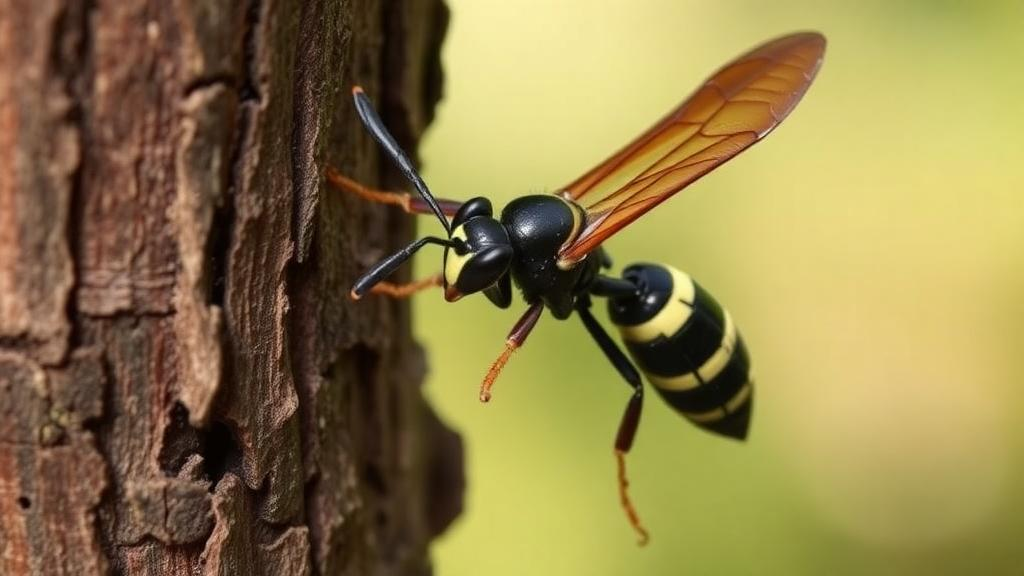
A field survey on Jeju Island, South Korea, identified Doggerella (Lelejobracon) chasanica as a larval parasitoid of Monochamus alternatus, establishing a new host record for the braconid wasp. Researchers reared the wasps from second- and third-instar M. alternatus larvae collected in pine trees affected by pine wilt disease. The parasitoid occurred at one of three surveyed sites during two consecutive sampling sessions in June and July 2019, attacking host larvae placed at heights from 2 to 8 metres.
Across the investigated sites, the average parasitism rate was 4.2%, and the maximum was 5.9%. The study documents a natural-enemy association but does not test whether the wasp can control M. alternatus populations or reduce pine wilt disease. Pine wilt disease is caused by the pine wood nematode, Bursaphelenchus xylophilus, which cannot move between pine trees on its own.
Monochamus beetles serve as vectors. Five Monochamus species have been recorded in East Asia, and two, M. alternatus and M. saltuarius, are known vectors in South Korea. M. alternatus is the more predominant vector on the Korean Peninsula and Jeju Island.
Its main food source is Pinus densiflora, the tree species occupying the largest forested area in South Korea and widely restored there since the 1970s. Pine wilt disease was first reported in South Korea from Busan in 1988 and on Jeju Island in 2004, and Jeju continued to report officially recognized damage in 2024. The investigation was the first study of natural enemies of M. alternatus on Jeju Island and combined field collection, parasitoid rearing, morphological examination and DNA barcoding.
The researchers selected three sites containing P. densiflora affected by pine wilt disease. They conducted three sessions at two-week intervals, from the fourth week of June through the third week of July 2019, a period corresponding to peak M. alternatus activity on the island. Fifteen sentinel logs were used in each session at each site, for 135 logs in total.
The sampled forests were natural, dominated by P. densiflora; the trees were 40 to 50 years old, had trunk diameters of 18 to 28 centimetres and had high crown density. Because female M. alternatus commonly lay eggs about six metres above the ground but may oviposit from ground level to approximately 12 metres, the team placed sentinel logs at several heights. At each site, three P. densiflora trees were selected about 20 metres apart.
Ropes, 340-gram sandbags and a 240-centimetre slingshot were used to lift the logs into the canopy, where they were attached at 0, 2, 4, 6 and 8 metres. Following the method described by Kim and colleagues, the investigators collected each log after two weeks, removed its bark gently in the laboratory and dissected the wood to inspect for M. alternatus larvae. The logs were kept moist and exposure to dry air was minimized to avoid killing parasitized hosts or their parasitoid larvae.
Unparasitized M. alternatus larvae were separated and preserved in 99% ethanol. The researchers inspected the parasitoid larvae daily and recorded their condition and eclosion dates. This approach yielded seven adult D. (L.) chasanica females, all from Site 2 and the first two sampling sessions.
The source lists five females collected from 17 June to 2 July and two from 1 to 16 July, and the adults were to be deposited in the Korea National Arboretum. No parasitoids were recovered from the third session or from the other two sites. Observation of the rearing process showed that D. (L.) chasanica is a solitary ectoparasitoid of M. alternatus.
Its larva develops externally on the beetle larva and later spins a cocoon close to the remains of the host. The attacked M. alternatus larvae were in the second or third instar and had an average head-capsule width of 1.6 ± 0.3 millimetres. At 25 °C, the parasitoid’s pupal stage lasted 11.6 ± 1.9 days.
The highest reported site-and-session parasitism rate was 5.9%, while the rate in the second sampling session at the collection site was 2.4%. The table identifies the calculation as the number of parasitized host larvae divided by the total number of host larvae, multiplied by 100. Species identification combined characters visible under stereomicroscopes with sequencing of a 658-base-pair mitochondrial cytochrome c oxidase subunit I, or COI, fragment.
Two COI barcodes were obtained from Korean specimens and were identical to one another. The researchers also redescribed the wasp and documented features not covered in earlier treatments. The reported body length was 2.6 millimetres, forewing length 2.8 millimetres, hind-wing length 2.2 millimetres and antenna length 2.1 millimetres.
The body was mostly polished black, with whitish to ivory setae, mostly brown antennae and legs, a brown pterostigma, mostly yellow mandibles, yellow tibial spurs and a slightly curved yellow ovipositor. The redescription placed particular emphasis on structures useful for taxonomic comparison, including the head, mesosoma, legs, wing venation and metasoma. The mesoscutum and scutellum were entirely polished, while the propodeum was smooth and polished and setose toward the front.
The first tergum was nearly rectangular and bore a Y-shaped, crenulate suture. In the fore wing, the pterostigma was 3.2 times as long as its width, the third radial cell reached the wing margin as a tubular vein, and the third cubital and medial veins also reached the margin as tubular veins. The hind-wing radial and medial veins were strongly developed but did not reach the margin.
The smooth, polished metasoma helps distinguish the subgenus Lelejobracon from Doggerella sensu stricto, whose recorded distribution is restricted to the Afrotropical region. The host record broadens the known hosts of D. (L.) chasanica, which had previously been described as an ectoparasitoid of the Asian longhorned beetle, Anoplophora glabripennis, in China. The Korean parasitism rates were close to the average of 4.0% and maximum of 5.9% reported previously for A. glabripennis.
Development was nevertheless faster on the Korean host: at 25 °C, pupation lasted 11.6 ± 1.9 days on M. alternatus, compared with 18 to 20 days on A. glabripennis in the earlier Chinese study. The researchers noted that the wasp attacked second- and third-instar M. alternatus, whereas female D. (L.) chasanica parasitized first-instar A. glabripennis in China. They proposed that this difference in host stage could contribute to the observed development-time difference, while noting that parasitoid quality can also vary with environmental conditions, host species and host stage.
These findings leave the biological-control implications unresolved. The parasitoid was found only at one of three sites, and no significant variation in parasitism was detected at the six-metre height commonly used by M. alternatus for oviposition compared with the other sampled heights. The authors said the small number of samples or limited parasitoid flight activity could explain that result, making additional sites and surveys necessary.
A. glabripennis occurs in Korea, but the parasitoid-host relationship has not been reported there, and genetic differences between Korean and Chinese A. glabripennis populations were proposed as one possible explanation. The study therefore establishes a new host record and baseline field measurements, rather than demonstrating that D. (L.) chasanica suppresses M. alternatus, limits pine wilt disease or is ready for operational deployment.
Subject of Research: First host record of the parasitoid wasp Doggerella chasanica attacking Monochamus alternatus larvae on Jeju Island, South Korea.
Article Title: New host record of Doggerella chasanica ( Hymenoptera , Braconidae , Braconinae ) as a larval parasitoid of the serious forest pest Monochamus alternatus ( Coleoptera , Cerambycidae ) in Korea
Article References: Kim, M.-S., Kim, I.-K., Sharkey, M., & Kang, I. (2025). New host record of Doggerella chasanica (Hymenoptera, Braconidae, Braconinae) as a larval parasitoid of the serious forest pest Monochamus alternatus (Coleoptera, Cerambycidae) in Korea. Journal of Hymenoptera Research, 98, 545-558. https://doi.org/10.3897/jhr.98.151974
Image Credits: AI Generated
Keywords: Doggerella chasanica, Monochamus alternatus, parasitoid wasp, pine wilt disease, pine wood nematode, new host record, Jeju Island, ectoparasitism, DNA barcoding, biological control, host, record
Cite Scienmag News
Gavin Prescott. (October 20, 2026). Parasitoid wasp recorded attacking pine wilt vector in Korea. Scienmag. https://scienmag.com/parasitoid-wasp-recorded-attacking-pine-wilt-vector-in-korea/
Gavin Prescott. "Parasitoid wasp recorded attacking pine wilt vector in Korea." Scienmag, 20 October 2026, https://scienmag.com/parasitoid-wasp-recorded-attacking-pine-wilt-vector-in-korea/. Accessed 20 October 2026.
Gavin Prescott. "Parasitoid wasp recorded attacking pine wilt vector in Korea." Scienmag. October 20, 2026. https://scienmag.com/parasitoid-wasp-recorded-attacking-pine-wilt-vector-in-korea/


