


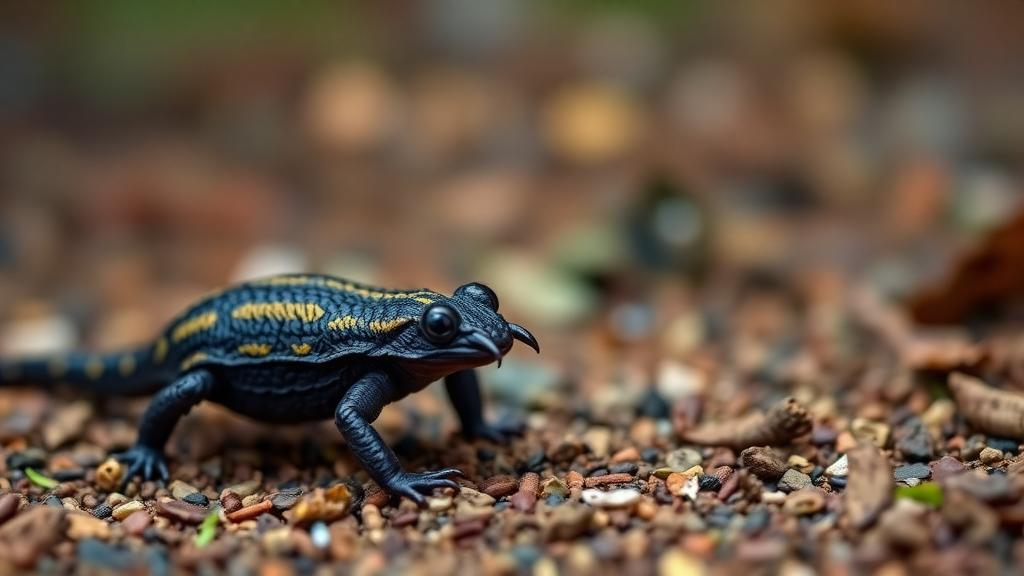
A comparative field study in southeastern Norway found that filtering water in which wild amphibians had been held detected the amphibian fungal pathogen Batrachochytrium dendrobatidis, or Bd, more consistently than sampling open pond water. A second experiment with common toad carcasses showed that gentle sampling with soft sandpaper also performed well, while conventional soft skin swabs frequently failed to yield a positive result even in toads known to be infected. The study compared several field and laboratory approaches, but its results apply to eight newt ponds and one toad population rather than establishing a universal testing protocol for amphibians.
Bd is a generalist fungal pathogen that lives in the keratinized skin of amphibians and spreads through aquatic zoospores. It has spread from its natural range in Asia to every continent inhabited by amphibians and is considered one of the pathogens contributing to global amphibian declines. Its effects differ among species and populations, and not every infected population undergoes an obvious decline.
Accurate detection is therefore important for establishing where Bd occurs and for comparing infected and apparently uninfected sites. A negative result from an insensitive method can classify a genuinely infected pond as uninfected and weaken subsequent analyses of population trends. The newt component of the study covered eight ponds south of Oslo that had been sampled for population monitoring since 2013.
Environmental DNA testing for Bd began in 2017, but results from the same ponds sometimes varied with the sample type used. Meaningful within-year comparisons were possible in 2018, 2023 and 2024, when researchers collected compatible samples during the same field seasons. Great crested newts and smooth newts were trapped along pond shorelines, and all captured animals were released after sampling.
A separate toad comparison used six fresh roadkill carcasses collected in April 2022 at a crossing in Nittedal, where the local population had previously been reported to have an 80% Bd prevalence. For pond-water sampling, researchers collected 15 subsamples of 0.2 litres at locations one to four metres apart and combined them into one mixed sample. This approach was intended to represent a pond more closely because environmental DNA can be unevenly distributed.
In 2018, 0.5 litres of mixed water was filtered through a 0.45-micrometre cellulose nitrate membrane. In later years, mixed water was filtered through 2.0-micrometre glass-fibre filters, which could process approximately 1 to 1.5 litres. During three May sampling periods in 2024, duplicate sets of both filter types were tested.
Field negative controls and technical controls did not amplify Bd DNA, providing no evidence of contamination in those samples. The 2024 filter comparison produced 94% positive qPCR results for the 0.45-micrometre filters and 77% for the 2.0-micrometre filters, although the difference was not statistically significant (t = 0.49, p = 0.62). The amount of DNA placed into the reaction nevertheless affected results for the finer filters: 5 nanograms of input produced a signal 1.3 cycles earlier than 1 nanogram (t = 2.52, p = 0.013).
Pond 8 provided a different pattern. There, the 2.0-micrometre filter yielded signals 2.04 cycles earlier at 1 nanogram of input (t = 3.53, p < 0.01) and 1.80 cycles earlier at 5 nanograms (t = 2.46, p = 0.017). Those values indicated higher Bd DNA concentrations in the larger-pore filter when detection succeeded, even though the finer filter had produced more positive reactions overall.
Detection in open water also varied among the three spring sampling dates in 2024. Ponds 7 and 8 had their highest Bd concentrations at the first visit, but each subsequent visit detected Bd in one additional pond, and the concentration in pond 6 increased over the two-week period. Ponds 1 and 2 produced an occasional positive water result at one sampling time.
These observations do not establish why detection changed: the three dates provided insufficient temporal resolution for statistical separation of seasonal patterns from other variation, and the study lacked continuous pond-specific temperature data. Longer seasonal sampling would be needed to determine how temperature and other temporal factors relate to Bd DNA in pond water. Amphibian-based samples often proved more informative than mixed pond water.
Among great crested newts, the proportion of positive swabs ranged from 50% under a strict threshold of at least three positive droplets to 90% when samples with one or two droplets were included. For smooth newts, all five ponds yielded at least one or two positive droplets, but only one pond met the stricter threshold. By comparison, the 0.45-micrometre mixed-water filters produced two unequivocally positive ponds, ponds 7 and 8, while pond 4 was weakly positive.
These comparisons were limited to the five ponds sampled with both methods in 2018, and the source material does not report a seasonal or host-dependent release mechanism for the observed differences. The 2023 comparisons included mixed pond water, bathwater from captured newts and collective swab samples from three ponds. Mixed water identified ponds 6, 7 and 8 as positive, although pond 7 produced only one positive reaction among six qPCRs using 1 nanogram of DNA input.
Pond 6 was detected for the first time, with five of six reactions positive. Across the five sample types examined from ponds 6, 7 and 8, extracted DNA concentrations ranged from 33.94 nanograms in a great crested newt swab sample to 2,456 nanograms in smooth newt bathwater. Concentrations of extracted DNA did not predict whether Bd was detected in the qPCR reactions, indicating that a larger total DNA yield did not by itself provide a detection advantage in these comparisons.
The toad experiment compared filtered bathwater, soft sandpaper, webbed skin and soft swabs. Each carcass was placed in 0.5 litres of pond water for 10 to 15 minutes, after which the bathwater was filtered. All six toads were positive for Bd, with at least 52% of their qPCR reactions positive.
Bathwater, soft sandpaper and webbed-skin samples all tested positive in every individual when 5 nanograms of DNA were used. At 1 nanogram of input, only one of 18 reactions from bathwater and soft sandpaper was negative, whereas seven of 18 webbed-skin reactions were negative. Soft swabs performed less consistently: dry swabs gave positive signals in 9.5% of reactions at 1 nanogram and 50% at 5 nanograms, while swabs stored in buffer were positive in 3.5% and 48.2% of reactions, respectively.
Bathwater produced the highest average Bd signal in the toad samples, with mean qPCR cycle values of 32.2 using 5 nanograms of DNA and 34.3 using 1 nanogram. At the higher input, bathwater differed significantly from soft sandpaper, webbed skin and combined soft swabs, with p values of 0.027, 0.022 and less than 0.01. Bathwater and soft sandpaper did not differ significantly at 1 nanogram (p = 0.3).
The results do not establish a precise mechanism for the poor performance of toad swabs. The animals had recently emerged from hibernation, and their swabs contained brownish debris, whereas the newt swabs came from wet animals captured directly from ponds. Soft sandpaper was tested only on the larger toads, not on the more delicate newts, so its performance in newt populations remains uncertain.
On the basis of these comparisons, the researchers identified filtering amphibian bathwater as the most economical method for determining the Bd status of a pond: capture local animals, hold them in water for about 10 to 15 minutes and filter the water. Where that procedure is not feasible, the toad results indicate that soft sandpaper can provide a straightforward alternative, although it was not tested on newts. Several swabs or sandpaper samples can also be pooled for a site-level screen, after which resources can be directed to more detailed prevalence work at confirmed positive ponds.
If only open water is sampled, the findings support using multiple filter pore sizes and testing replicated DNA inputs to reduce the risk of missing weak or inhibited signals. The monitoring data did not provide evidence of a clear short-term population decline that could confidently be attributed to Bd. Catch per unit effort from 2013 to 2024 showed smooth newt numbers increasing in most ponds during the final five years, while great crested newts were scarce and intermittently recorded.
Pond 8 maintained a relatively stable great crested newt population. The researchers did not statistically compare population sizes between infected and uninfected ponds because the study included only eight ponds, infection classifications were uncertain, and amphibian abundance varied naturally. The results therefore concern the reliability of detecting Bd in wild amphibians, not proof of population-level effects, and they reinforce the need for accurate infection surveys before infected and apparently uninfected sites are compared in ecological models.
Subject of Research: Comparison of field sampling methods for detecting Batrachochytrium dendrobatidis DNA in wild amphibians
Article Title: Comparing sampling protocols and results to better detect the amphibian fungal parasite Batrachochytrium dendrobatidis in the wild
Article References: Taugbøl, A. (2025). Comparing sampling protocols and results to better detect the amphibian fungal parasite Batrachochytrium dendrobatidis in the wild. NeoBiota, 104, 73-93. https://doi.org/10.3897/neobiota.104.160230
Image Credits: AI Generated
DOI: 10.3897/neobiota.104.160230
Keywords: chytrid fungus, Batrachochytrium dendrobatidis, amphibian disease, environmental DNA, field sampling, newts, common toads, wildlife surveillance, false negatives, Norway, Comparing, sampling
Cite Scienmag News
Margaret Porter. (October 20, 2026). Comparing sampling protocols for detecting Batrachochytrium dendrobatidis in the wild. Scienmag. https://scienmag.com/comparing-sampling-protocols-for-detecting-batrachochytrium-dendrobatidis-in-the-wild/
Margaret Porter. "Comparing sampling protocols for detecting Batrachochytrium dendrobatidis in the wild." Scienmag, 20 October 2026, https://scienmag.com/comparing-sampling-protocols-for-detecting-batrachochytrium-dendrobatidis-in-the-wild/. Accessed 20 October 2026.
Margaret Porter. "Comparing sampling protocols for detecting Batrachochytrium dendrobatidis in the wild." Scienmag. October 20, 2026. https://scienmag.com/comparing-sampling-protocols-for-detecting-batrachochytrium-dendrobatidis-in-the-wild/


