

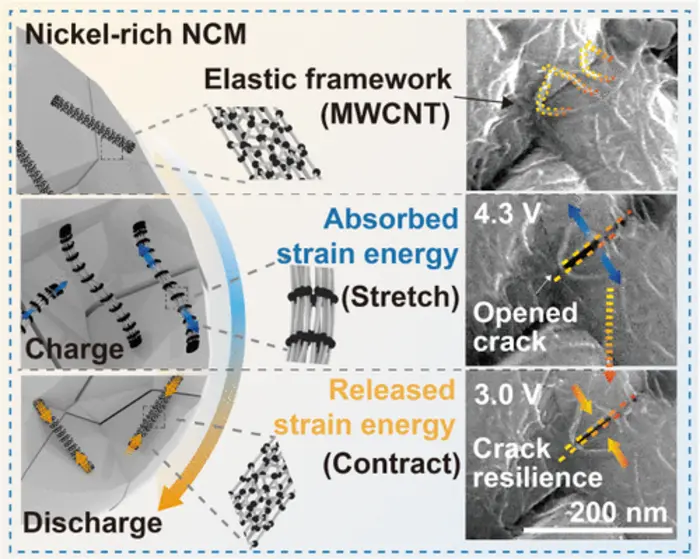
A revolutionary breakthrough in electric vehicle (EV) battery technology has emerged from a collaborative research initiative led by Professor Kyu-Young Park at POSTECH, the Pohang University of Science and Technology. This groundbreaking study, which saw contributions from Samsung SDI, Northwestern University, and Chung-Ang University, addresses a critical need in the field of energy storage systems—enhancing the durability and energy density of lithium-ion batteries used in EVs. The findings of this research have been published in the esteemed journal, ACS Nano, marking a significant step forward in battery technology.
The challenges faced by lithium-ion batteries during their operational life largely stem from the repetitive cycles of charging and discharging. As these batteries function, their cathode active materials are subjected to expansion and contraction. Over time, this mechanical strain leads to the development of microscopic cracks within the battery structure, which ultimately culminates in a noticeable decline in battery performance. Traditional methods to remedy this issue, such as increasing the strength of cathode materials or introducing reinforcement dopants, have not proven to be comprehensive solutions.
What sets this research apart is the innovative approach taken by the team, specifically the introduction of a ‘nano-spring coating’ technology that employs elastic structures at the nanoscale. This technology relies on multi-walled carbon nanotubes (MWCNTs) meticulously applied to the surface of battery electrode materials. The addition of these nanoscale materials absorbs the strain energy generated throughout the charging and discharging cycles. By mitigating the impact of mechanical stress, this coating effectively prevents cracks from forming, thereby preserving the integrity and stability of the battery.
The research team’s experiments have revealed that this pioneering technology significantly minimizes the thickness changes within the electrodes, enhancing overall stability and lifespan. With the use of just a small quantity of conductive material—around 0.5 weight percent—the team successfully realized an astonishing energy density of 570 Wh/kg or greater. This energy density is not only impressive but also critical for the viability and appeal of EVs in an increasingly competitive market.
Complementing the high energy density achieved by utilizing the nano-spring technology, the researchers have demonstrated excellent longevity for the batteries, with the ability to maintain 78% of their initial capacity even after 1,000 charge and discharge cycles. This level of performance is particularly noteworthy given the typical degradation rates observed in standard lithium-ion batteries, where capacity loss can be significant after repeated use.
What truly highlights the significance of this breakthrough is its compatibility with existing battery manufacturing processes, which paves the way for mass production and commercialization. This ease of integration into current manufacturing frameworks is a crucial aspect that may facilitate rapid adoption of the new technology by industry stakeholders. The potential implications extend beyond just improved battery performance; they could transform the landscape of electric vehicles, making them more efficient and durable than ever before.
The implications of this research are vast, reaching not just consumers in the EV market, but also industries that require high-performance battery solutions in various capacities. Professor Kyu-Young Park expressed excitement regarding the research outcomes, noting that this novel approach successfully addresses battery performance degradation during use. He emphasized that the findings could be widely applied across multiple sectors, particularly in fields where material resilience is paramount.
The impact of this study is underscored by the collaborative efforts and financial support received from Samsung SDI, the Ministry of Trade, Industry and Energy, and the basic research funding from the Ministry of Science and ICT. Such partnerships highlight the synergy between academia and industry, fostering innovations that could redefine technological boundaries and enhance sustainability.
In summary, the research led by POSTECH signifies a critical advancement in the field of battery technology, particularly relevant to the burgeoning electric vehicle sector. As manufacturers and consumers alike seek more reliable and longer-lasting energy solutions, the implementation of nano-spring coating technology could herald a new era of electric vehicle performance. The resulting enhancements to energy density and lifespan of lithium-ion batteries serve not only to boost the industry’s offerings but also to reassure consumers about the longevity and efficacy of electric vehicles.
The publication of this research offers a beacon of hope amidst the ongoing challenges faced by battery technology. As the automotive sector shifts increasingly towards electrification, innovations such as these will be crucial in driving consumer acceptance and adoption of electric vehicles. The effects of this advancement may soon ripple across various industries, revamping not just how we think about transportation, but also how we harness energy in our everyday lives.
This pioneering work stands as a testament to what can be achieved through interdisciplinary collaboration, where diverse expertise converges to solve pressing global issues. As society continues to navigate the challenges of environmental sustainability, such advancements in battery technology will be indispensable in shaping a future powered by clean energy solutions.
Cite this news
SCIENMAG. (March 13, 2025). Revolutionary Nano-Spring Technology Enhances Battery Longevity and Energy Density. https://scienmag.com/revolutionary-nano-spring-technology-enhances-battery-longevity-and-energy-density/
SCIENMAG. "Revolutionary Nano-Spring Technology Enhances Battery Longevity and Energy Density." Scienmag, 13 March 2025, https://scienmag.com/revolutionary-nano-spring-technology-enhances-battery-longevity-and-energy-density/. Accessed 28 August 2026.
SCIENMAG. "Revolutionary Nano-Spring Technology Enhances Battery Longevity and Energy Density." Scienmag. March 13, 2025. https://scienmag.com/revolutionary-nano-spring-technology-enhances-battery-longevity-and-energy-density/


