


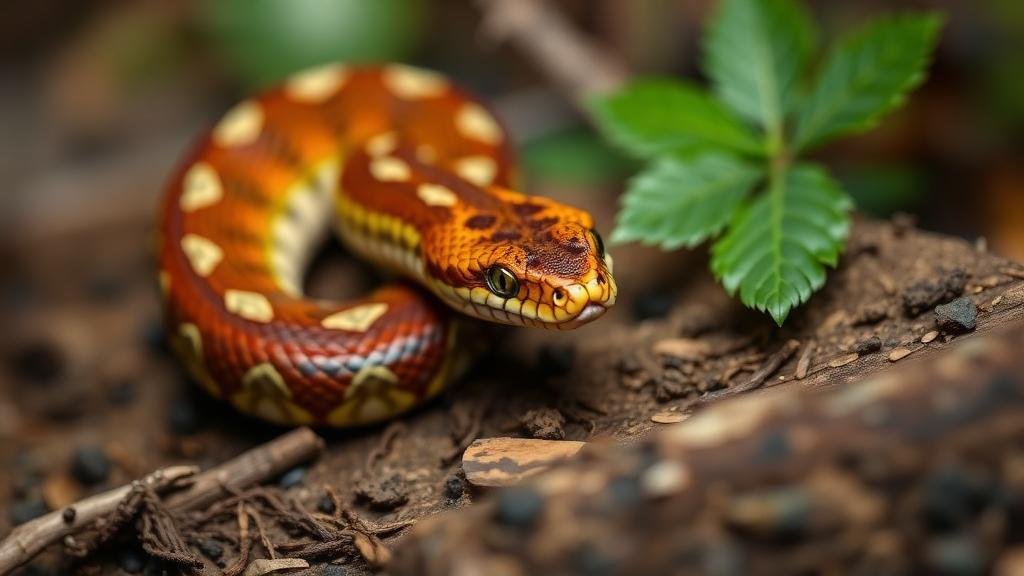
A small snake crossing a road in southeastern Yunnan has helped uncover a species that scientists did not know existed. Researchers examining three specimens from Malipo County identified them as a new member of the Hebius atemporalis complex, a group of non-venomous keelback snakes whose members can be nearly impossible to distinguish by appearance alone. The new species, formally named Hebius yangi, combines distinctive proportions and scale counts with genetic separation of 6.0–7.8% from close relatives, suggesting that the biodiversity of East and Southeast Asian keelbacks remains substantially underestimated.
The discovery, reported in ZooKeys, is an example of how a combination of close observation and modern genetic analysis can expose biodiversity hidden within a familiar-looking animal. The three snakes were collected in 2025 from Xiajinchang Township at an elevation of 1,450 metres. One was found crossing the road during the day, while the other two were recovered as roadkill, one largely intact and the other badly flattened and dried. All were preserved in approximately 70% ethanol and deposited at the Kunming Natural History Museum of Zoology in the Kunming Institute of Zoology, Chinese Academy of Sciences.
Hebius is the most species-rich lineage within the natricid snake family, with its diversity still poorly resolved. Its members are generally small to medium-sized, non-venomous and often associated with water, but the species in the H. atemporalis complex appear to be more terrestrial than many of their relatives. H. yangi was found beside evergreen broad-leaved forest and farmland, with no nearby stream or pond, challenging the common assumption that these snakes depend on aquatic prey such as fish, frogs or tadpoles.
The new snake is relatively small and slender. The three specimens measured 237–306 millimetres in snout–vent length, meaning the distance from the tip of the snout to the rear of the body, excluding the tail. Their total lengths ranged from 355 to 449 millimetres. Tail length accounted for 32–33% of total length, making the tail moderately long and proportionally more substantial than in H. malnatei, another close member of the complex. The body carried 17 dorsal scale rows at midbody, with all but the outermost row keeled, while the underside had 130–131 ventral scales and 80–85 paired subcaudal scales.
Details of the head provide further clues. Each side has six upper lip scales, with the third and fourth entering the orbit, as well as seven lower lip scales, one preocular, two postoculars and a small anterior temporal scale. The mouth contains 32–34 maxillary teeth, gradually enlarged toward the rear and separated by no diastema. In life, the holotype has a grayish-brown to blackish-brown back, a brownish-gray iris and alternating black-and-white markings along the lips. Small orange spots form neat rows along both sides of the body, while a light orange neck collar is broken in the middle.
Those details separate H. yangi from H. atemporalis sensu stricto, the name applied to populations in northern Vietnam. The new species has more subcaudal scales, 80–85 compared with 63–79, and a larger combined total of ventral and subcaudal scales, 210–215 compared with 198–209. It also has seven lower lip scales rather than usually six, more maxillary teeth, a brownish-gray rather than copper-colored iris, a brown rather than brownish-red anterior body, and a discontinuous instead of continuous neck collar. Only one row of smooth dorsal scales occurs on each side of the anterior body, compared with three to six rows in H. atemporalis.
Genetic evidence independently supports the morphological diagnosis. The researchers amplified and sequenced a 1,106-base-pair fragment of the mitochondrial cytochrome b gene, producing an alignment of 1,108 base pairs. Bayesian inference and maximum-likelihood analysis placed the Malipo specimens together as a strongly supported branch within the H. atemporalis complex. The branch received a Bayesian posterior probability of 1.00 and 95% maximum-likelihood ultrafast bootstrap support, indicating that the genetic result was not an artifact of one analytical method. Uncorrected sequence distances were 7.6% from H. atemporalis from northern Vietnam, 6.0% from central-southern Chinese populations provisionally called H. cf. atemporalis, and 7.8% from H. malnatei in southwestern China.
Because the three Malipo snakes agreed in both anatomy and genetics, the authors considered them one new species rather than several. They named it after the late Chinese herpetological taxonomist Datong Yang, proposing the English common name “Yang’s Keelback” and the Chinese name “杨氏腹链蛇.” The type locality lies in southeastern Yunnan, and the species is currently known only from Malipo County in Wenshan Prefecture. The known range therefore remains very small, even though local villagers reportedly encounter the snake frequently at the discovery site.
The new species also complicates the wider taxonomy of the complex. A recent integrative revision treated populations in northern Vietnam and central-southern China as H. atemporalis while describing H. malnatei from central-eastern Yunnan and western Guizhou. The new study argues that the central-southern Chinese populations show enough genetic and morphological divergence to represent one or possibly several species separate from H. atemporalis. Re-examination of three older museum specimens produced a more complicated picture: one from Menglian County was assigned to H. malnatei, while two from Hekou and Pingbian were judged to belong to H. atemporalis sensu stricto. Records assigned to H. atemporalis in other regions therefore require renewed scrutiny.
Conservation questions remain open. H. yangi may be locally abundant, but villagers’ reports of frequent encounters do not establish that its broader population is secure. Its known habitat includes extensive forest as well as farmland, where agricultural production and pesticide use could affect local populations. Its diet is also unverified. Although the authors suspect that the snake feeds on earthworms, as known for H. malnatei, they did not observe predation; abundant earthworms near the discovery area provide only partial support for that hypothesis. More extensive fieldwork is needed to map the species’ true distribution, establish its population trend and determine how it moves through the landscape between forest patches and agricultural habitats.
Even before H. yangi was described, 23 species of Hebius had been recorded in Yunnan, a province known for exceptional biological richness. The discovery raises that documented total to 24, but the authors caution that the real number is probably much higher. Their conclusion carries a broader implication: many “well-known” snakes may still be hiding multiple species behind similar body plans, subdued colors and overlapping scale patterns. For a group that is generally overlooked because its members are small, harmless and superficially uniform, DNA sequencing, specimen re-examination and patient attention to roadside encounters are revealing an unexpected world of evolutionary distinction beneath an unchanging exterior.
Subject of Research: Taxonomic discovery of a new Hebius keelback snake species in southeastern Yunnan, China, supported by morphological and mitochondrial DNA evidence.
Article Title: A new species of the Hebius atemporalis complex ( Squamata , Natricidae ) from southeastern Yunnan, China
Article References: Liu, S., Wang, J., Hou, M., Deng, T., Zhang, C., Wang, M., & Rao, D. (2026). A new species of the Hebius atemporalis complex (Squamata, Natricidae) from southeastern Yunnan, China. ZooKeys, 1289, 141-157. https://doi.org/10.3897/zookeys.1289.189681
Image Credits: AI Generated
DOI: 10.3897/zookeys.1289.189681
Keywords: new snake species, Hebius yangi, keelback snake, Yunnan biodiversity, cryptic species, mitochondrial DNA, species delimitation, reptile taxonomy, conservation, southeastern China, species, Hebius
Cite Scienmag News
Margaret Porter. (October 19, 2026). New Yunnan keelback snake reveals hidden biodiversity hotspot. Scienmag. https://scienmag.com/new-yunnan-keelback-snake-reveals-hidden-biodiversity-hotspot/
Margaret Porter. "New Yunnan keelback snake reveals hidden biodiversity hotspot." Scienmag, 19 October 2026, https://scienmag.com/new-yunnan-keelback-snake-reveals-hidden-biodiversity-hotspot/. Accessed 19 October 2026.
Margaret Porter. "New Yunnan keelback snake reveals hidden biodiversity hotspot." Scienmag. October 19, 2026. https://scienmag.com/new-yunnan-keelback-snake-reveals-hidden-biodiversity-hotspot/


