


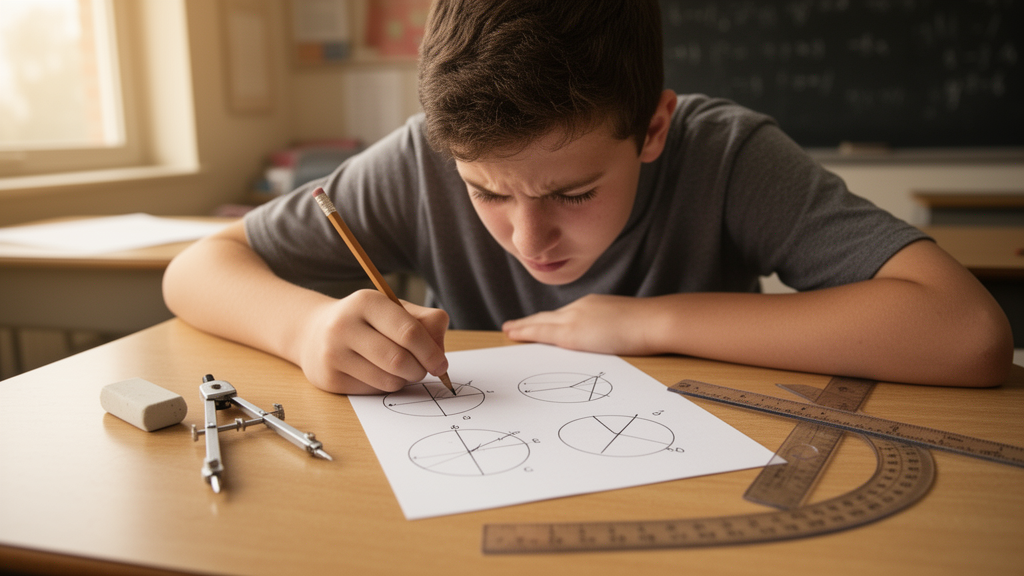
Circle theorems occupy a curious position in secondary school mathematics. They are elegant, compact statements about angles, chords, tangents, and arcs, yet for many students they remain among the most intimidating topics on the syllabus. A new study published in Frontiers in Education by Bright Asare, Ebenezer Owusu, and Ebenezer Kwesi Lotey of Akenten Appiah-Menka University of Skills Training and Entrepreneurial Development in Kumasi, Ghana, has now mapped exactly where students go wrong when tackling these problems, using a decades-old diagnostic framework known as Newman’s Error Analysis. The results offer a detailed picture of how geometric reasoning breaks down, and they suggest that the biggest obstacles are not failures of memory but failures of translation and execution.
The research team worked with Form Two students at a single senior high technical school in Ghana, a population of 100 students from which 80 were selected by simple random sampling using Yamane’s formula with a 0.05 margin of error. The participants, whose average age was about 17 years, had already completed instruction on circle theorems, making them ideal candidates for revealing the difficulties that persist after formal teaching. From this group, five low-performing students were later purposively selected for individual interviews to explain, in their own words, what had gone wrong in their written solutions.
The quantitative backbone of the study was a Circle Theorem Achievement Test consisting of six open-ended questions drawn from past examination papers and researcher-designed items. Before deployment, the test was vetted by three experienced senior high school mathematics teachers for clarity and relevance, and then piloted with 30 students from a different school. The pilot yielded a split-half reliability coefficient of 0.802, indicating good internal consistency. Students sat the test under uniform classroom conditions and were instructed to show all their working, a crucial requirement because the entire analysis depended on tracing the path of reasoning from the first line to the final answer.
Newman’s Error Hierarchical Model, first proposed by M. A. Newman in 1977, classifies student errors into five sequential stages: reading, comprehension, transformation, process skills, and encoding. Reading errors occur when a student misreads the question, a diagram, or a symbol. Comprehension errors arise when the student understands the words but not the mathematical relationships they describe. Transformation errors appear when the student grasps the problem but selects the wrong theorem, formula, or strategy to convert the given information into a workable mathematical form. Process skill errors happen during execution, when the right approach is chosen but arithmetic, algebra, or procedural steps go awry. Encoding errors, the final category, occur when correct reasoning produces an incorrectly recorded or improperly formatted answer.
To ensure that this classification was applied consistently, the researchers developed an operational coding rubric specifying observable indicators for each error category, such as misreading an angle measure, selecting an inappropriate circle theorem, or omitting required units. Two expert raters independently coded a sample of scripts, and the agreement between them, measured by Cohen’s kappa, reached 0.85, well above the commonly accepted threshold of 0.70 for educational research. After discussing and resolving discrepancies, the raters coded the remaining scripts. In total, 259 errors were identified across the six test items.
The distribution of those errors was striking. Transformation errors dominated, accounting for 39.38 percent of all coded errors, or 102 instances. Process skill errors followed closely at 35.14 percent, with 91 instances. Comprehension errors ranked third at 15.83 percent, reading errors fourth at 6.56 percent, and encoding errors last at 3.09 percent. In other words, nearly three-quarters of all mistakes occurred at the two middle stages of problem-solving: choosing the right mathematical route and then walking it correctly. Students were far less likely to fail at the very beginning, by misreading a question, or at the very end, by botching the final answer.
The test items themselves told a parallel story. Item 2 proved the most challenging, with only 2.5 percent of students answering correctly, 72.5 percent answering incorrectly, and a full quarter not attempting it at all. Item 5, by contrast, was the most successfully answered, with 77.5 percent correct responses. Items 1, 3, 4, and 6 fell in between, with correct response rates ranging from roughly 26 to 37 percent. These figures echo the examiners’ reports for the West African Senior School Certificate Examination from 2021 to 2023, which recorded error rates on circle theorem questions of roughly 30 to 40 percent, gradually declining as instructional strategies and practice improved.
The qualitative interviews added texture to these numbers and revealed the cognitive and environmental factors students themselves identified. One student explained that transformation errors stemmed from an inability to picture how angles related inside a complex diagram: when a circle contained too many lines and markings, the student became confused about which points to use, even while knowing some of the theorems. Another described the crushing cognitive load of multi-step problems, recalling the theorem that the angle at the center is twice the angle at the circumference but then losing track of the subsequent additions and subtractions of angles. A third attributed comprehension failures to teacher-centered instruction, in which theorems were written on the board, a few examples were worked through, and students were left to apply them alone, an experience the student described as leaving the material permanently opaque.
Other accounts pointed to more mundane but equally consequential factors. One student admitted to rushing through questions out of fear that time would run out, leading to misread details such as treating a labeled point of intersection as the center of the circle. Another confessed to guessing when unfamiliar terminology appeared. Encoding errors, though rare, were traced to carelessness at the finish line: one student solved a problem correctly but failed to round the answer to two decimal places as instructed, while another’s illegible handwriting made it impossible to tell which letters had been written. These accounts, the authors caution, represent the perceptions of five selected individuals and should not be generalized to the entire sample, but they align closely with the error patterns visible in the written work.
The implications for teaching are concrete. Because transformation errors loom largest, the authors argue that instruction should give students far more opportunities to interpret diagrams and explicitly connect visual information with symbolic relationships, possibly through dynamic geometry software such as GeoGebra, which prior research has linked to improved understanding of circle theorems. The high rate of process skill errors suggests that scaffolded, guided practice in managing multi-step reasoning could build fluency. The interview findings on teacher-centered instruction and limited practice point toward inquiry-based approaches and varied problem sets. The study’s limitations are acknowledged: it involved one school, 80 students, and only five interviewees selected for low performance, so the findings are context-bound rather than universal. Still, by pinpointing exactly where the chain of geometric reasoning snaps, the research offers teachers a diagnostic map, and a reminder that the hardest part of a circle theorem problem is rarely remembering the theorem itself.
Subject of Research: Error analysis of senior high school students' mistakes in solving circle theorem problems using Newman's Error Analysis Model
Article Title: Using Newman's error analysis model to analyze the errors of senior high school students in solving circle theorem problems
Article References: Asare, B., Owusu, E., & Lotey, E. K. (2026). Using Newman's error analysis model to analyze the errors of senior high school students in solving circle theorem problems. Frontiers in Education, 11, Article 1875952. https://doi.org/10.3389/feduc.2026.1875952
Image Credits: AI Generated
DOI: 10.3389/feduc.2026.1875952
Keywords: circle theorems, Newman's Error Analysis, mathematics education, geometry, error analysis, Ghana, senior high school, mixed-methods research, transformation errors, process skill errors, STEM education, problem-solving
Cite Scienmag News
Reid Dalton. (October 19, 2026). Why Students Stumble on Circle Theorems: A New Error Analysis Reveals the Pattern. Scienmag. https://scienmag.com/why-students-stumble-on-circle-theorems-a-new-error-analysis-reveals-the-pattern/
Reid Dalton. "Why Students Stumble on Circle Theorems: A New Error Analysis Reveals the Pattern." Scienmag, 19 October 2026, https://scienmag.com/why-students-stumble-on-circle-theorems-a-new-error-analysis-reveals-the-pattern/. Accessed 19 October 2026.
Reid Dalton. "Why Students Stumble on Circle Theorems: A New Error Analysis Reveals the Pattern." Scienmag. October 19, 2026. https://scienmag.com/why-students-stumble-on-circle-theorems-a-new-error-analysis-reveals-the-pattern/


