


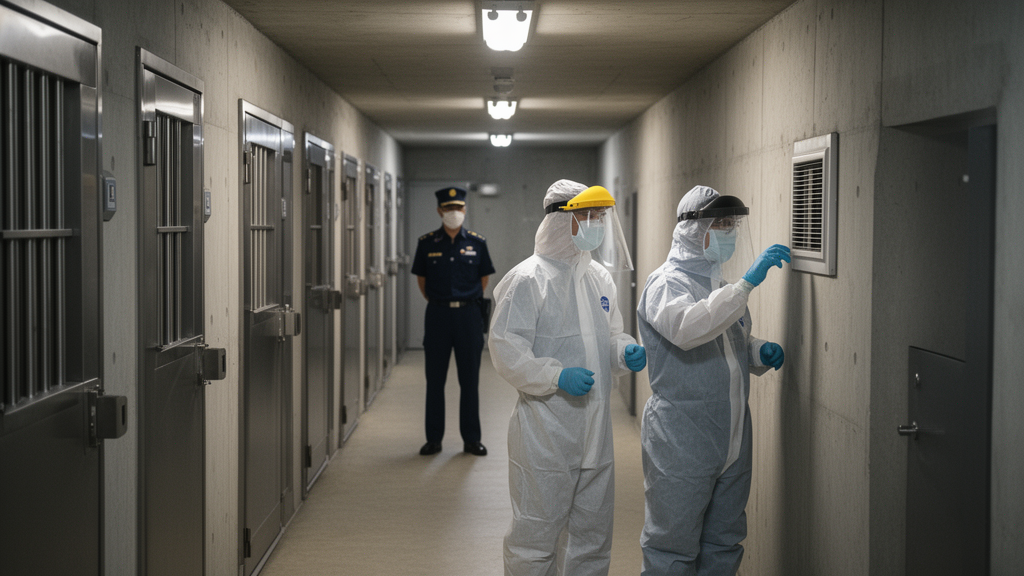
When the highly transmissible Omicron variant slipped into a high-rise detention center in Seoul in January 2022, it found nearly ideal conditions for spread: hundreds of people living in close quarters, shared air across floors, limited room to isolate the sick, and a population that could not simply shelter in place. A retrospective outbreak investigation now published in BMC Infectious Diseases by researchers from the Korea Disease Control and Prevention Agency and Seoul National University College of Medicine reconstructs, floor by floor and day by day, exactly how the virus moved through the facility — and how a rapid, multi-layered response brought it under control within roughly one month.
The investigation identified 492 confirmed COVID-19 cases during the outbreak, which ran from January to March 2022. Of these, 474 were inmates and 18 were staff members. Laboratory and epidemiologic data indicated that the Omicron variant was the predominant strain responsible. The cumulative attack rate among the facility’s 1,977 inmates reached 24.0 percent, meaning nearly one in four people in custody was infected over the course of the outbreak. Five inmates required hospitalization, but no deaths were reported — an outcome the investigators attribute in part to the relatively low severity of Omicron infections combined with the protective effect of vaccination.
What makes this study particularly valuable to viral outbreak science is its spatiotemporal granularity. Rather than treating the detention center as a single unit, the researchers mapped cases at the building and floor levels, revealing how transmission clustered in specific wards. The highest ward-level attack rate occurred on the 7th floor of Building 4, where the proportion of infected residents climbed from 54.7 percent (29 of 53) at the start of the outbreak to 88.7 percent (47 of 53) by its end. This pattern — a single floor nearly saturated with infection while other areas remained relatively spared — illustrates how respiratory viruses exploit crowding and shared environments in vertical facilities.
Epidemiologic reconstruction, supported by supplementary transmission-dynamics schematics, traces the probable primary Omicron case to the 12th floor of Building 3 on January 22, 2022 — designated Day 1 of the outbreak timeline. That individual was subsequently relocated to the 7th floor of Building 4, from which additional transmission cases emerged. Two epidemiologically linked Delta cases were identified on the 11th floor of Building 4 on Day 4, indicating that more than one variant circulated within the facility. The investigators used documented inmate movements, inferred horizontal transmission within the same floor, inferred inter-floor transmission within the same building, and contact opportunities identified through person-based investigation to build the most plausible reconstruction of how the virus spread — while cautioning that these pathways represent epidemiologic inference rather than phylogenetically confirmed transmission chains.
Beyond mapping the outbreak’s geography, the study offers a rare quantitative estimate of vaccine effectiveness in a detention setting. Using a modified Poisson regression adjusted for sex, age, prior infection, and proximity to confirmed cases, the researchers found that receipt of a booster dose was associated with an adjusted vaccine effectiveness against infection of 23.5 percent (95 percent confidence interval, 3.8 to 39.1 percent) compared with no vaccination. While this figure is modest — reflecting both the real-world challenge of preventing Omicron infection and the constraints of an exploratory analysis — it still suggests that boosters provided some measurable protection in a population where physical distancing was impossible.
The control strategy that ultimately contained the outbreak was not a single measure but a layered combination of interventions. Investigators documented modified lockdowns, contact tracing, mass and targeted testing, and de-densification of housing units as the principal tools deployed. Together, these measures helped bring the outbreak under control within approximately one month of its onset. The speed of the response matters: in a facility where the basic reproduction number of Omicron is amplified by crowding, delaying even a few days can allow the virus to seed multiple floors before controls take hold.
The findings carry weight beyond this single facility. Correctional settings worldwide share the structural vulnerabilities documented here — crowding, shared spaces, limited isolation capacity, and frequent population movement — yet evidence from high-rise detention facilities has been sparse. By quantifying attack rates at the ward level and estimating vaccine effectiveness in a real-world outbreak, the study fills a gap in the literature on respiratory virus control in confinement. It also demonstrates that even in environments where individual behavior change is constrained, institutional interventions can meaningfully alter transmission dynamics.
Methodologically, the investigation drew on demographic, clinical, and vaccination data obtained from interviews, detention records, and national registries. The researchers estimated attack rates at both the floor and building levels, then used exploratory vaccine effectiveness modeling to assess whether booster vaccination modified infection risk. The study was reviewed and approved by the Institutional Review Board of the Korea Disease Control and Prevention Agency, with the requirement for written informed consent waived because the retrospective analysis used anonymized and de-identified records. The authors declare no competing interests, and the research received no specific grant from any funding agency.
For outbreak scientists and public health officials, the Seoul detention center investigation offers a concrete template. It shows that in vertical confinement facilities, crowding and shared environments can accelerate SARS-CoV-2 spread to the point where individual wards approach saturation. But it also demonstrates that early, intensive, multi-layered interventions — modified lockdowns, contact tracing, mass and targeted testing, de-densification, and booster vaccination — can substantially reduce within-facility transmission and severe outcomes. As respiratory virus threats continue to evolve, the lessons from this outbreak will remain relevant to any institution that must balance security, crowding, and infection control.
Subject of Research: Spatiotemporal transmission and control of a COVID-19 outbreak in a high-rise detention center in Seoul, South Korea
Article Title: Spatiotemporal transmission and control of a COVID-19 outbreak in a high-rise detention center, South Korea: a retrospective outbreak investigation
Article References: Lee, S., Kim, D., Yi, S., Choi, S., Park, E., Kim, M., & Song, J. S. (2026). Spatiotemporal transmission and control of a COVID-19 outbreak in a high-rise detention center, South Korea: a retrospective outbreak investigation. BMC Infectious Diseases. https://doi.org/10.1186/s12879-026-14388-y
Image Credits: AI Generated
DOI: 10.1186/s12879-026-14388-y
Keywords: COVID-19, Omicron variant, detention center, outbreak investigation, vaccine effectiveness, SARS-CoV-2, South Korea, public health, Spatiotemporal, transmission, control, outbreak
Cite Scienmag News
Kristina Jarvis. (October 19, 2026). COVID-19 tore through a high-rise detention center in Seoul — here’s how investigators stopped it. Scienmag. https://scienmag.com/covid-19-tore-through-a-high-rise-detention-center-in-seoul-heres-how-investigators-stopped-it/
Kristina Jarvis. "COVID-19 tore through a high-rise detention center in Seoul — here’s how investigators stopped it." Scienmag, 19 October 2026, https://scienmag.com/covid-19-tore-through-a-high-rise-detention-center-in-seoul-heres-how-investigators-stopped-it/. Accessed 19 October 2026.
Kristina Jarvis. "COVID-19 tore through a high-rise detention center in Seoul — here’s how investigators stopped it." Scienmag. October 19, 2026. https://scienmag.com/covid-19-tore-through-a-high-rise-detention-center-in-seoul-heres-how-investigators-stopped-it/


