


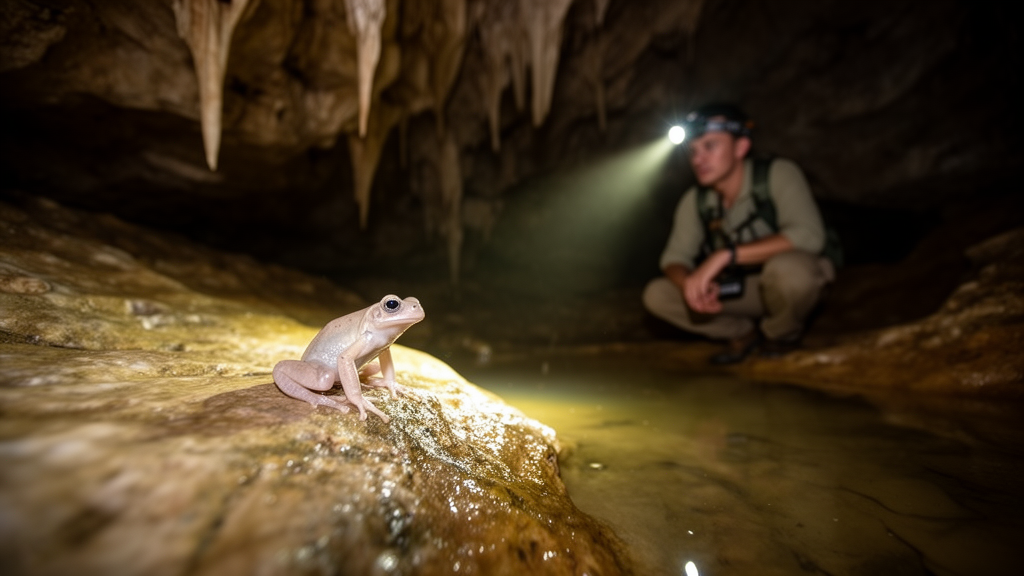
Deep beneath the forests and savannas of Brazil, in the permanent darkness of limestone, iron ore, quartzite and sandstone caves, researchers have been documenting something that challenges a long-standing assumption in biospeleology: frogs are not merely stumbling into caves by accident. A new discussion paper published in Neotropical Biology and Conservation argues that many anuran species recorded in Brazilian caves should be classified as trogloxenes, animals that regularly use the subterranean environment for reproduction, feeding or shelter, rather than as accidental visitors that wander in and quickly die or depart. The argument carries real weight for conservation, because the legal framework protecting Brazilian subterranean environments currently has no place for frogs.
Caves are, by definition, subterranean spaces that range from canaliculi only a few millimeters wide to caverns large enough for human entry and transit. Compared with the surface, their characteristics are strikingly peculiar. Light is permanently absent, which means little or no primary productivity. Humidity tends toward saturation. Temperatures remain mild and stable. Energy resources are largely allochthonous, arriving from outside rather than being generated within. These conditions arise because caves form in the most varied types of rock, mainly through mechanical and chemical action of water on the matrix rock in landscapes known as karst. Water also acts as the great transporter of trophic resources into the subterranean realm, carrying organic material from the entire recharge area, and it can remain stored in caves for prolonged periods due to underground water dynamics. That stability attracts organisms seeking an environment that is less disturbed than the surface.
For amphibians, whose permeable skin makes them exquisitely vulnerable to desiccation, the cave environment offers an almost ideal combination. High relative humidity and low incidence of sunlight prevent the skin from drying out, a factor that has long been recognized as decisive for frog shelter. But the subterranean realm also provides conditions for other fundamental activities in the anuran life cycle. Feeding is possible because caves support a wide diversity and abundance of invertebrates. Reproduction is feasible because water bodies are frequently present inside caves. Moreover, the cave environment reduces exposure to predators. Taken together, these features suggest that caves could function as true habitats rather than mere rocky refuges, yet the scientific literature has treated frog presence underground with skepticism.
The skepticism has a history. Frogs have traditionally been considered accidental animals in the subterranean environment, meaning they eventually enter a cave and do not stay there, leaving within a short period, or failing to find their way out and dying inside. This assumption has shaped decades of research priorities, and it shows. Studies on reptiles and amphibians linked to speleology in South America remain scarce. The works focused on this type of habitat occupation have recorded only about 6 percent of the 1,144 Brazilian frog species inside caves. The scarcity of data is itself a product of the accidental-fauna assumption, creating a circular problem: because frogs are presumed accidental, few studies document them, and because few studies document them, the presumption goes unchallenged.
The new paper challenges that presumption directly. Drawing on the authors’ own records and those of research partners in biospeleology, the study compiles evidence of numerous frog species found in caves of four different lithologies, distributed from north to south of Brazil across the Amazon, Atlantic Forest, Caatinga, Cerrado and areas near the Pantanal. The records span sites in Parauapebas in Pará, Natividade and Arraias in Tocantins, Ourolândia in Bahia, Caverna da Ponte de Pedra in Goiás, Caverna das Pitangueiras in Mato Grosso do Sul, Serra da Piedade and Belo Horizonte in Minas Gerais, Ribeirão Bonito and Caverna do Cafezal in São Paulo, and Caverna do Zé in Paraná. Among the species documented are Adelphobates galactonotus, Rhaebo guttatus, Rhinella diptycha, Scinax x-signatus, Leptodactylus labyrinthicus, Bokermannohyla species, Scinax fuscovarius, Ischnocnema verrucosa, Physalaemus cuvieri, Bokermannohyla martinsi, Crossodactylus caramaschii, Cycloramphus eleutherodactylus, Aplastodiscus albosignatus and Boana bischoffi. This geographic and taxonomic breadth suggests that cave use by frogs is neither rare nor restricted to a single geological setting.
Based on this evidence, the authors argue that several species can be classified as trogloxenes, following the Schiner-Racovitza classification as adapted by Sket in 2008. Trogloxenes are animals that can inhabit the cave environment for reproduction, food or shelter. In the case of anurans, this resembles the group with cryptozoic habits, hiding in galleries or small cavities in the ground or ravines, and rheophilic tendencies, occupying rocks located next to or beside small streams or rapids. Preliminary studies already show signs that anurans are inhabitants better suited to being classed as trogloxenes rather than accidents, and they are already treated this way in other parts of the world, including studies in Mexico and Thailand. The Brazilian evidence now adds a continental-scale dimension to that global picture.
Yet the authors are careful to frame their argument as a discussion rather than a definitive conclusion, and they identify several important questions for future biospeleological research. Are frogs able to complete their entire life cycle inside caves? Can they maintain a diet without nutritional deficit in this environment? Are they preyed upon, and if so, by whom? How does the use of cave habitat differ from the use of the rocky environment? Answering these questions systematically is difficult because it is nearly impossible to follow the life cycle of an anuran in this hard-to-access environment. The authors propose that studies in controlled laboratory environments could bring new evidence to fill the knowledge gap, and that an increase in long-term population studies with frogs in caves would help improve the ecological understanding of the taxon.
The conservation implications of the accidental-fauna assumption are substantial. When all anurans are considered accidental fauna, there is no legal support for these species in the environmental legislation for subterranean environments currently in force in Brazil. There is no legal obligation to collect and register anurans in caves, and companies responsible for projects are optional in registering these species in studies of relevance, impacts and environmental monitoring. Anurans thus go against the grain of other groups such as Chiroptera and invertebrates, which served as the basis for studies that leveraged subterranean biology research from Decree 6640 in 2008. For those groups, there has since been a significant increase in descriptions of cave invertebrates, research of paramount importance for bats, and the description of hotspots of subterranean fauna in various regions of Brazil. Despite these advances, the herpetofauna remains completely neglected.
The stakes are high because the cave environment is one of the most threatened habitats in the face of mineral exploration and urban development, even though it is classified as Brazilian cultural, biological and geological heritage. Today, Brazilian caves are under high pressure for licensing, including those classified as of maximum relevance, which have hitherto been prevented from being impacted. The diversification of ecological and conservation studies expanded to other groups, such as herpetofauna, could bring new insights into subterranean environments and increasingly consolidate the paths for recognition of their ecological importance. Whether caves are true habitats for anurans or merely a favorable rocky environment is more than an academic question. It determines whether frogs count when the fate of a cave is decided.
Subject of Research: Are caves true habitats for anurans or more a favorable rocky environment? A discussion of habitat occupation by frogs in Neotropical caves
Article Title: Are caves true habitats for anurans or more a favorable rocky environment? A discussion of habitat occupation by frogs in Neotropical caves
Article References: Sperandei, V. D. F., Alvarenga, D. D. A., Araújo, M. S. D., & Pereira, C. C. (2023). Are caves true habitats for anurans or more a favorable rocky environment? A discussion of habitat occupation by frogs in Neotropical caves. Neotropical Biology and Conservation, 18(3), 131-137. https://doi.org/10.3897/neotropical.18.e100778
Image Credits: AI Generated
DOI: 10.3897/neotropical.18.e100778
Keywords: caves, true, habitats, anurans, favorable, rocky, environment, discussion, habitat, occupation, frogs, Neotropical
Cite Scienmag News
Gavin Prescott. (October 19, 2026). Frogs in Brazilian caves are residents, not lost visitors, study argues. Scienmag. https://scienmag.com/frogs-in-brazilian-caves-are-residents-not-lost-visitors-study-argues/
Gavin Prescott. "Frogs in Brazilian caves are residents, not lost visitors, study argues." Scienmag, 19 October 2026, https://scienmag.com/frogs-in-brazilian-caves-are-residents-not-lost-visitors-study-argues/. Accessed 19 October 2026.
Gavin Prescott. "Frogs in Brazilian caves are residents, not lost visitors, study argues." Scienmag. October 19, 2026. https://scienmag.com/frogs-in-brazilian-caves-are-residents-not-lost-visitors-study-argues/


