


A crewed journey to Mars has long been framed as one of the most demanding physiological challenges ever contemplated, and few organs have raised as much concern as the heart. Now a new study led by researchers at Northwestern Medicine, UT Southwestern Medical Center and UTHealth Houston offers the most encouraging evidence yet that the cardiovascular system can withstand the round trip. Tracking 13 astronauts through roughly six-month missions aboard the International Space Station, the team found that the heart adapts to weightlessness and, crucially, copes well with simulated Martian gravity upon return. The findings, published in the American Heart Association journal Circulation, suggest that with the right countermeasures in place, the human body may be better prepared for the Red Planet than many had feared.
The central question the researchers set out to answer was deceptively simple but enormously consequential for mission planners. When astronauts spend months floating in microgravity, the heart no longer has to pump blood uphill against the pull of Earth’s gravity, and the body begins to shed the capacity it no longer uses. Muscle mass and cardiac mass both decline in orbit because the cardiovascular system is working far less than it does on the ground. The worry has always been what happens at the other end of the journey: Mars has a surface gravity only about one-third as strong as Earth’s, and a crew arriving after months of weightlessness would need to stand, walk and work almost immediately after landing. If their hearts could not maintain blood pressure and blood flow to the brain in that transition, the mission concept itself would be in jeopardy.
Historically, that worry was well founded. Many astronauts returning from earlier space missions struggled with dizziness and lightheadedness when they stood up after landing, a phenomenon known as orthostatic hypotension. The sudden shift back into a gravitational environment causes blood to pool in the lower body, producing a drop in blood pressure that can leave people faint or unsteady. It is one of the classic hazards of re-entry into gravity, and it has shaped decades of thinking about how long a crew could safely remain in space before losing the ability to function on a planetary surface.
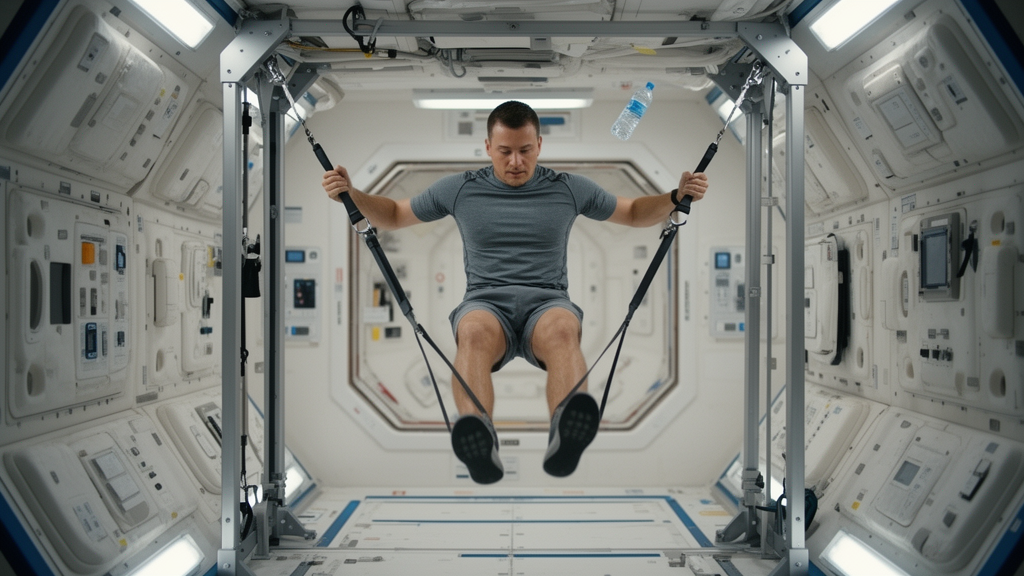
What distinguished the astronauts in this study was their exercise regimen. Following a NASA program called Exercise Countermeasures, the crew members worked out for up to two hours every day while in orbit. That routine included 30 to 45 minutes of endurance exercise and 60 to 75 minutes of resistance training, a combination designed to preserve both the aerobic capacity of the heart and the strength of the skeletal and cardiac muscle that gravity normally maintains. The payoff was clear in the data: the astronauts largely tolerated the transition back into a gravitational environment without the severe orthostatic problems seen in earlier eras of spaceflight.
Senior author Dr. James Thomas, professor of medicine in the division of cardiology at Northwestern University Feinberg School of Medicine and a Northwestern Medicine cardiologist, explained the underlying physiology in plain terms. You lose muscle mass and cardiac mass in a weightless environment because you are working less up there, he noted, describing how astronauts float through the cabin and can sail across the module with a light tap of the foot. To counter that loss, he said, exercise is crucial when you are in space. The study’s message, in his view, is optimistic: with these findings, there is now reason to think that crews would be able to traverse to Mars, get there and actually work on the surface of Mars.
The technical backbone of the study was a remarkable series of echocardiograms, ultrasound scans of the heart, collected before, during and after each mission. Rather than relying solely on ground-based measurements taken before launch and after landing, the researchers captured cardiac structure and function continuously in flight. The astronauts were trained to perform echocardiographic scans on one another every few weeks aboard the station, and the images were transmitted to Earth for analysis. Thomas, working with collaborators Dr. Benjamin Levine of UT Southwestern Medical Center and Dr. Michael Bungo of McGovern Medical School at UTHealth Houston, reviewed the recordings as they arrived. Because the space station runs on Greenwich Mean Time, that often meant monitoring live scans around 3 a.m., coaching the astronauts in real time to adjust their technique and improve image quality. The result is an unusually rich longitudinal dataset on how the human heart behaves in prolonged weightlessness.
That dataset revealed a clear pattern of adaptation. During the first two weeks of spaceflight, the astronauts experienced reductions in cardiac filling, stroke volume and other measures of cardiac performance. In practical terms, their hearts were filling with less blood between beats and pumping less blood with each contraction, reflecting the reduced circulatory demands of weightlessness. But this early dip proved temporary. As the missions progressed, cardiac filling and stroke volume gradually moved back toward preflight levels, indicating that the heart stabilized rather than continuing to deteriorate over the months in orbit. For mission designers, that trajectory matters enormously: it suggests the cardiovascular system reaches a workable equilibrium in microgravity rather than entering an open-ended decline.
The most novel part of the study came after the astronauts returned to Earth. To simulate the moment of arrival on Mars, the research team tilted the astronauts 22 degrees upward from a lying-down position. This head-up tilt shifts blood toward the lower body, mimicking the hydrostatic effects of Martian gravity, which pulls with roughly one-third of Earth’s force. The scientists then assessed how the astronauts’ hearts responded to this simulated Martian environment. The verdict was striking: the astronauts’ hearts handled the simulated Martian conditions as well as they had handled simply standing upright on Earth before launch. In other words, after six months in space, their cardiovascular performance under Mars-like loading was indistinguishable from their preflight baseline on Earth.
The study, titled Impact of Prolonged Spaceflight on Cardiac Structure and Function: An Exploratory Longitudinal Observational Study, is the first to examine how the heart responds to simulated Martian gravity after prolonged exposure to microgravity. That combination, long-duration flight data plus a Mars-gravity simulation, is what gives the findings their weight for future exploration planning. A Mars transit is expected to take far longer than a typical six-month station increment, so questions remain about even longer exposures, but the demonstration that daily exercise can preserve cardiac function through half a year of weightlessness and a gravity transition removes one of the major physiological roadblocks from the mission architecture.
For the growing community of scientists and engineers working toward human exploration of deep space, the study is a reminder that the body is not a fixed liability but a adaptable system that responds to the demands placed on it. The astronauts in this study did not avoid the cardiovascular deconditioning of weightlessness entirely; their hearts initially shrank in output just as predicted. What they did was counter that loss with disciplined, hours-long daily training, and their hearts repaid the effort by performing under simulated Martian gravity as though the months in orbit had barely happened. As NASA refines its plans to send astronauts to the Red Planet, the message from Circulation is clear: the heart, given the right workout every day, appears ready to make the trip.
Subject of Research: Effects of prolonged spaceflight and exercise countermeasures on astronaut cardiac function and adaptation to simulated Martian gravity
Article Title: Exercise helps astronauts’ hearts handle months in space, boosting prospects for Mars
Article References: Exercise helps astronauts’ hearts handle months in space, boosting prospects for Mars. Original publication (Bibliographic details unavailable.)
Image Credits: AI Generated
DOI: Not provided
Keywords: astronauts, cardiac function, microgravity, Mars, International Space Station, echocardiography, exercise countermeasures, orthostatic hypotension, stroke volume, space medicine, Circulation, Northwestern University
Cite Scienmag News
Grant Pearson. (October 19, 2026). Daily Workouts in Orbit Keep Astronaut Hearts Ready for Mars Gravity. Scienmag. https://scienmag.com/daily-workouts-in-orbit-keep-astronaut-hearts-ready-for-mars-gravity/
Grant Pearson. "Daily Workouts in Orbit Keep Astronaut Hearts Ready for Mars Gravity." Scienmag, 19 October 2026, https://scienmag.com/daily-workouts-in-orbit-keep-astronaut-hearts-ready-for-mars-gravity/. Accessed 19 October 2026.
Grant Pearson. "Daily Workouts in Orbit Keep Astronaut Hearts Ready for Mars Gravity." Scienmag. October 19, 2026. https://scienmag.com/daily-workouts-in-orbit-keep-astronaut-hearts-ready-for-mars-gravity/


