


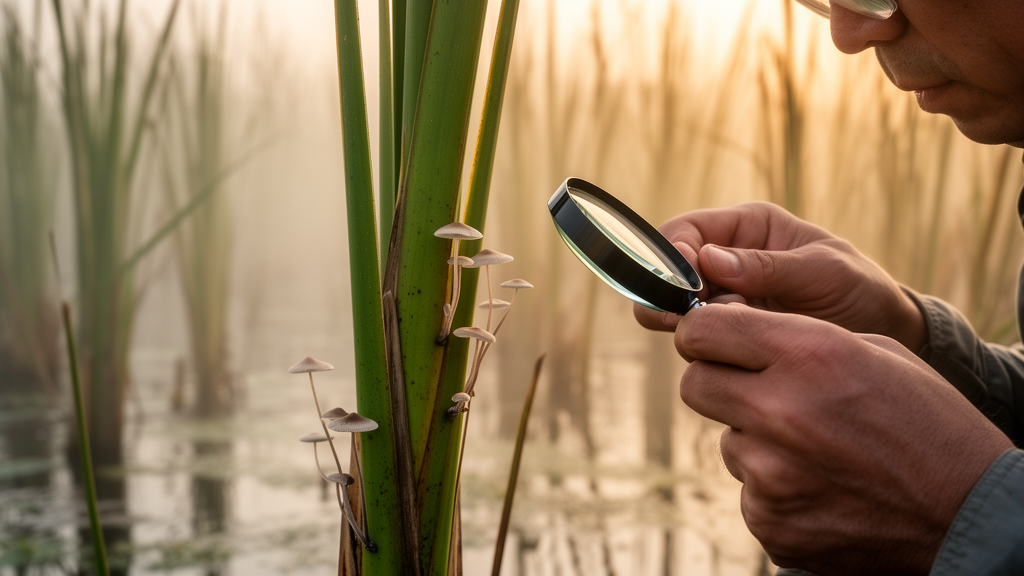
Deep in the wetlands of Jiangxi Province, China, a towering grass with a global reputation has quietly been harboring microscopic newcomers. Scientists surveying the fungi that live on dead stems of Arundo donax, the giant reed, have discovered two species previously unknown to science: Lentimurispora arundinis and Stachylidium arundinis. The finding, published in the journal MycoKeys, marks the first time either fungal genus has been recorded on this host and the first report of these microfungi from Jiangxi Province, adding fresh branches to the fungal tree of life and underscoring how much biodiversity still hides in plain sight on a plant that grows along waterways across the tropics and subtropics.
Arundo donax is no ordinary grass. This perennial herb thrives in poor soils, tolerates low temperatures and saline-alkali conditions, and has become a plant of considerable economic and ecological interest. It is used in ecological restoration, holds promise as a green energy crop, contributes to carbon sequestration, enhances wetland carbon sinks, and has even been investigated as a biomass source for hydrogen production. Yet despite its prominence, the fungal resources associated with the reed have rarely been explored in a systematic way. While numerous fungal species have been recorded on Arundo donax worldwide, only a small number, including Bipolaris sorokiniana and Corynespora donacis, have been formally accepted in China. That gap made the Jiangxi wetlands an inviting hunting ground for mycologists searching for saprobic microfungi, the organisms that decompose dead plant material.
In 2025, researchers collected samples of rotting Arundo donax from wetland sites in Jiangxi and brought them into the laboratory in sealed plastic bags. Under stereomicroscopes and compound microscopes, they documented the macroscopic and microscopic features of the fungi growing on the dead petioles, then used single-spore isolation techniques to obtain pure cultures. Germinated spores were transferred aseptically onto potato dextrose agar plates and incubated at 25 degrees Celsius. The resulting living cultures were deposited in the culture collection of Zhongkai University of Agriculture and Engineering, while dried herbarium specimens were archived at the university’s mycological herbarium, ensuring that the physical evidence behind the new species is permanently preserved for future study.
The first of the two newcomers, now named Stachylidium arundinis, belongs to a genus first proposed by Link in 1809 and refined over nearly two centuries of taxonomic debate. Fries designated S. bicolor as the type species in 1832, a recommendation upheld by later researchers. Species of Stachylidium typically colonize herbaceous and woody substrates, with occasional reports from soil, and only their asexual form has ever been documented. The new species fits the genus profile: it produces septate, verticillate conidiophores, the spore-bearing stalks that arise in whorls, with a pale brown to brown base and a paler, roughened apex. Its conidiophores measure 140 to 290 micrometers long and 5 to 6 micrometers wide, bearing cylindrical, hyaline conidia of roughly 5.6 by 2.2 micrometers. On potato dextrose agar the colonies grow fast, reaching 4 to 5 centimeters in diameter after two weeks, cream in the middle with a white edge and a strongly radiating, lobate outline.
What convinced the team that S. arundinis was genuinely new rather than a variant of a known species came from DNA. The researchers extracted genomic DNA from fresh mycelia and amplified four gene regions: the internal transcribed spacer (ITS), part of the large subunit of nuclear ribosomal RNA (LSU), the translation elongation factor 1-alpha gene (tef1-α), and the second largest subunit of RNA polymerase II (rpb2). Using standard primer pairs and polymerase chain reaction, they sequenced the loci and compared them with reference sequences from GenBank. In multigene phylogenetic analyses combining maximum likelihood and Bayesian inference, the two isolates of S. arundinis formed a separate lineage clustered next to Stachylidium pallidum with maximal statistical support of 100 percent ML bootstrap and 1.00 Bayesian posterior probability. Nucleotide differences excluding gaps between the new species and S. pallidum were modest in the ribosomal regions, 0.06 percent for ITS and 0.11 percent for LSU, but substantial in the protein-coding genes, 2.92 percent for tef1-α and 7.94 percent for rpb2.
Morphology reinforced the molecular verdict. S. arundinis produces lateral branches in the upper part of its conidiophores, a trait that distinguishes it from S. pallidum, which instead has strongly branched conidiophores and an apex bearing an almost imperceptible minute collarette. The combination of phylogenetic placement and these visible differences led the authors to formally describe the fungus as new to science, with the species epithet arundinis honoring the host genus Arundo from which the holotype was isolated near Jingdezhen City in September 2025.
The second discovery, Lentimurispora arundinis, is equally intriguing. Lentimurispora is a monotypic genus introduced in 2018 and typified by L. urniformis, a fungus with reduced, micronematous conidiophores, monoblastic conidiogenous cells, and distinctive muriform, lenticular conidia, meaning multicellular, lens-shaped spores divided into brick-like compartments, with dark brown central cells and paler peripheral cells. The new Jiangxi isolate shares this overall architecture but shows telling differences: its conidia carry a black ellipsoid area in the median region and mostly three-layered subhyaline or pale brown peripheral cells. The spores are thick-walled, cushion-like, and slightly constricted at the septa, topped by a large, hyaline, inverted vase-like attachment cell. Genetic divergence from L. urniformis was clear, with differences of 1.54 percent in LSU, 0.49 percent in SSU, and 5.47 percent in tef1-α, and the two isolates clustered with L. urniformis in the phylogenetic tree with 99 percent ML support and 1.00 Bayesian posterior probability. The holotype was collected near Jiujiang City in November 2025.
Beyond adding two species names to the catalogue, the study prompts a rethink of how the genus Lentimurispora itself should be defined. The authors suggest that the genus may be more accurately characterized by the prominent basal attachment cell on its conidia rather than by the wedge-shaped conidiogenous cells emphasized in the original description. That large, hyaline, appendage-like structure is hypothesized to function as an adhesion mechanism, helping the spores stick to substrate surfaces, a common adaptive strategy among saprobic microfungi colonizing specific microhabitats. Meanwhile, the discovery of S. arundinis highlights the taxonomic complexity within Stachylidium, a nineteenth-century genus long plagued by interspecific morphological similarities and the absence of molecular data from type specimens of older names. The new species shows both considerable molecular divergence from its closest relative and distinct morphological traits, producing secondary conidiogenous cells exclusively at the apex of the conidiophore, a finding that supports the integration of multilocus phylogeny with detailed morphology as the most effective way to resolve cryptic species in historically ambiguous genera.
Geographically, the study is a first: no microfungi had previously been reported from Arundo donax in Jiangxi Province, so the work expands the known distribution of this host-mycobiota association. The authors argue that plant-host affinity and regional microclimates are key drivers of fungal diversity, and they infer that a considerable number of undiscovered fungal taxa associated with the giant reed may still await description, particularly in subtropical and temperate ecosystems. Because plant-associated mycobiomes play central roles in nutrient cycling and biomass degradation, understanding which fungi live on and in Arundo donax matters well beyond pure taxonomy. The reed is increasingly valued for ecological management and industrial applications, from wetland restoration to bioenergy, and baseline taxonomic and ecological data on its fungal partners could ultimately inform how this versatile plant resource is managed and exploited.
The two new species also serve as a reminder of how much of the fungal kingdom remains unmapped. Mycologists estimate that millions of fungal species exist, yet only a fraction have been formally described, and saprobic microfungi on economically important plants remain especially under-sampled. Each new species documented with careful morphology, preserved type specimens, living cultures, and multigene DNA sequences strengthens the framework that all future research on these organisms depends on. For now, two names, Lentimurispora arundinis and Stachylidium arundinis, have joined the scientific register, both rooted in the dead stems of a giant grass in Jiangxi, and both hinting that the wetlands of southern China hold far more fungal diversity than anyone had recorded before.
Subject of Research: Novel saprobic fungal species associated with the giant reed Arundo donax in Jiangxi, China
Article Title: Novel fungal species associated with Arundo donax ( Poales , Poaceae ) in Jiangxi, China
Article References: Xiong, Y., Manawasinghe, I. S., Zhang, M., Ren, Q., & Zhou, L. (2026). Novel fungal species associated with Arundo donax (Poales, Poaceae) in Jiangxi, China. MycoKeys, 136, 161-176. https://doi.org/10.3897/mycokeys.136.194074
Image Credits: AI Generated
DOI: 10.3897/mycokeys.136.194074
Keywords: mycology, Arundo donax, new species, Lentimurispora arundinis, Stachylidium arundinis, Jiangxi China, taxonomy, multigene phylogeny, saprobic fungi, wetland biodiversity, fungal ecology, MycoKeys
Cite Scienmag News
Roger Howard. (October 19, 2026). Two New Fungal Species Unearthed on Giant Reed in Chinese Wetlands. Scienmag. https://scienmag.com/two-new-fungal-species-unearthed-on-giant-reed-in-chinese-wetlands/
Roger Howard. "Two New Fungal Species Unearthed on Giant Reed in Chinese Wetlands." Scienmag, 19 October 2026, https://scienmag.com/two-new-fungal-species-unearthed-on-giant-reed-in-chinese-wetlands/. Accessed 19 October 2026.
Roger Howard. "Two New Fungal Species Unearthed on Giant Reed in Chinese Wetlands." Scienmag. October 19, 2026. https://scienmag.com/two-new-fungal-species-unearthed-on-giant-reed-in-chinese-wetlands/


