


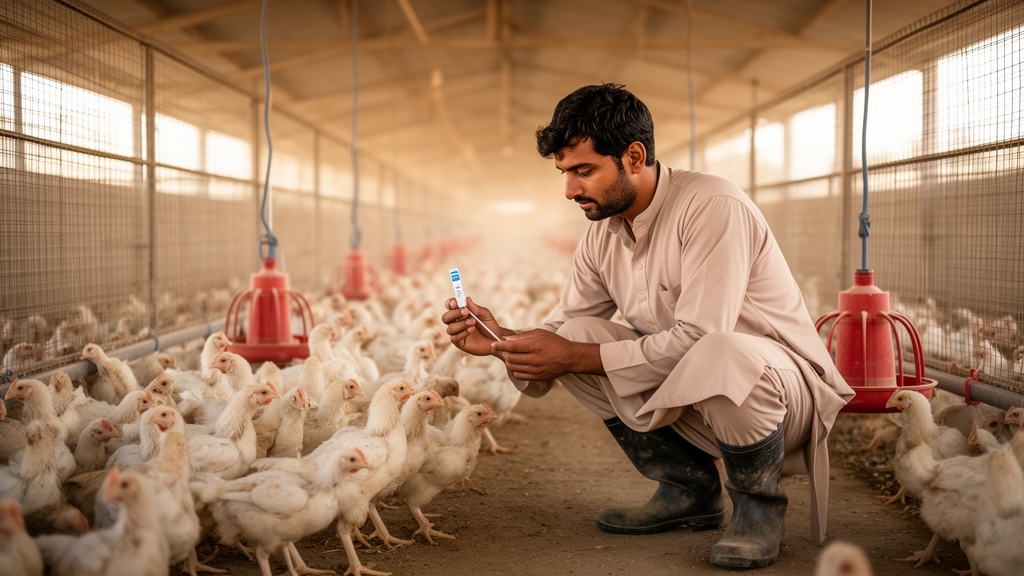
A sweeping survey of poultry production systems in Pakistan has uncovered a startling concentration of drug-resistant Klebsiella pneumoniae, an opportunistic bacterium that ranks among the world’s most dangerous carriers of antimicrobial resistance. Researchers recovered the organism from roughly one in three of 900 samples collected across commercial broiler farms, backyard flocks and retail poultry markets in Faisalabad Division, and found that most of the isolates were resistant to multiple antibiotic classes. The study, published in Molecular Biology Reports, provides one of the most detailed molecular portraits to date of resistance genes circulating in South Asian poultry, and its findings carry uncomfortable implications for food safety and human health far beyond the farm gate.
The research team, led by Rameen Parvez and Mohsin Khurshid of the Institute of Microbiology at Government College University Faisalabad, with collaborators including James Jacob Sasanya of the International Atomic Energy Agency in Vienna, sampled three distinct tiers of the poultry economy between September 2024 and April 2025. By including commercial broiler operations, small-scale backyard flocks and retail markets, the design captured the full trajectory of poultry production from intensive rearing to point of sale. This matters because each tier represents a different interface between bacteria and humans, from farm workers exposed directly to birds and litter, to consumers handling raw meat in their kitchens.
Identification of the isolates was rigorous. The team combined conventional biochemical testing with API 20E strips, matrix-assisted laser desorption ionization time-of-flight mass spectrometry, a proteomic technique that fingerprints bacterial species by their protein profiles, and amplification of the rpoB gene, a molecular marker widely used to confirm species identity. This layered approach guards against the misidentification that has plagued some earlier surveys, since K. pneumoniae and its close relative K. oxytoca can be difficult to distinguish phenotypically. Of the 900 samples, 303, or 33.7 percent, yielded K. pneumoniae, a prevalence figure that underscores how thoroughly this organism has colonized the poultry environment.
The resistance picture that emerged was grim. Among the 303 isolates, 199, or 65.7 percent, qualified as multidrug-resistant under internationally accepted definitions, meaning they were nonsusceptible to at least one agent in three or more antibiotic classes. A further 48 isolates, 15.8 percent, were extensively drug-resistant, a category reserved for bacteria that have lost susceptibility to agents in all but one or two classes. Perhaps most tellingly, isolates from commercial broiler farms carried a heavier resistance burden than those recovered from backyard flocks or retail markets, a gradient consistent with the intensive antimicrobial use documented on industrial poultry operations in the region.
At the molecular level, polymerase chain reaction screening revealed a familiar but troubling cast of resistance genes. The dominant extended-spectrum beta-lactamase determinants were blaCTX-M-15 and blaTEM, enzymes that hydrolyze third-generation cephalosporins, workhorse antibiotics in both human and veterinary medicine. CTX-M-15 in particular is a global success story for the bacterium, having spread explosively through human clinical populations over the past two decades. Its prominence in poultry-associated isolates suggests that the farm environment is not merely a passive reservoir but an active participant in the circulation of the very genes that compromise treatment of urinary tract infections, bloodstream infections and hospital-acquired pneumonia.
More alarming still was the detection of carbapenemase genes among carbapenem-resistant isolates. The team identified blaNDM, blaKPC and blaOXA-48, three of the most clinically consequential carbapenemase families known. Carbapenems are often described as last-line antibiotics for infections caused by gram-negative bacteria, and the World Health Organization lists carbapenem-resistant K. pneumoniae as a critical-priority pathogen. The presence of NDM-type enzymes, which originated on the Indian subcontinent and have since spread worldwide, in bacteria recovered from poultry points to a plausible environmental bridge by which these determinants could move between animal, food and human compartments.
Colistin, a polymyxin antibiotic revived as a treatment of last resort when carbapenems fail, fared no better. Resistance to colistin was detected in 5.9 percent of the isolates, and the plasmid-mediated mcr-1 gene was identified among the resistant strains. The mcr-1 gene is of particular concern because, unlike chromosomal mutations that confer colistin resistance, it sits on mobile genetic elements that can hop between bacterial species and genera with relative ease. First described in Chinese pigs and pork in 2015, mcr-1 has since been reported on every inhabited continent, and its presence in poultry systems in Pakistan adds another node to its global distribution network.
One of the study’s most striking findings is the sheer combinatorial diversity of the resistance determinants. The researchers identified twenty-one distinct resistance gene combinations, including combinations that unite ESBL genes, carbapenemase genes and colistin resistance determinants within the same isolates. Co-occurrence of this kind is the molecular nightmare scenario for antimicrobial resistance control, because a single plasmid carrying multiple determinants can simultaneously confer resistance to front-line, last-line and reserve antibiotics. Such plasmids can be transferred laterally to other Enterobacteriaceae, including Escherichia coli and Salmonella, multiplying the number of pathogenic species that can acquire the resistance package in a single horizontal gene transfer event.
The authors frame their findings within a One Health perspective, the recognition that human, animal and environmental health are inextricably linked. Poultry production is a recognized amplifier of resistance: antimicrobials are used for growth promotion, prophylaxis and treatment in many low- and middle-income settings, selective pressure favors resistant clones, and resistant bacteria and their genes disperse through litter, wastewater, workers, carcasses and meat. Prior studies have documented intermingled K. pneumoniae populations between retail meats and human urinary tract infections, and the persistence of multidrug-resistant strains long after colistin withdrawal in poultry production, suggesting that contamination events can leave durable legacies in the food chain.
The study’s conclusions point toward concrete interventions: strengthened antimicrobial stewardship to curb unnecessary drug use, improved farm-level biosecurity to reduce the infection pressure that drives treatment, and integrated molecular surveillance that tracks resistance genes across the production chain rather than in isolated snapshots. The work was funded under an International Atomic Energy Agency Coordinated Research Project, and the authors report no competing interests. As resistance genes continue to accumulate in the animals that feed billions of people, the Faisalabad survey serves as a quantitative warning that the poultry sector, if left unmonitored, can function as both a reservoir and a launchpad for some of medicine’s most feared resistance determinants.
Subject of Research: Molecular characterization of antimicrobial resistance genes in Klebsiella pneumoniae from poultry production systems in Pakistan
Article Title: Molecular characterization and co-occurrence of ESBL, carbapenemase and mcr-1 genes in Klebsiella pneumoniae from poultry production systems in Pakistan
Article References: Parvez, R., Khurshid, M., Rasool, M. H., Aslam, B., & Sasanya, J. J. (2026). Molecular characterization and co-occurrence of ESBL, carbapenemase and mcr-1 genes in Klebsiella pneumoniae from poultry production systems in Pakistan. Molecular Biology Reports, 53(1), Article 1538. https://doi.org/10.1007/s11033-026-12718-6
Image Credits: AI Generated
DOI: 10.1007/s11033-026-12718-6
Keywords: Klebsiella pneumoniae, antimicrobial resistance, ESBL, carbapenemase, mcr-1, colistin resistance, poultry, One Health, Pakistan, multidrug resistance, food chain, molecular surveillance
Cite Scienmag News
William Thompson. (October 19, 2026). Drug-Defying Klebsiella Bacteria Rife in Pakistan’s Poultry Farms, Study Finds. Scienmag. https://scienmag.com/drug-defying-klebsiella-bacteria-rife-in-pakistans-poultry-farms-study-finds/
William Thompson. "Drug-Defying Klebsiella Bacteria Rife in Pakistan’s Poultry Farms, Study Finds." Scienmag, 19 October 2026, https://scienmag.com/drug-defying-klebsiella-bacteria-rife-in-pakistans-poultry-farms-study-finds/. Accessed 19 October 2026.
William Thompson. "Drug-Defying Klebsiella Bacteria Rife in Pakistan’s Poultry Farms, Study Finds." Scienmag. October 19, 2026. https://scienmag.com/drug-defying-klebsiella-bacteria-rife-in-pakistans-poultry-farms-study-finds/


