


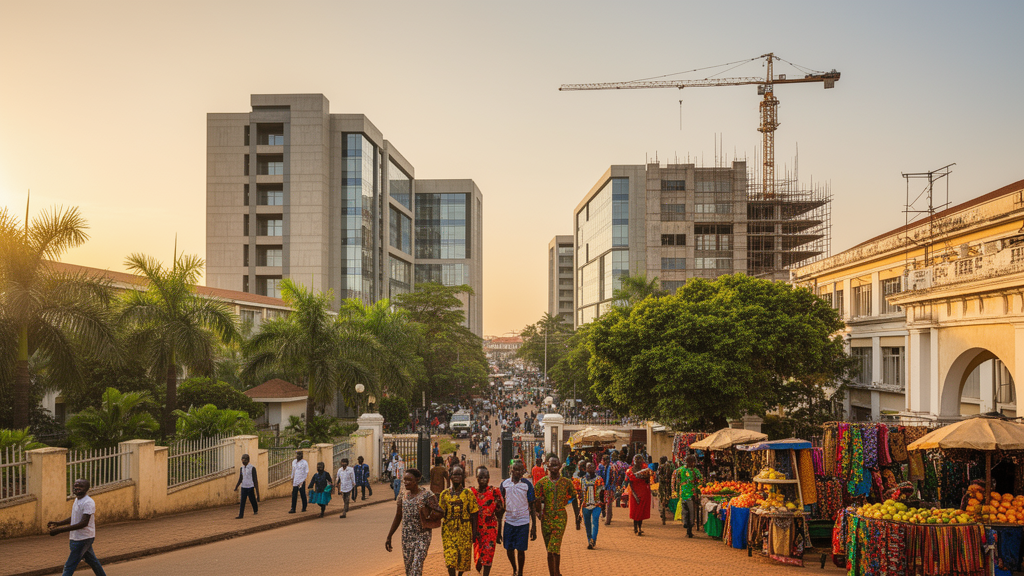
When a university grows, its influence rarely stops at the campus gate. In the communities surrounding one of Ghana’s largest public universities, researchers have documented how decades of institutional expansion have reshaped land use, strained infrastructure, and altered the daily environmental conditions of thousands of residents. A new study published in SN Social Sciences examines this phenomenon in detail, using a mixed-methods approach to trace the environmental consequences of university-driven urbanization in four neighborhoods near the Kwame Nkrumah University of Science and Technology (KNUST) in Kumasi.
The research team, led by Richmond Oppong Darko of the Department of Planning at KNUST and colleagues from the university’s Centre for Settlement Studies, surveyed 356 residents across Ayeduase, Kotei, Bomso, and Deduako. These communities were purposefully selected because of their proximity to the university campus and their distinctive land-use patterns, making them ideal case studies for understanding how academic institutions act as engines of urban growth. The researchers combined closed-ended questionnaires with open-ended interviews, allowing them to capture both quantitative measures of environmental change and the nuanced, lived experiences of residents navigating that change.
The most striking finding concerns the sheer speed of physical transformation. Between 2003 and 2023, built-up infrastructure in the study area expanded from 65.8 percent to 87.05 percent of the land surface. That represents a dramatic conversion of what was once agricultural land, forest patches, and open space into residential blocks, student hostels, commercial premises, and access roads. The researchers attribute this acceleration primarily to the university’s growing population and the corresponding demand for student and staff housing, which spills well beyond the campus boundary into neighboring settlements.
This pattern is not unique to Kumasi. Across sub-Saharan Africa, universities have increasingly been recognized as anchors of urbanization, drawing migrants, stimulating local economies, and generating secondary development that municipal authorities often struggle to regulate. What makes the KNUST case particularly instructive is the clarity with which the causal chain can be traced: institutional growth drives population influx, population influx drives housing demand, and housing demand drives land conversion with measurable environmental consequences.
Among those consequences, residents identified noise pollution as the single most pressing concern, cited by 38.9 percent of respondents. Poor waste management followed closely at 33.1 percent. These are not abstract environmental indicators but daily realities that shape quality of life, public health, and community cohesion. Noise from student hostels, commercial activities, and increased vehicular traffic disrupts sleep patterns and contributes to stress, while inadequate waste collection infrastructure leads to open dumping, blocked drains, and heightened disease risk during the rainy season.
Beyond these two dominant complaints, the study documented a 21.25 percent loss of green infrastructure across the study period. Trees, vegetated buffers, and informal green spaces that once moderated local temperatures, absorbed stormwater, and supported urban biodiversity have been progressively cleared to make way for construction. This loss compounds other environmental pressures: increased carbon emissions from growing vehicular traffic, and poor drainage systems that, combined with wetland encroachment, have made flooding a recurring hazard in low-lying areas.
The researchers employed the Drivers-Pressures-State-Impact-Response (DPSIR) framework to structure their analysis, a widely used conceptual model in sustainability science that links causal drivers to environmental pressures, changes in environmental state, impacts on human wellbeing, and societal responses. This framework allowed the team to move beyond simple correlation and articulate the specific mechanisms through which university expansion translates into environmental degradation, from land-use change and population density to infrastructure overload and ecosystem service loss.
Based on their findings, the researchers propose a set of policy interventions aimed at reconciling continued academic growth with environmental sustainability. They recommend strict zoning and building regulations to manage urban expansion, the establishment of waste recycling programs developed in partnership with the university, the enforcement of noise control policies, and the creation of community-based biodiversity conservation initiatives that promote green infrastructure and mass transit systems. These recommendations reflect a growing recognition that universities cannot be treated as isolated institutional enclaves but must be integrated into broader urban planning frameworks.
The study’s implications extend well beyond Ghana. As higher education systems across Africa and the Global South continue to expand in response to rising demand, the environmental footprint of that expansion will only grow. Cities hosting major universities face a choice between reactive management, where environmental problems are addressed only after they become crises, and proactive planning, where institutional growth is anticipated and its spatial and ecological consequences are managed from the outset. The KNUST case suggests that without deliberate policy intervention, the latter path is far more likely to produce sustainable outcomes.
What emerges from this research is a portrait of university communities as complex socio-ecological systems where institutional ambition, market forces, and environmental limits intersect. The residents of Ayeduase, Kotei, Bomso, and Deduako are not passive recipients of change but active stakeholders whose perceptions and priorities must inform any credible sustainability strategy. As the researchers conclude, building a more sustainable environment in these communities will require coordinated action from researchers, policymakers, planners, and the university itself, working together to ensure that the benefits of academic expansion are not purchased at an unsustainable environmental cost.
Subject of Research: Environmental impacts of university-driven urbanization in communities near KNUST, Ghana
Article Title: Environmental costs of university expansion: perceptions and policy implications in selected communities, Ghana
Article References: Oppong Darko, R., Mensah, H., Asamoah, P. K. B., Boafo, H. K., Adazuru, P., & Simpeh, E. K. (2026). Environmental costs of university expansion: perceptions and policy implications in selected communities, Ghana. SN Social Sciences, 6(9), Article 388. https://doi.org/10.1007/s43545-026-01633-z
Image Credits: AI Generated
DOI: 10.1007/s43545-026-01633-z
Keywords: university expansion, urbanization, Ghana, KNUST, environmental degradation, noise pollution, waste management, land use change, DPSIR framework, urban planning, green infrastructure, sustainability
Cite Scienmag News
Courtney Benton. (October 19, 2026). Ghana’s Expanding Universities Are Quietly Reshaping Their Host Communities. Scienmag. https://scienmag.com/ghanas-expanding-universities-are-quietly-reshaping-their-host-communities/
Courtney Benton. "Ghana’s Expanding Universities Are Quietly Reshaping Their Host Communities." Scienmag, 19 October 2026, https://scienmag.com/ghanas-expanding-universities-are-quietly-reshaping-their-host-communities/. Accessed 19 October 2026.
Courtney Benton. "Ghana’s Expanding Universities Are Quietly Reshaping Their Host Communities." Scienmag. October 19, 2026. https://scienmag.com/ghanas-expanding-universities-are-quietly-reshaping-their-host-communities/


