


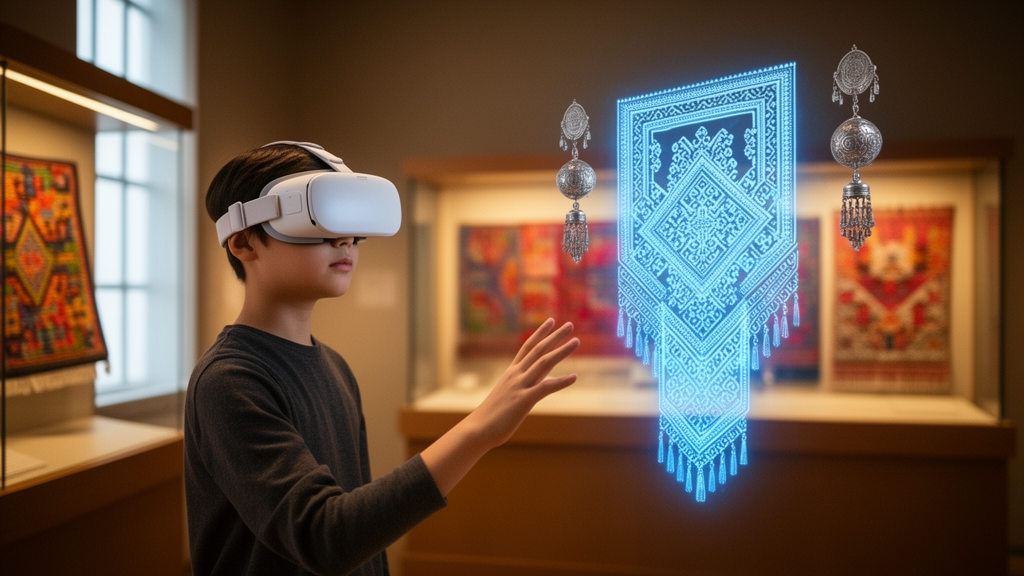
Deep in the mountains of Liangshan Yi Autonomous Prefecture in southwestern Sichuan Province, China, the textiles of the Yi ethnic group carry centuries of migration memory and nature worship in their geometric motifs, flame patterns, ram’s horn designs, and bracken symbols. A new study published in Discover Artificial Intelligence describes a virtual display experience (VDE) system that combines an improved graph capsule neural network with a user-aware path planning algorithm to digitize, classify, and present this heritage in an immersive virtual village, and the reported results suggest the approach could become a template for digital preservation of minority cultures worldwide.
The researcher behind the study, Xiaofan He of the College of Art and Design at Jiangsu University of Technology, identified a persistent gap in existing cultural virtual display systems: computer vision pipelines that classify heritage images rarely consider how their outputs could guide navigation, while path planning methods in human-computer interaction seldom exploit high-precision classification to personalize tours. Existing systems either achieve accurate classification but offer interaction paths unrelated to visitor interests, or provide smooth experiences built on coarse content labels. The new work closes that loop by feeding classification results directly into the cost function of a path planner.
The classification engine is built on a Graph Capsule Neural Network, or CapsGNN, a hybrid of capsule networks and graph neural networks. Capsule networks, unlike conventional convolutional neural networks, represent features as vectors whose length encodes the probability that a feature exists and whose orientation encodes its pose, such as rotation, scale, and deformation. This matters for Yi textiles, which are full of rotationally symmetric, repeating units and nonlinear deformations. Standard CNN pooling discards precise spatial position information, so the same pattern viewed at different angles is easily misclassified. Capsules, routed through a dynamic routing algorithm, can recognize what the study calls different poses of the same type.
The key architectural modification replaces the pose matrix in the original CapsGNN with a Graph Convolutional Network (GCN). The pose matrix parameterization in standard CapsGNN struggles to exploit adjacency information when processing graph structures, making it hard to capture the spatial relationships between repeating units in fabric patterns. GCNs, by contrast, explicitly aggregate neighbor node features through Laplacian smoothing operations, integrating low-level capsules into higher-level representations via neighborhood-weighted aggregation. An attention mechanism further refines the weighting of capsule information. The resulting CapsGNN-GCN model passes Yi fabric images through input, initial capsule, hierarchical capsule, and class capsule layers, where low-level capsules cluster into high-level capsules that map to specific pattern categories.
To train and test the model, the study assembled a dataset of 3,086 Yi fabric images collected online, from books, and through field photography, spanning five labeled categories: 700 abstract geometric images, 570 fire patterns, 460 horn patterns, 610 bracken patterns, and 746 other traditional patterns. Data augmentation through brightness adjustment, rotation, horizontal flipping, random cropping, and scaling expanded each category to 4,500 images, all resized to 300 by 300 pixels. Under five-fold cross-validation, CapsGNN-GCN reached a training accuracy of 96.8 percent and an F1 score of 0.93. Ablation tests confirmed the contribution of each module: removing the GNN module dropped training accuracy to 83.4 percent, removing GCN lowered it to 87.6 percent, and removing both collapsed test accuracy to 70.5 percent.
Head-to-head comparisons against ResNet50 V2, EfficientNet B0, and a GCN-CNN baseline showed the improved model winning every category. In the Abstract Geometry class, CapsGNN-GCN achieved 96.6 percent accuracy with only 10 misclassifications, while the Sheep’s Horn Pattern and Other Traditional Patterns categories reached 95.7 and 95.5 percent respectively. ResNet50 V2 managed only 87.6 percent on fire patterns, and EfficientNet B0 topped out at 95.5 percent on abstract geometry. Paired t-tests confirmed the differences were statistically significant at p less than 0.01. Notably, when evaluated on the original unaugmented test set, the model’s accuracy fell by only 0.6 percentage points, to 91.7 percent, indicating the augmentation had not inflated performance. The few failures clustered in texture-similar regions between fire and ram’s horn patterns and between fern and abstract geometry designs, accounting for just 0.7 percent of the test set.
The second half of the system tackles how visitors move through virtual heritage spaces. Using oblique photography and 3D modeling software integrated into Unreal Engine 4, the study reconstructed a village in Liangshan as a navigable virtual scene, gridded into a 100 by 60 cell raster over an 800 by 1,000 meter area. The team then modified the classic A* pathfinding algorithm, which combines best-first search heuristics with Dijkstra-style guarantees of shortest paths, by adding three user experience constraints to its heuristic function: landmark salience, user movement trajectory overlap, and user preference. Landmark salience combines visual contrast with semantic importance ratings from three cultural experts, diffused across the grid with a Gaussian kernel. Trajectory overlap was computed from the free-exploration walking paths of 30 users, and preference grids were linked to the classification model’s pattern labels, scored on a five-point Likert scale. A cubic uniform B-spline curve then smooths the raw grid path to reduce sharp turns.
Across six start-end pairs connecting key village nodes such as the center, entrance, sacrificial site, handicraft workshop, viewing platform, and cultural square, the improved algorithm produced an average total path length of 523.7 plus or minus 42.9 meters, roughly 6.3 to 9.6 percent shorter than simulated annealing and dynamic window approach baselines. The average number of turns fell to 13.7 plus or minus 2.2, the average turning angle dropped to 6.5 plus or minus 0.6 degrees, a 30 to 40 percent reduction in corner severity, and the average computation time was 15.3 plus or minus 1.9 seconds, well below the 19.5 seconds of traditional A* and the 25.4 seconds of DWA. Sensitivity analysis showed satisfaction scores changed by no more than 0.3 points on a five-point scale when weights were perturbed, indicating the algorithm is robust to weight selection.
Human trials with 50 participants, randomized between the new system and a non-interactive static display platform, demonstrated substantial gains in experience quality. Task completion averaged five minutes with a system response time of 0.5 seconds, immersion scored 4.2 on the Slater Immersion Scale, satisfaction reached 4.5 on a five-point Likert scale, and the operation error rate was just 3 percent. Independent samples t-tests showed the immersion and satisfaction differences were significant at p less than 0.001 with large effect sizes. A second experiment with 30 participants from diverse cultural backgrounds found that knowledge of Yi culture increased by 25 percent after using the system, with pre-test scores rising from 24 to 30 points, compared with a 10 percent gain for the traditional platform, and the cultural identity score reached 4.3.
The study’s broader significance lies in its methodological transferability. The quantification of landmark salience relies only on visual contrast and expert semantic scoring, the trajectory overlap grid can be generated from exploration data in any virtual environment, and the preference grid links directly to any classification model with a label-to-preference mapping, meaning the framework could extend to museums, educational platforms, and other heritage sites with spatial navigation needs. The author acknowledges limitations: the experiments covered only Yi fabric images and one virtual village scene, and adaptability to other cultural elements remains unverified. Future work aims to expand the method to other heritage types and optimize real-time feedback, but the demonstration that human-computer interaction factors can be quantitatively embedded in a path planning cost function marks a concrete step toward virtual heritage systems that do not just display culture, but anticipate what visitors want to see.
Subject of Research: A virtual display experience system for Yi cultural heritage that integrates CapsGNN-based fabric image classification with user-experience-driven A* path planning in a virtual village
Article Title: Virtual display experience design for Yi cultural heritage using CapsGNN and user experience
Article References: He, X. (2026). Virtual display experience design for Yi cultural heritage using CapsGNN and user experience. Discover Artificial Intelligence, 6(1), Article 1193. https://doi.org/10.1007/s44163-026-02017-1
Image Credits: AI Generated
DOI: 10.1007/s44163-026-02017-1
Keywords: CapsGNN, graph capsule neural network, Yi culture, cultural heritage, virtual reality, image classification, path planning, A* algorithm, user experience, Unreal Engine, digital preservation, Liangshan
Cite Scienmag News
Courtney Benton. (October 19, 2026). Capsule Networks and User-Aware Path Planning Bring Yi Cultural Heritage Into Virtual Reality. Scienmag. https://scienmag.com/capsule-networks-and-user-aware-path-planning-bring-yi-cultural-heritage-into-virtual-reality/
Courtney Benton. "Capsule Networks and User-Aware Path Planning Bring Yi Cultural Heritage Into Virtual Reality." Scienmag, 19 October 2026, https://scienmag.com/capsule-networks-and-user-aware-path-planning-bring-yi-cultural-heritage-into-virtual-reality/. Accessed 19 October 2026.
Courtney Benton. "Capsule Networks and User-Aware Path Planning Bring Yi Cultural Heritage Into Virtual Reality." Scienmag. October 19, 2026. https://scienmag.com/capsule-networks-and-user-aware-path-planning-bring-yi-cultural-heritage-into-virtual-reality/


