


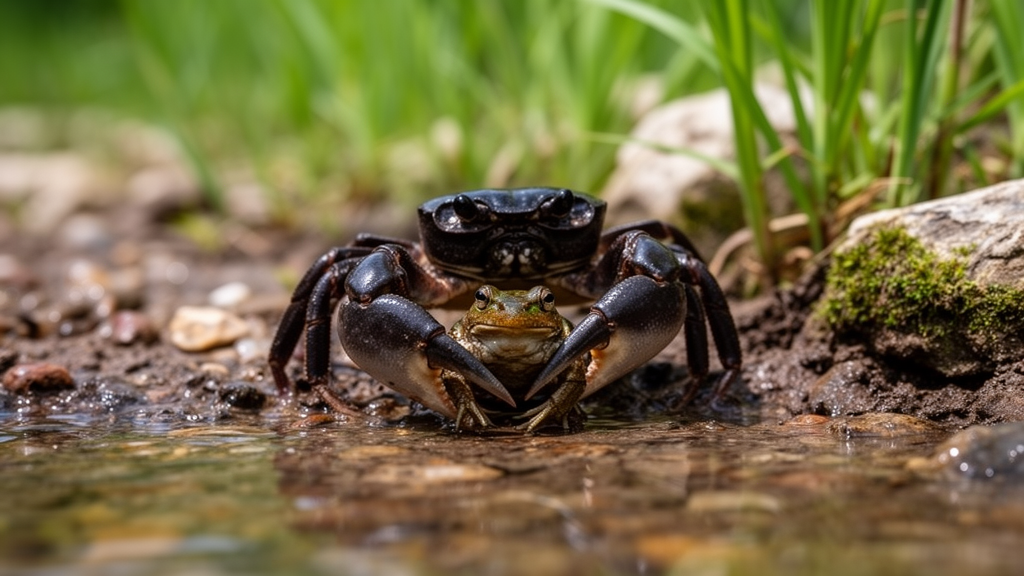
On a scorching June afternoon in 2021, along a shallow stream on the Greek island of Karpathos, field biologists witnessed something that had never before been documented in Europe: a freshwater crab locked in a lethal grip with an endangered frog. The crab, an adult Potamon karpathos with a carapace width of 75 millimeters, was clutching the hind limbs of a Karpathos water frog (Pelophylax cerigensis) with a snout-vent length of 51 millimeters. Even when the researchers captured the crab in an attempt to free its prey, the crustacean refused to let go, holding the frog with such force that the encounter could only be described as an active predation event. The observation, published in the journal Herpetozoa, marks the first documented case of a crustacean preying on an amphibian anywhere in Europe, and it adds a surprising new threat to one of Greece’s most imperiled amphibians.
The Karpathos water frog is no ordinary frog. Until recently, it was considered endemic to Karpathos alone and was classified as critically endangered by the IUCN. A phylogenetic study later revealed that frog populations on the nearby island of Rhodes belong to the same species, prompting a reassessment that downgraded its status to endangered. That relative reprieve, however, masks a precarious reality. The Karpathos populations are sparse, the island’s freshwater bodies are few and in poor condition, and devastating wildfires that swept across Rhodes in July 2023 may have further damaged frog habitat. Adult Karpathos frogs are small animals, usually measuring between five and seven centimeters from snout to vent, and they remain diurnal throughout the year, feeding opportunistically on beetles, spiders, isopods, and wasps. Every individual lost to predation matters for a population already squeezed by shrinking water sources.
The freshwater crab Potamon karpathos, by contrast, is a native and apparently thriving member of the island’s ecosystem. The genus Potamon includes 22 species distributed across Asia, Southern Europe, and Northern Africa, and seven of these species inhabit the Aegean Islands, with P. karpathos being the sole representative on Karpathos. The feeding ecology of this particular crab remains largely understudied, but research on related Potamon species points to an opportunistic, omnivorous diet with a general preference for plant material. That dietary flexibility can extend to surprising extremes, including documented cases of snake-eating, or ophiophagy, in other members of the genus. The new observations from Karpathos suggest that frogs, too, fall within the crab’s predatory repertoire when circumstances bring the two animals into close quarters.
Invertebrate predation on amphibians is a well-documented phenomenon across much of the world, with insects and arachnids serving as the most frequent attackers. Marine and freshwater crabs of the infraorder Brachyura have also been recorded preying on frogs in other parts of the globe, including reports from South America. What makes the Karpathos discovery remarkable is its geographic novelty: despite centuries of natural history study in Europe, no crustacean had ever been formally documented consuming an amphibian on the continent. The finding also fills in a gap in understanding the ecological relationships of the South Aegean Islands, where isolated endemic species have evolved in intimate, and sometimes deadly, coexistence.
The first hints of the crab-frog conflict came not from scientists but from the guards of the local management unit of the Dodecanese, who reported unconfirmed incidents of frog predation by crabs. During annual fieldwork carried out under the implementation of Greece’s national action plan for the conservation of the Karpathos frog, researchers confirmed those reports in striking fashion. They noticed many frogs with amputated limbs or digits, as well as adults bearing trunk scars, clear evidence that a predator equipped with a sharp instrument had attempted to capture them. These injuries, widespread across the frog population, indicated that the June 2021 encounter was no isolated curiosity but part of a recurring pattern of attacks.
The second fully documented predation event unfolded on 3 December 2023, again along the Argoni Stream, this time at an elevation of 185 meters. At 11:47 in the morning, an adult frog with a snout-vent length of approximately 52 millimeters jumped into the water. Almost instantly, a crab with a carapace width of roughly 70 millimeters emerged from beneath a stone and seized the frog with its chelae, the powerful pincers that define freshwater crabs. The frog struggled to escape, but the crustacean held it underwater with a firm grip on the hind part of its trunk. The crab then immobilized its prey completely, grasping one hind limb with one chela while maneuvering its other chela toward the frog’s body.
What followed was a methodical killing sequence that the researchers documented in photographs. When the crab squeezed the frog’s neck for several seconds, the frog stopped reacting. After a few minutes, during which the frog lost consciousness, the crab began to consume its prey, starting from the outer side of the thigh base. The precision of the attack, with one pincer holding a limb while the other compressed the neck, suggests a practiced predatory technique rather than a chance encounter gone wrong. Combined with the June 2021 observation and the numerous scarred and maimed frogs seen in the field, the evidence points to crabs regularly preying on Karpathos water frogs whenever the two species share the same confined waters.
The root of the conflict lies in the island’s worsening water scarcity. From April to October, when rain essentially ceases on Karpathos, frogs and crabs are forced to cohabitate in the same shallow ditches. The small river puddles that constitute their main habitat are becoming increasingly scarce due to prolonged drought, particularly during the long Aegean summer. As a result, the two species now coexist in microhabitats that can be as restricted as 30 square centimeters in width and 3 centimeters in depth. In ponds this small, encounters between predator and prey are inevitable, and apparently they frequently end in predation attempts by the crab. Climate-driven drying across the Mediterranean means this squeeze is likely to intensify, forcing ever more frequent and deadly meetings in the island’s shrinking wet refuges.
Designing effective conservation measures for the frog is far from straightforward, and the researchers are candid about the complexity of the problem. The crab cannot simply be removed from the equation: Potamon karpathos is a native species and an integral part of the island’s ecosystem, so eradication is neither feasible nor desirable. Meanwhile, the water scarcity that forces the two species into the same microhabitats is a landscape-scale challenge that no single intervention can solve. Any mitigation strategy must therefore balance the protection of an endangered endemic amphibian against the preservation of a native crustacean, all within habitats that are themselves under threat from drought, wildfire, and habitat degradation. The ongoing national action plan for the Karpathos frog, which runs through December 2025, is expected to shed light on these questions and inform the next generation of conservation decisions.
For now, the image of a crab strangling a frog in a ditch on a remote Aegean island stands as a vivid reminder that conservation threats can come from unexpected quarters, including native species behaving in ways no one had documented before. The researchers emphasize that further investigation of the interactions between Pelophylax cerigensis and Potamon karpathos is urgently required, since these predator-prey dynamics have direct implications for the frog’s survival. As drought tightens its grip on the South Aegean and freshwater bodies dwindle, the lethal grip of the crab may become an ever more common feature of life for an amphibian already fighting for its existence on one of Europe’s most isolated outposts.
Subject of Research: First documented predation of the endangered Karpathos water frog by the freshwater crab Potamon karpathos in Greece
Article Title: Lethal grip for an endangered endemic frog: The freshwater crab Potamon karpathos ( Decapoda , Potamidae ) preys on Karpathos water frog Pelophylax cerigensis ( Anura , Ranidae )
Article References: Christopoulos, A., Kotselis, C., Protopappas, D., Spaneli, V., & Pafilis, P. (2024). Lethal grip for an endangered endemic frog: The freshwater crab Potamon karpathos (Decapoda, Potamidae) preys on Karpathos water frog Pelophylax cerigensis (Anura, Ranidae). Herpetozoa, 37, 295-298. https://doi.org/10.3897/herpetozoa.37.e132815
Image Credits: AI Generated
DOI: 10.3897/herpetozoa.37.e132815
Keywords: Karpathos water frog, Pelophylax cerigensis, Potamon karpathos, freshwater crab, predation, endangered species, Greece, amphibian conservation, Herpetozoa, Aegean Islands, water scarcity, invertebrate predation
Cite Scienmag News
Margaret Porter. (October 19, 2026). Killer crabs: Freshwater crab caught preying on endangered Greek island frog. Scienmag. https://scienmag.com/killer-crabs-freshwater-crab-caught-preying-on-endangered-greek-island-frog/
Margaret Porter. "Killer crabs: Freshwater crab caught preying on endangered Greek island frog." Scienmag, 19 October 2026, https://scienmag.com/killer-crabs-freshwater-crab-caught-preying-on-endangered-greek-island-frog/. Accessed 19 October 2026.
Margaret Porter. "Killer crabs: Freshwater crab caught preying on endangered Greek island frog." Scienmag. October 19, 2026. https://scienmag.com/killer-crabs-freshwater-crab-caught-preying-on-endangered-greek-island-frog/


