


Deep in the mountain forests of northeastern Tanzania, a group of large, flightless crickets has been hiding in plain sight — or rather, out of sight, tucked into holes dug into the forest floor. Now, a taxonomic revision published in the Journal of Orthoptera Research has given these secretive insects a formal identity of their own. The study establishes Tryposoma gen. nov., a new genus of chevron crickets in the family Anostostomatidae, and moves two previously known East African species into it: Tryposoma brachyurum comb. nov., originally described by Karny in 1928, and Tryposoma kilomeni comb. nov., described by Hemp and Johns in 2015. Both species had long been classified under the genus Libanasa, but detailed comparisons of body size, external morphology, and — crucially — male genital structure revealed that they do not belong there at all.
Chevron crickets, often called king crickets or wētā, are a diverse lineage of large orthopterans. Africa hosts 75 species distributed among 14 genera, spanning the subfamilies Lezininae and Anostostomatinae. Many African anostostomatids are famous for dramatic sexual specialization: adult males of some species carry enlarged, arched, or horn-like mandibles. Henicus monstrosus shows the most extreme variation in male head and jaw morphology, Libanasidus impicta males bear horn-like processes on their mandibles, and males of Nasidius have large, expanded jaws while females show no such modifications. Tryposoma stands apart from this crowd precisely because its males lack any sexual modification of the mouthparts — a quiet, unadorned head on a conspicuously large body.
The new genus is no small addition. Specimens measure between 28 and 40 millimeters in body length, making Tryposoma species substantially larger than most other African genera in the group, which typically range from 15 to 25 millimeters. In life, the insects range from yellow to reddish-brown or golden brown, with darker pigmentation on the posterior margins of the tergites and bright yellow hind femora that darken slightly toward the apex. The head is smooth dorsally and frontally, with a fastigium twice as broad as the first antennal segment, conspicuous ocelli, and antennae that exceed the length of the body. Wings are entirely absent, consistent with the ground-dwelling habits of the group.
The common name chevron cricket is earned on the hind legs. The hind femur of Tryposoma carries 14 to 16 distinct chevron ridges, well separated by a medial groove that runs from the base to the distal edge of the chevron area. The hind tibia bears fully movable apical spurs within insertion rings, and — a key diagnostic character — a conspicuously developed median spur that extends beyond the first tarsal segment. In related genera such as Bochus, Onosandridus, and Onosandrus, the median spur is medium-sized, similar to the dorsal and ventral spurs, and never exceeds half of the first tarsal segment. Tryposoma also lacks the rough, cylindrical, inflexible rostrum of Bochus, and its wide, flexible, flattened paraprocts contrast with the protruding cylindrical paraprocts of that genus.
To place Tryposoma firmly within the family tree, the authors compared it with the Neotropical tribe Lutosini, whose members it resembles most closely in genital morphology. The differences are nonetheless substantial. Tryposoma lacks a plastron — the air-trapping structure found in aquatic lutosine genera such as Hydrolutos and Tintiyakus — and its tenth tergite is notably slender rather than divided into two plates as in Lutosa, Neolutosa, and Rhumosa. Certain species of Lutosa and Neolutosa carry spiny projections at the apex of the subgenital plate near the base of the styli, a character absent in Tryposoma. The paraprocts of Lutosini are typically slender and narrow, with the epiproct predominantly covering them, whereas Tryposoma species possess paraprocts with a rigid upper section and a ventrally prominent membranous section. The sclerotized plate of the dorsal lobe in Tryposoma is narrow, ribbon-like, rather than the shoulder-blade-shaped plate of the Lutosini, and the titillatory structures are more pronounced.
The genital dissections yielded the study’s most intriguing discovery. Following the methodology of Cadena-Castañeda and the nomenclature of Chamorro-Rengifo and Lopes-Andrade, the team meticulously examined the male genitalia of Tryposoma brachyurum and identified a unique organizational pattern of internally and externally sclerotized components. Among these, a particularly striking element — denoted Sp.dl, the sclerotized plate of the dorsal lobe — came to light. This thin, ribbon-shaped structure arises conspicuously from the dorsal lobe and forks at the apex. It could potentially be mistaken for apodeme sclerites, but it is external rather than internal in nature. Notably, this element had previously gone unobserved in the genital structure of Tettigoniidea and was not included in the Chamorro-Rengifo and Lopes-Andrade system, leading the authors to extrapolate that terminology to interpret the phallus of the taxa under investigation.
The authors consider Sp.dl a novel structural element with limited documentation within the superfamily Stenopelmatoidea. Earlier work had assigned the designation of the lateral sclerite of the titillator to this structure, but the new observations indicate that Sp.dl does not derive from the titillator; it is an autonomous component. The researchers suggest it likely functions as claspers, aiding in the intrusion and direction of a large spermatophore during copulation. This interpretation gains support from the mating biology of the group: copulation in these crickets involves the male providing a substantial nuptial gift to the female, as documented in earlier fieldwork by Johns and Hemp. Whether Sp.dl occurs in other African Anostostomatini remains an open question, and the authors argue that further genital studies of African taxa are needed to determine whether it may serve as a synapomorphy — a shared derived character — that could help define and differentiate these higher-level taxa.
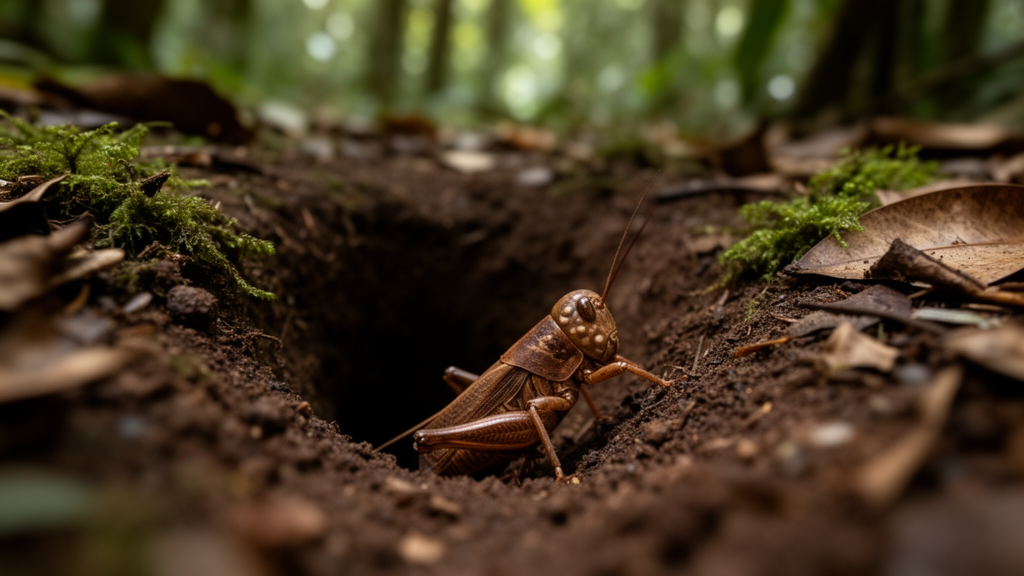
Beyond anatomy, the biology of Tryposoma is what gives the genus its name. The etymology derives from the Greek trýpes, meaning hole, and soma, meaning body — Tryposoma, hole inhabiting. All known species in East Africa are nocturnal and live in closed forest from lowland to montane zones. During the day they hide in holes dug into the ground; at night they emerge onto the forest floor among leaf litter or perch on low vegetation. Field photographs from the Mazumbai forest reserve in the West Usambara Mountains show a male sitting in its hole and later emerging after dark. Every species and population studied is seasonal, with adults appearing during the warm period of the year, typically from December to April — the first wet season.
The distribution of the two species is revealing. Tryposoma brachyurum is known from the East and West Usambara Mountains, with specimens from the Zigi trail, Amani Nature Reserve, Nilo forest reserve, and Magoroto Estate in the east, and the Mazumbai, Ndelemai, and Magamba forest reserves in the west, alongside earlier collections from the Kazimzumbwi and Kambai forest reserves. Tryposoma kilomeni is restricted to the montane forests of the North Pare Mountains, with the type series from the Kindoroko forest reserve at 1,750 meters elevation. This patchwork of montane forest localities mirrors the fragmented sky-island geography of the Eastern Arc Mountains, a recognized biodiversity hotspot where many species are confined to single forest blocks.
The taxonomic history of the type species adds a cautionary tale about working with immature specimens. Tryposoma brachyurum was originally described from an immature female — the holotype nymph held at the Natural History Museum in Vienna, collected in Dar es Salaam. Only by comparing that specimen with additional immature and adult material examined by Johns and Hemp in 2015, together with specimens subsequently collected in Tanzania by Claudia Hemp, could the accurate identification be confirmed. The study also provides a species key for adults: Tryposoma brachyurum is large, at 35 to 40 millimeters, with triangular distal lobes on the male subgenital plate and cylindrical styli, while Tryposoma kilomeni is medium-sized at about 28 millimeters, with rounded distal lobes, divergent styli that thicken progressively from base to apex, and a female subgenital plate bearing a small medial prolongation. The authors conclude that the genus should not be placed in any of the current tribes until additional evidence is presented — a reminder that in chevron crickets, as in much of African orthopteran diversity, systematic study remains imperative to ascertain species status and define genera using characteristics beyond traditional criteria.
Subject of Research: Taxonomic description of Tryposoma gen. nov., a new genus of Anostostomatidae crickets from Tanzania, including comparative morphology and genital structure analysis.
Article Title: Studies on chevron crickets: Tryposoma gen. nov. ( Orthoptera , Anostostomatidae ), a new genus from Tanzania
Article References: Cadena-Castañeda, O. J., & Hemp, C. (2024). Studies on chevron crickets: Tryposoma gen. nov. (Orthoptera, Anostostomatidae), a new genus from Tanzania. Journal of Orthoptera Research, 33(1), 59-66. https://doi.org/10.3897/jor.33.115670
Image Credits: AI Generated
Keywords: Tryposoma, chevron crickets, Anostostomatidae, Tanzania, Orthoptera, taxonomy, new genus, king crickets, male genitalia, Eastern Arc Mountains, Studies, chevron
Cite Scienmag News
Gavin Prescott. (October 19, 2026). New hole-dwelling cricket genus Tryposoma uncovered in Tanzania’s mountain forests. Scienmag. https://scienmag.com/new-hole-dwelling-cricket-genus-tryposoma-uncovered-in-tanzanias-mountain-forests/
Gavin Prescott. "New hole-dwelling cricket genus Tryposoma uncovered in Tanzania’s mountain forests." Scienmag, 19 October 2026, https://scienmag.com/new-hole-dwelling-cricket-genus-tryposoma-uncovered-in-tanzanias-mountain-forests/. Accessed 19 October 2026.
Gavin Prescott. "New hole-dwelling cricket genus Tryposoma uncovered in Tanzania’s mountain forests." Scienmag. October 19, 2026. https://scienmag.com/new-hole-dwelling-cricket-genus-tryposoma-uncovered-in-tanzanias-mountain-forests/


