


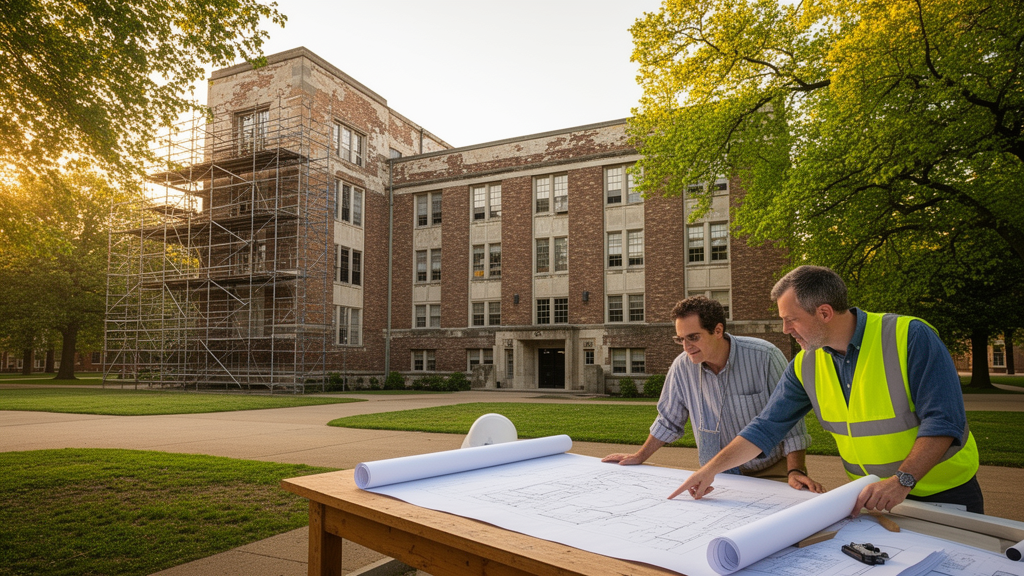
Across Western Europe, the building sector is confronting an uncomfortable truth: the era of endless new construction is over. Cities are largely built out, and the priority has shifted decisively to the renovation and transformation of what already exists. The European Union has made this explicit, requiring member states to decarbonize their building stock by 2050 under the revised Energy Performance of Buildings Directive, with renovation rates needing to climb to at least 2 to 3 percent of the stock every year. Yet progress remains slow, and the technical question of how to renovate in a way that is genuinely circular—rather than simply energy-efficient—has remained surprisingly unsettled.
Now, a critical literature review published in Frontiers in Built Environment by Fujing Ma, Torsten Schröder, and Juliette Bekkering of Eindhoven University of Technology has taken aim at this conceptual fog. The team, based in the university’s Circular Built Environment Group, systematically analyzed academic papers and practice guidelines to clarify what circular renovation actually means, identify the barriers constraining its implementation, and synthesize the approaches available for one particularly urgent category of building stock: aged educational buildings. Their findings reveal a field that is expanding rapidly but remains fragmented, with definitions that diverge across scales, temporalities, and levels of abstraction.
The urgency is not abstract. Globally, the construction industry accounts for more than 32 percent of energy consumption, generates more than 25 percent of global solid waste, and is responsible for roughly 35 percent of total greenhouse gas emissions. Within the European Union, buildings account for about 40 percent of energy consumption and 36 percent of CO2-equivalent emissions. In the Netherlands, a country widely regarded as a circular economy frontrunner with a government-wide plan to make its economy 50 percent circular by 2030 and fully circular by 2050, a considerable share of higher-educational buildings built during the university sector’s expansion in the 1960s and 1970s are now approaching or exceeding their intended service life, showing marked deficits in energy performance, spatial functionality, and indoor environmental quality.
The scale of the challenge is considerable. In the EU, an estimated 17 percent of non-residential buildings are educational. The Netherlands alone has around 12,000 educational buildings totaling approximately 20.6 million square meters of floor area, with higher-educational buildings accounting for 62 percent of that total. Many of these structures, averaging over 40 years in age, can no longer fully meet current standards for energy efficiency, material performance, structural safety, functionality, or building regulations. Yet the review’s authors are careful to note that educational buildings do not require a fundamentally different set of circular renovation principles from offices or hospitals. What makes them distinctive is how shared principles—retention, reuse, life extension, adaptability, reversibility—are prioritized, combined, and implemented under their particular functional, spatial, pedagogical, and institutional conditions.
One of the review’s central findings is that circular renovation remains a less clearly defined concept than circular design. While circular design for new construction has developed into a relatively mature body of knowledge, supported by frameworks from Stewart Brand’s shearing layers theory to Cheshire’s building revolutions approach to the Ellen MacArthur Foundation and Arup’s Circular Building Toolkit, circular renovation has produced only six distinct definitions in the literature the team identified. These range from the Ellen MacArthur Foundation’s aspirational framing of durability and adaptability to DRIVE 0’s ambitious benchmark of renovation powered entirely by life-cycle renewable energy. Most, the authors conclude, function either as conceptual visions or strategic reference points, providing little decision support at the level of actual renovation practice, and none is tailored to the specific context of aged educational buildings.
To address this fragmentation, the review proposes its own definition: circular renovation of aged educational buildings is a systemic process of transforming existing buildings that integrates circular design principles with renovation practice, prioritizing the strategic retention, adaptation, and selective replacement of building elements across different layers. It does so by combining material circularity, energy performance improvement, and spatial adaptability, in order to extend both functional and building lifespans. Crucially, the definition bridges a gap that existing frameworks have largely ignored: the interrelationship between circular design and energy refurbishment. Of the six definitions analyzed, only DRIVE 0 explicitly incorporates energy renovation as a core component, leaving a significant conceptual divide between material loops and operational performance.
The review also maps the barriers to implementation with unusual precision, adopting a dual-lens classification that differentiates between renovation stages and building elements. Across five stages—pre-renovation assessment, design and decision-making, permitting and regulatory approval, construction and deconstruction, and operation and long-term maintenance—the barriers are cumulative rather than isolated. Information gaps span all five stages, reflecting persistent technical uncertainty, data fragmentation, and incomplete records. Regulatory barriers concentrate in the middle of the process, where compliance uncertainty for reused structural components and absent standards for reclaimed materials create procedural delays. Economic uncertainty emerges at the pre-renovation, construction, and operation stages, linked to high perceived upfront costs and the long-term erosion of circular value.
At the building-element level, the barriers materialize unevenly across what Brand called shearing layers—the site, structure, skin, services, space plan, and stuff that compose a building and change at different rates. Structural components, with their long service lives and high physical integration, resist disassembly and reuse, so circular strategies here prioritize preservation and life extension rather than component recycling. Envelope systems, though more frequently replaced, are multi-layered and tightly integrated with adhesives and membranes of low separability, frequently preventing dismantling without significant material loss. Building services—ventilation, heat recovery, heating, cooling, hot water, photovoltaics—have shorter lifespans yet are deeply embedded in structural and spatial systems, limiting modular replacement. Notably, installations can contribute up to 67 percent of the total embodied emissions associated with energy renovation measures, with 60 to 80 percent of their environmental impact occurring during production, highlighting the importance of circular design across service system lifecycles.
The review’s most distinctive contribution is its application of the shearing layers concept as an organizing lens to classify circular renovation approaches at the building scale. Because layers change at different rates, circularity cannot be applied uniformly but must be matched to each layer’s lifespan and functional role. For the structure layer, the highest-value circular strategy is retention and life extension, with reversible connections such as bolted steel and dry joints where replacement is unavoidable. For the skin, energy-efficiency measures like insulation upgrades converge with circular strategies like modular facade systems and reversible connections. For services, circularity emphasizes accessibility, modularity, replaceability, and upgradability rather than material durability alone. For space plan and stuff, flexible layouts and modular, repairable interior elements dominate. This layer-based classification converts broad circular design intentions into concrete, layer-specific interventions, showing how energy-efficiency and circularity measures align or compete at each layer rather than operating as separate agendas.
The authors acknowledge that their contributions are primarily a critical synthesis of a fragmented literature, along with modest conceptual extensions, and that the proposed definition and layer-based classification should be understood as hypotheses for testing rather than fully validated decision-making tools. The review relied on Scopus as its single primary database, restricted its search to English- and Dutch-language sources, and involved interpretive judgment in source selection. Still, the team outlines a future research agenda centered on what they call the circularity–energy–learning performance coupling: future work should address retention, disassembly, reuse, and lifespan extension; operational carbon, envelope, and system efficiency; and learning adaptability, flexibility, sharing, and hybrid learning as interdependent rather than separate objectives. Aged educational buildings, they argue, are not only technical objects but also learning environments that play a crucial role in inspiring future generations. Renovation projects can act as living laboratories, demonstrating how reuse, adaptability, and resource efficiency can be embedded in everyday spaces—and, when circular principles are made materially visible within students’ daily educational experience, they can shift awareness and inspire the practices that will define the built environment of the coming decades.
Subject of Research: Circular renovation of aged educational buildings
Article Title: Conceptualizing circular renovation for aged educational buildings: a critical review of definitions, barriers, and approaches
Article References: Ma, F., Schröder, T., & Bekkering, J. (2026). Conceptualizing circular renovation for aged educational buildings: a critical review of definitions, barriers, and approaches. Frontiers in Built Environment, 12, Article 1925223. https://doi.org/10.3389/fbuil.2026.1925223
Image Credits: AI Generated
DOI: 10.3389/fbuil.2026.1925223
Keywords: circular economy, circular renovation, educational buildings, shearing layers, building renovation, sustainability, Conceptualizing, circular, renovation, aged, educational, buildings
Cite Scienmag News
Beatrice Stafford. (October 19, 2026). Circular renovation gets a blueprint for aging university buildings. Scienmag. https://scienmag.com/circular-renovation-gets-a-blueprint-for-aging-university-buildings/
Beatrice Stafford. "Circular renovation gets a blueprint for aging university buildings." Scienmag, 19 October 2026, https://scienmag.com/circular-renovation-gets-a-blueprint-for-aging-university-buildings/. Accessed 19 October 2026.
Beatrice Stafford. "Circular renovation gets a blueprint for aging university buildings." Scienmag. October 19, 2026. https://scienmag.com/circular-renovation-gets-a-blueprint-for-aging-university-buildings/


