


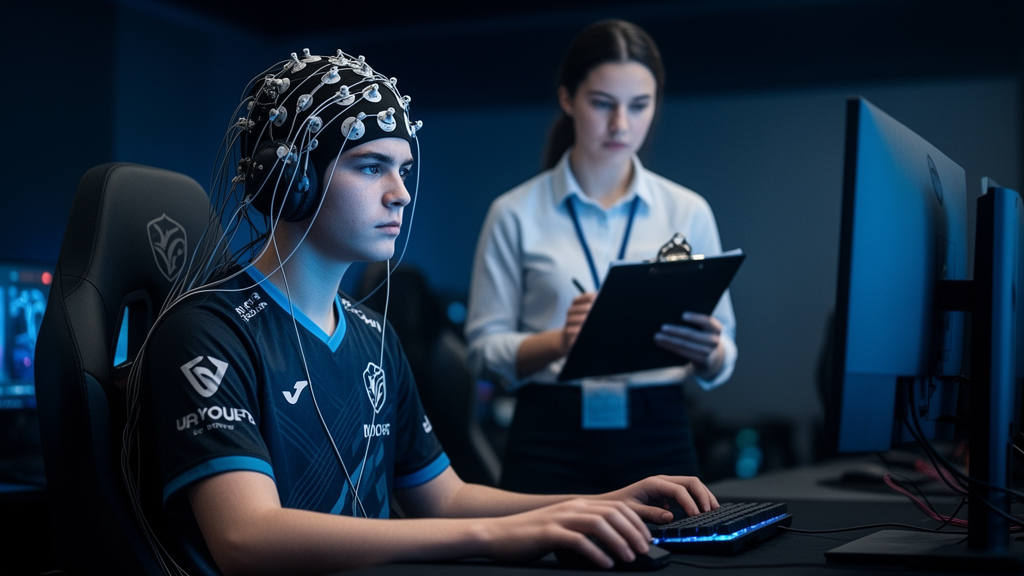
Competitive video gaming has quietly become one of the world’s largest performance industries, and with it has come a growing catalogue of mental health complaints: depression, anxiety, poor sleep and chronic exhaustion. What has been missing is a way to see how all of those problems fit together. A new study published in BMC Psychology by Lucas Van Ruysevelt, Jolan Kegelaers and colleagues at the Vrije Universiteit Brussel and international partners offers the most detailed attempt yet, drawing on responses from 1,025 esports players across more than 60 countries to map the architecture of psychological distress in competitive gaming.
The team’s central innovation was methodological. Rather than treating each symptom as an isolated risk factor, they used two advanced statistical models — a Bayesian Gaussian Graphical Copula Model and a Directed Acyclic Graph, or DAG — to estimate how seventeen carefully chosen indicators depend on one another. Each indicator, from depressed mood and uncontrollable worrying to sleep quality, mental fatigue, emotion control, autonomy and esports-specific stress, was measured with a single, theoretically anchored item on a ten-point scale, covering the previous two weeks. The result is not a list of problems but a wiring diagram of how they connect.
The scale of the underlying burden is striking. Earlier work from the same Erasmus+ ‘The Good Game’ project, which spans research institutions in Belgium, Spain, Iceland, Germany and Sweden, found that nearly 45 percent of esports players reported depressive symptoms, a third reported anxiety, and almost 70 percent reported sleep disturbances. In the new sample, the highest-scoring indicators were a perceived lack of skill, mental fatigue and insufficient sleep quantity — all averaging above five on the ten-point scale — suggesting that exhaustion and self-doubt are woven into the daily experience of players at every level, from recreational to internationally ranked professionals.
The network analysis produced a clear headline finding: game-related thought preoccupation, a core feature of gaming disorder, emerged as the most robust ‘sink’ node in the entire system. In plain terms, intrusive thoughts about the game sat at the bottom of the dependency structure, receiving arrows from several psychosocial indicators but sending none out. The authors propose a provocative hypothesis: that obsessive preoccupation with gaming may not be the root cause of distress at all, but rather a compound downstream signal of broader psychosocial strain — a maladaptive coping response rather than a primary driver.
At the other end of the map sat depressed mood. It was the only source node in the estimated network, with outgoing connections to anhedonia, anxiety, worrying, mental fatigue, diminished emotion control and a lack of personal support, and no incoming arrows of its own. The strongest single dependencies in the whole model ran from depressed mood to anxiety and to anhedonia. The researchers are careful to stress that these arrows reflect statistical conditional dependence, not proven causation — and the depressed-mood-to-anxiety edge was only weakly directed, hinting that the relationship between the two may in fact be reciprocal.
Perhaps the most unexpected structure appeared in the sleep and fatigue cluster. Conventional clinical thinking treats fatigue as a consequence of poor sleep; this network suggested the reverse. Mental fatigue occupied an intermediate, connecting position between the affective variables and the sleep indicators, positioned upstream of both sleep quantity and sleep quality. The authors speculate that in high-pressure competitive environments, players may end gruelling twelve-hour training days thoroughly exhausted yet too physiologically and psychologically aroused to sleep well — a pattern familiar from overtraining research in traditional sport, where extreme loads provoke insomnia-like symptoms despite profound tiredness.
Between the emotional and the esports-specific clusters, the analysis identified a structural bottleneck. A lack of emotion control and a lack of autonomy together formed a minimal edge cut: remove both nodes, and every directed path from depressed mood and anxiety to esports stress, game preoccupation and inadequate esports support disappears. This aligns with self-determination theory, which places autonomy at the heart of well-being, and with growing evidence that emotion regulation is a persistent weak point in esports. Unlike traditional athletes, most players develop through largely self-directed online play with little structured coaching, offering few opportunities to build these skills.
The authors are unusually candid about the limits of their map. The data are cross-sectional, so no causal or temporal claims can be made; the DAG cannot represent feedback loops that many of these relationships almost certainly involve; and each node was a single item, meaning broad constructs like autonomy and emotion regulation stand in as proxies rather than validated measures. Sensitivity analyses showed the game-preoccupation sink was the most stable feature, holding in 88 percent of bootstrap resamples, while the emotion-control and autonomy bottleneck was the least stable, surviving in under a third. Every pathway, the team insists, is a hypothesis to be tested, not a finding to be acted on.
Even so, the study opens concrete research directions. The most fundamental question it frames is whether distressed players are drawn to competitive gaming as an escape — esports as coping — or whether the demands of the environment generate the distress — esports as stress — or whether both processes reinforce each other over time. It also flags mental fatigue as an under-examined variable that may deserve a central place in future studies of training load, recovery and sleep, and suggests that interventions targeting emotion regulation and autonomy could pay dividends across the whole network.
For an industry that valorises relentless grinding and often lacks the coaching infrastructure of traditional sport, the implications are hard to ignore. The study does not tell teams or players what to change tomorrow, but it provides something the field has never had: a structured, testable map of where the pressure actually pools. If follow-up longitudinal and intervention research confirms these pathways, the route to healthier players may run not through treating symptoms one by one, but through the connective tissue the network has now exposed — mood, fatigue, autonomy and control.
Subject of Research: Psychosocial network analysis of mental health, sleep and esports-specific stressors among competitive video game players
Article Title: Mapping mental health complexity in esports: an exploratory psychosocial network approach
Article References: Van Ruysevelt, L., Van Heel, M., Trotter, M. G., Watson, M., Pedraza-Ramirez, I., Bonilla, I., Davis, P., Ragnarsson, J., Mairesse, O., & Kegelaers, J. (2026). Mapping mental health complexity in esports: an exploratory psychosocial network approach. BMC Psychology, 14(1), Article 1504. https://doi.org/10.1186/s40359-026-05800-y
Image Credits: AI Generated
DOI: 10.1186/s40359-026-05800-y
Keywords: esports, mental health, network analysis, depression, sleep disturbances, mental fatigue, gaming disorder, emotion regulation, autonomy, Bayesian networks, directed acyclic graph, psychosocial stressors
Cite Scienmag News
Glenn Wilkins. (October 19, 2026). Scientists Map the Hidden Network Behind Esports Players’ Mental Health. Scienmag. https://scienmag.com/scientists-map-the-hidden-network-behind-esports-players-mental-health/
Glenn Wilkins. "Scientists Map the Hidden Network Behind Esports Players’ Mental Health." Scienmag, 19 October 2026, https://scienmag.com/scientists-map-the-hidden-network-behind-esports-players-mental-health/. Accessed 19 October 2026.
Glenn Wilkins. "Scientists Map the Hidden Network Behind Esports Players’ Mental Health." Scienmag. October 19, 2026. https://scienmag.com/scientists-map-the-hidden-network-behind-esports-players-mental-health/


