


A seven-year-old boy arrived at the hospital with a combination of symptoms that pediatricians see regularly: fever, difficulty swallowing, and a stiff neck. The clinical picture pointed toward a deep neck space infection, and an initial contrast-enhanced computed tomography scan appeared to confirm the suspicion, suggesting a left parapharyngeal abscess. Surgical drainage was planned. What a team of radiologists subsequently uncovered, however, was something far more dangerous hiding behind that familiar diagnosis, and their findings, published in Pediatric Radiology, offer a stark lesson about how easily a life-threatening vascular lesion can masquerade as a routine infection.
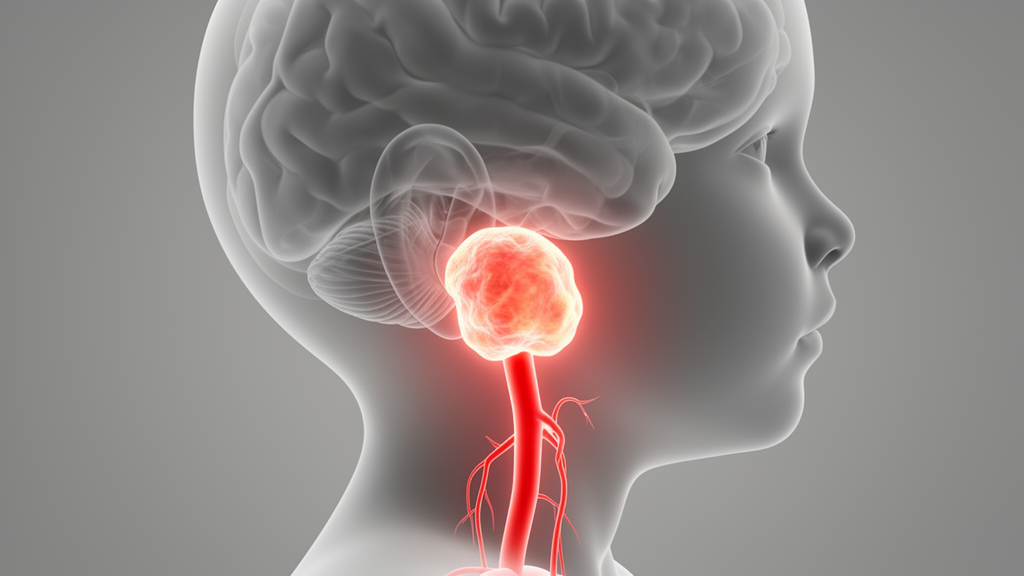
The case, reported by Lamya Eissa of Alexandria Faculty of Medicine, Esra’a Alyateem of the University of Jordan, and Hassan Magdy Abdelrazek of Mansoura University, describes a completely thrombosed mycotic pseudoaneurysm of the cervical internal carotid artery in a malnourished child. A mycotic aneurysm, despite its name, has nothing to do with fungal infection in most cases; the term refers to an infected, weakened segment of an artery wall that balloons outward under arterial pressure. When such a lesion fills with clot, it loses the flowing blood signal that normally gives it away on imaging, and instead presents as a solid-appearing mass that can be nearly indistinguishable from a collection of pus.
Parapharyngeal abscesses are relatively rare in children but carry serious risk. The parapharyngeal space is a deep compartment of the neck bounded by critical structures, including the carotid sheath, which houses the internal carotid artery, the internal jugular vein, and cranial nerves. Infection in this space can spread along fascial planes toward the mediastinum, and documented vascular complications include arterial narrowing, pseudoaneurysm formation, and ischemic stroke. Prior literature, cited in the report, has described internal carotid artery pseudoaneurysms arising secondary to retropharyngeal and parapharyngeal abscesses, as well as carotid mycotic pseudoaneurysms masquerading as peritonsillar abscesses in pediatric patients.
The danger in this specific scenario is mechanical as much as infectious. If a surgeon incises what appears to be an abscess but is actually an aneurysm, the result can be catastrophic hemorrhage. A pseudoaneurysm is a false aneurysm: blood escapes through a defect in the arterial wall and is contained not by the vessel’s own layers but by surrounding tissue, forming a fragile sac. The classic ultrasound signature of a patent pseudoaneurysm is the so-called to-and-fro waveform, in which blood surges into the sac during systole and back into the artery during diastole. But when the sac is completely thrombosed, that diagnostic flow pattern vanishes, and the lesion becomes a silent impostor.
That is precisely what happened in this child. The initial contrast-enhanced CT was suboptimal, and it suggested an abscess rather than a vascular lesion. Only when the team pursued dedicated, high-quality multimodal imaging did the true nature of the mass emerge. The workup included magnetic resonance imaging with diffusion-weighted imaging and apparent diffusion coefficient mapping, magnetic resonance angiography, and three-dimensional CT angiography. Each modality contributed a different piece of evidence, and together they overturned the working diagnosis before a scalpel ever touched the neck.
The technical logic of this multimodal approach is worth unpacking. Diffusion-weighted imaging is exquisitely sensitive to restricted water diffusion, which is characteristic of pus-filled abscess cavities; on apparent diffusion coefficient maps, abscesses typically show marked hypointensity because the viscous, cellular contents of pus impede the random motion of water molecules. A thrombosed aneurysm, by contrast, contains organized clot whose diffusion characteristics differ from those of an abscess. Magnetic resonance angiography visualizes flowing blood without ionizing radiation and can demonstrate the absence of flow within the lesion as well as the relationship of the mass to the parent internal carotid artery. Three-dimensional CT angiography then provides high-resolution anatomical mapping of the cervical vasculature, delineating the aneurysm’s origin, size, and spatial relationship to the skull base and surrounding structures.
The case also highlights the role of the child’s nutritional status. Malnutrition is known to impair immune function and tissue integrity, and the report’s authors note that the patient was malnourished at presentation. Infected aneurysms in children are rare, and when they occur, they are often secondary to bacteremia, local infection spread, or, as in documented cases, deep neck abscesses eroding into the adjacent carotid artery. The report’s associated subject listings, which include primary herpetic gingivostomatitis and meningitis among related topics, reflect the infectious context in which such vascular complications arise.
What makes this case report valuable to clinicians is not the rarity of the lesion alone but the specificity of the imaging lesson it delivers. Complete thrombosis transforms a mycotic pseudoaneurysm into a mass that can easily be mistaken for an abscess without the right imaging modalities and high-quality imaging, the authors conclude. In practical terms, this means that when a deep neck mass in a child does not behave as expected, when contrast enhancement is suboptimal, or when the anatomical relationship to the carotid sheath is unclear, the workup should escalate to dedicated MRI with diffusion-weighted sequences, MR angiography, and CT angiography rather than proceeding to incision and drainage on the basis of a single imperfect scan.
The stakes of that escalation are enormous. Misdiagnosed and incised, an infected carotid pseudoaneurysm can exsanguinate a patient within minutes, and even when recognized, management is complex, often requiring endovascular or surgical intervention combined with prolonged antimicrobial therapy. Recognized vascular complications of deep neck infections also include internal carotid artery narrowing, as documented in children with retropharyngeal lymphadenitis and abscess, and ischemic stroke secondary to carotid pseudoaneurysm, as reported in the pediatric literature. The parapharyngeal space’s proximity to the carotid sheath means that every deep neck infection carries at least a theoretical vascular risk, and this case demonstrates how that theoretical risk can become a concrete diagnostic trap.
For the broader radiology and pediatric communities, the case reinforces a principle that imaging specialists have long championed: no single modality is definitive, and the diagnosis of a deep neck mass in a child demands correlation across clinical findings, laboratory data, and complementary imaging techniques. The authors’ contribution statement indicates that the work encompassed conceptualization, imaging analysis, study design, and figure preparation, with all authors reviewing and approving the final version. Conducted in accordance with the Declaration of Helsinki and published with informed parental consent, the report adds a well-documented data point to a small but clinically critical literature. As deep neck infections continue to present in emergency departments worldwide, this child’s story stands as a warning that the most familiar diagnosis is not always the correct one, and that the tools to see the difference already exist for those who know to reach for them.
Subject of Research: Pediatric Radiology
Article Title: Thrombosed mycotic aneurysm of the cervical internal carotid artery mimicking a parapharyngeal abscess in a child: a case report of multimodal imaging diagnosis
Article References: Eissa, L., Alyateem, E., & Abdelrazek, H. M. (2026). Thrombosed mycotic aneurysm of the cervical internal carotid artery mimicking a parapharyngeal abscess in a child: a case report of multimodal imaging diagnosis. Pediatric Radiology. https://doi.org/10.1007/s00247-026-06814-9
Image Credits: AI Generated
DOI: 10.1007/s00247-026-06814-9
Keywords: mycotic aneurysm, pseudoaneurysm, internal carotid artery, parapharyngeal abscess, deep neck infection, multimodal imaging, diffusion-weighted MRI, CT angiography, pediatric radiology, thrombosis, case report, diagnostic imaging
Cite Scienmag News
Ophelia Keating. (October 19, 2026). When a Neck Abscess Is Actually a Blood Vessel: Rare Arterial Danger Unmasked in a Child. Scienmag. https://scienmag.com/when-a-neck-abscess-is-actually-a-blood-vessel-rare-arterial-danger-unmasked-in-a-child/
Ophelia Keating. "When a Neck Abscess Is Actually a Blood Vessel: Rare Arterial Danger Unmasked in a Child." Scienmag, 19 October 2026, https://scienmag.com/when-a-neck-abscess-is-actually-a-blood-vessel-rare-arterial-danger-unmasked-in-a-child/. Accessed 19 October 2026.
Ophelia Keating. "When a Neck Abscess Is Actually a Blood Vessel: Rare Arterial Danger Unmasked in a Child." Scienmag. October 19, 2026. https://scienmag.com/when-a-neck-abscess-is-actually-a-blood-vessel-rare-arterial-danger-unmasked-in-a-child/


