


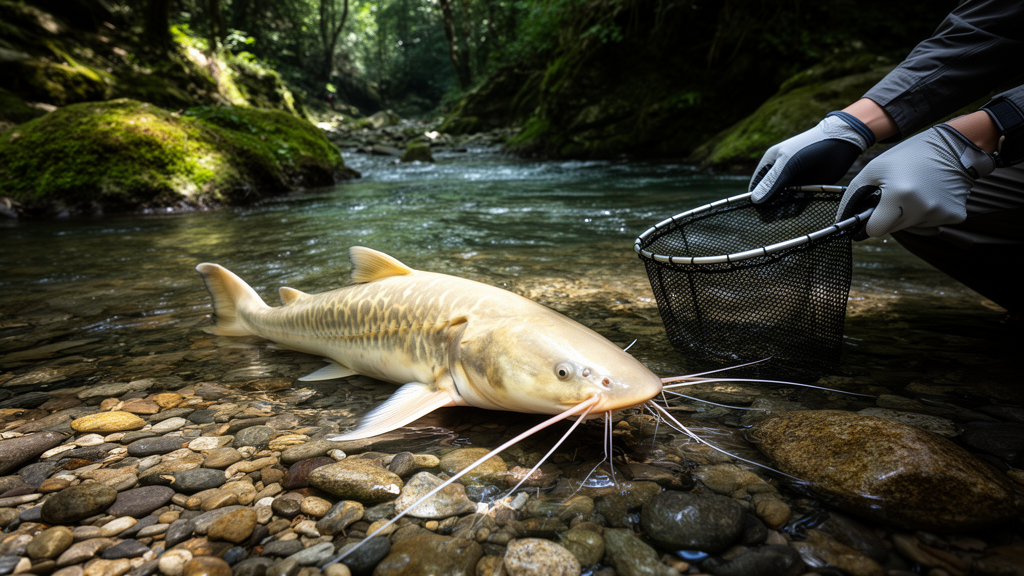
A strikingly patterned catfish with bright yellow spots and stripes against a dark body has been formally described as a new species from the upper Pearl River system in southwest China. The fish, named Glyptothorax pulcher, was collected from the Tuoniang River in south-eastern Yunnan Province and western Guangxi Zhuang Autonomous Region, and its description, published in the journal Zoosystematics and Evolution, marks the first new species of this catfish genus discovered east of the Red River in China in more than two decades. The species epithet pulcher is Latin for beautiful, a nod to the animal’s distinctive and attractive colouration, and researchers have suggested mei li wen xiong zhao as its common name in Chinese.
The genus Glyptothorax is one of the most successful groups of small catfishes in Asia, with a range stretching from the Euphrates and Tigris river basins in Turkey in the west all the way to the Yangtze River in China in the east, and southwards to Borneo and Java. It is the most species-rich genus in the family Sisoridae, and its members share one of the most remarkable adaptations in freshwater fish biology: a thoracic adhesive apparatus, a patch of longitudinal or oblique skin folds arranged in an roughly elliptical area on the underside of the chest. This natural suction cup allows the fish to cling to rocks and gravel in fast-flowing hill streams, holding its position against currents that would sweep away less specialised fish.
China is a stronghold for the genus, with 27 documented species as of 2025. Most of these are concentrated in the south-west of the country, in the great river systems of the Brahmaputra, Irrawaddy, Nujiang-Salween, Lancangjiang-Mekong and Red River. Only four species were previously known from the vast area east of the Red River, encompassing the Pearl River, the Yangtze River, Hainan Island and the south-eastern coastal drainages. It was in this comparatively well-surveyed region that the new catfish turned up, a reminder that even familiar waters can still conceal undocumented biodiversity.
Between 2023 and 2024, researchers collected specimens from Yunnan and Guangxi, preserving them initially in 10 percent formalin before transferring them to 75 percent ethanol for long-term storage. Small clips of right pelvic fin tissue were kept in pure alcohol for genetic work. The team assembled a type series of 28 specimens, with the holotype, an 83.5 millimetre individual from Bamei Town in Guangnan County, and 17 paratypes deposited at the Kunming Zoological Museum of the Kunming Institute of Zoology, Chinese Academy of Sciences, and a further 10 paratypes held at the Fisheries Administration of Qiubei in Yunnan. The paratypes range from 47.1 to 106.4 millimetres in standard length and come from three localities: the Tuoniang River at Bamei, the Xiyang River at Banbang Township, and the Leli River in Tianlin County, Guangxi.
Morphologically, G. pulcher most closely resembles G. quadriocellatus, sharing a similar outline, skin tubercles and general colour pattern. Yet a careful combination of traits separates it from all of its relatives east of the Red River. The new species has a distinctive dark body marked with bright yellow spots and stripes, sparse soft tubercles on the skin that feel similar in texture to the surrounding tissue, and a smooth dorsal surface on the head. Its thoracic adhesive apparatus is unusually broad, with a length of just 1 to 1.2 times its width, and the apparatus spans 12.0 to 14.3 percent of standard length. The adipose fin base is short, measuring 11.7 to 15.4 percent of standard length, and the caudal peduncle, the narrow stalk preceding the tail fin, is notably deep and short, at 13.7 to 17.5 percent of standard length in depth terms and 10.3 to 12.3 percent in depth.
Compared specifically with G. quadriocellatus, the new species lacks the yellow spot behind the eye that its relative possesses, has smooth rather than tubercled skin on top of the head, a broader adhesive apparatus with a width of 12.0 to 14.3 percent of standard length versus 9.4 to 11.1 percent, no anteromedial striae on the adhesive disc, and a shorter adipose fin base. Against G. interspinalum, it again shows the broader adhesive disc and a shorter, deeper caudal peduncle. These measurements, taken with micrometer calipers to the nearest 0.1 millimetre and expressed as proportions of standard length and head length, follow established taxonomic conventions for the genus, and fin ray and vertebral counts were verified using X-ray imaging.
The colour pattern alone makes the fish unmistakable. In preserved specimens the head and body are brownish-black, with a light yellow ventral surface and adhesive apparatus. A yellow mid-dorsal stripe runs along the back, and yellow spots mark the dorsal fin origin, sometimes merging into a saddle patch. All of the fins are basically black with yellow margins: the dorsal fin carries a C-shaped yellow band, the paired and anal fins have irregular pincer-like yellow edges, and the caudal fin bears a large black dumbbell-shaped patch at its base with an M-shaped yellow posterior margin. In life, the brownish-black areas shift to a light chestnut colour and the adhesive apparatus turns pale pink, a living palette that justified the species name.
To test whether the morphology pointed to a genuinely distinct species, the team turned to DNA. They generated eleven new sequences of the mitochondrial cytochrome c oxidase subunit I gene, COI, and nine sequences of the cytochrome b gene from seven Glyptothorax species, adding eight previously published sequences to build a dataset of nineteen COI and seventeen Cyt b sequences. Two outgroup species, Bagarius protos and Pseudecheneis brachyura, were included to root the tree. Phylogenies were reconstructed with both Maximum Likelihood, using IQ-TREE with ultrafast bootstrap support over 1,000 iterations, and Bayesian Inference, using MrBayes with two independent runs of Markov Chain Monte Carlo for 10 million generations, with convergence confirmed when the average standard deviation of split frequencies fell below 0.01.
Both methods recovered the same topology and delivered a clear verdict. The new species forms a strongly supported monophyletic group, and within the broader tree it sits as the sister lineage to G. pallozonum, another Pearl River inhabitant. The two species fall within a clade of dark-bodied fish decorated with creamy or bright yellow spots and stripes, distinct from a second clade of species bearing black saddle-like patches. Kimura 2-parameter genetic distances between G. pulcher and G. pallozonum, based on the COI gene, range from 5.7 to 6.0 percent, a level of divergence consistent with separate species status in this group. The phylogeny also matched the patterns reported by earlier studies of the genus, reinforcing confidence in the result.
The study produced a second, equally consequential finding: a taxonomic revision that removes a name from the books. Glyptothorax zhujiangensis, described in 2003 from the Pearl River Delta, has long been treated as valid, but its type specimens have been lost. The holotype and nine paratypes once held at the Institute of Hydrobiology in Beijing cannot be found, the ten remaining paratypes were reportedly kept at an institution in Zhuhai that apparently never existed, and no photographs survive. The team collected fresh specimens matching the original description from the Pearl River Delta, roughly 50 kilometres from the type locality, and found that these fish nest firmly within G. pallozonum in the phylogenetic tree, with COI distances of just 0.3 to 1.0 percent. Given the overlapping morphology, the minimal genetic separation and the fact that G. pallozonum’s known range already includes the type locality of G. zhujiangensis, the authors conclude that the two are conspecific and that G. zhujiangensis should be regarded as a junior synonym of G. pallozonum, with the apparent differences likely reflecting populational variation, measurement error and the small size of the original type series.
For now, G. pulcher is known only from the Tuoniang River basin, a sub-basin of the upper Pearl River in Yunnan and Guangxi, and its discovery hints that the hill streams of southern China may hold more surprises. The combination of classical morphology, X-ray verified anatomy and mitochondrial genomics used here offers a template for untangling the region’s catfish diversity, and the loss of the G. zhujiangensis type material stands as a cautionary tale about the irreplaceable value of museum specimens. As researchers continue to survey the upper Pearl River’s rocky, fast-flowing tributaries, the beautiful new catfish serves as both a celebration of hidden biodiversity and an argument for protecting the clear hill streams that such specialised species depend on.
Subject of Research: Description of a new sisorid catfish species, Glyptothorax pulcher, from the upper Pearl River basin in China, with molecular phylogenetic analysis and taxonomic revision
Article Title: Glyptothorax pulcher ( Siluriformes , Sisoridae ), a new species from the upper Pearl River of Yunnan and Guangxi, southwest China
Article References: Zeng, Y.-Y., Lin, F., Yang, H.-F., Pu, X.-R., Jiang, W.-S., & Chen, X.-Y. (2026). Glyptothorax pulcher (Siluriformes, Sisoridae), a new species from the upper Pearl River of Yunnan and Guangxi, southwest China. Zoosystematics and Evolution, 102(1), 17-26. https://doi.org/10.3897/zse.102.167142
Image Credits: AI Generated
Keywords: Glyptothorax pulcher, new species, catfish, Sisoridae, Pearl River, Yunnan, Guangxi, taxonomy, molecular phylogeny, COI, cytochrome b, freshwater biodiversity
Cite Scienmag News
Margaret Porter. (October 19, 2026). Beautiful New Catfish Species Discovered Hiding in China’s Pearl River Headwaters. Scienmag. https://scienmag.com/beautiful-new-catfish-species-discovered-hiding-in-chinas-pearl-river-headwaters/
Margaret Porter. "Beautiful New Catfish Species Discovered Hiding in China’s Pearl River Headwaters." Scienmag, 19 October 2026, https://scienmag.com/beautiful-new-catfish-species-discovered-hiding-in-chinas-pearl-river-headwaters/. Accessed 19 October 2026.
Margaret Porter. "Beautiful New Catfish Species Discovered Hiding in China’s Pearl River Headwaters." Scienmag. October 19, 2026. https://scienmag.com/beautiful-new-catfish-species-discovered-hiding-in-chinas-pearl-river-headwaters/


