


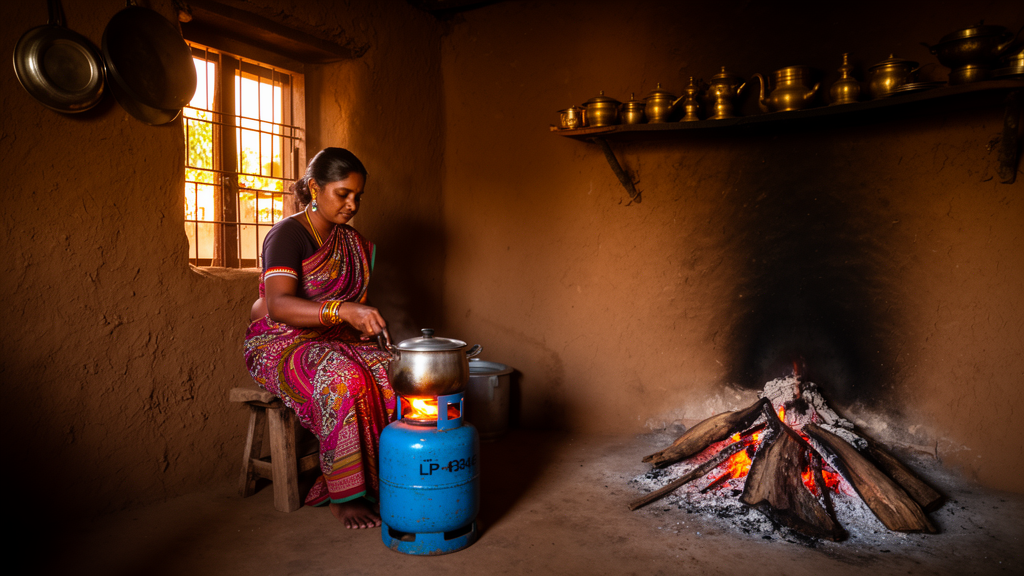
A new study of more than 14,500 tribal households in the eastern Indian state of Odisha has found that while the adoption of clean cooking fuels more than doubled over five years, fewer than one in eight such households actually cooked with a clean fuel by the end of the period. The research, published in the journal Discover Sustainability, examined trends, determinants and policy effects surrounding clean cooking fuel use among Scheduled Tribe households, with a particular focus on India’s flagship Pradhan Mantri Ujjwala Yojana, the programme that has provided liquefied petroleum gas connections to millions of below-poverty-line families since 2016. The findings paint a picture of genuine but fragile progress, in which the barriers to a full energy transition are as much economic and behavioural as they are infrastructural.
The analysis drew on unit-level data from the fourth and fifth rounds of the National Family Health Survey, conducted in 2015-16 and 2019-21 respectively, covering a total of 14,542 tribal households across Odisha. This period is analytically valuable because it straddles the launch of the Ujjwala scheme, allowing researchers to compare clean fuel adoption before and after the policy intervention. The headline number is stark: clean cooking fuel use among tribal households rose from just 5.3 percent in the fourth round to 12.6 percent in the fifth. That is a substantial relative improvement, yet it means that nearly nine out of ten tribal households in the state still relied on traditional biomass such as firewood, dung and crop residues for their daily cooking, with all the health and environmental burdens that entails.
To understand why some households made the switch and others did not, the researchers estimated binary probit and logit models, standard econometric techniques for modelling a binary outcome such as whether or not a household uses a clean fuel. Because these models produce coefficients that are not directly interpretable as probabilities, the team also calculated marginal effects, the change in the probability of adoption associated with each factor. The models were estimated separately for the two survey rounds and for rural and urban subsamples, and the results were statistically robust, with Wald chi-square tests significant at the one percent level and pseudo R-squared values indicating strong explanatory power.
The determinants that emerged tell a consistent story. Urban residence substantially increased the likelihood of clean fuel use: in the fifth round, the marginal effect of urban living was 8.2 percentage points, meaning urban tribal households were considerably more likely to cook with LPG than their rural counterparts, reflecting better supply chains, distribution networks and market access. Female-headed households were also more likely to adopt clean fuels, an effect that grew stronger between the two survey rounds, consistent with the idea that women, who bear the primary burden of cooking and fuel collection, are powerful agents of transition when they control household decisions. Education mattered in a graded fashion: primary education raised adoption modestly, secondary education more strongly, and higher education most strongly of all, with a marginal effect of 6.2 percentage points in the recent round.
Wealth was the single most powerful predictor. Households classified as rich had a marginal effect of 47.6 percentage points relative to poor households in the fifth round, while middle-wealth households showed an effect of 16.4 points. This gradient underscores a central tension in clean cooking policy: a free LPG connection does not by itself overcome the recurring costs of refills, which many poor households find prohibitive. The finding that larger family size reduced the probability of adoption, with a marginal effect of minus 2.4 percentage points per additional member, likely reflects the economics of cooking volume, since bigger families need more fuel and biomass remains effectively free even when its true cost, measured in smoke and labour, is enormous.
Two other negative determinants deserve attention because they speak to the specific livelihoods of tribal communities. Ownership of agricultural land reduced adoption probability by 1.7 percentage points, and ownership of livestock or farm animals reduced it by 2.2 points. These assets tie households to agrarian routines in which biomass is readily available and often collected as a by-product of farm work, lowering the perceived need to purchase fuel. Even more striking was the effect of cooking location: households that cooked outdoors were 11 percentage points less likely to use clean fuel than those with a separate kitchen room. Outdoor cooking, common in many tribal settlements, appears to reduce the perceived health benefits of switching, since smoke disperses in open air, and it also reflects housing conditions that limit the practical use of LPG stoves.
To isolate the effect of the Pradhan Mantri Ujjwala Yojana itself, the researchers employed a Propensity Score Matching combined with a Difference-in-Differences design, a quasi-experimental approach that compares below-poverty-line households eligible for the scheme with comparable non-eligible households before and after the intervention. The matching step constructs a counterfactual group of households statistically similar in observable characteristics, while the difference-in-differences step nets out time trends that would have occurred regardless of the policy. The results indicated a significantly higher increase in LPG adoption among below-poverty-line households during the PMUY period, providing credible evidence that the scheme did accelerate the transition among its intended beneficiaries rather than merely subsidising households that would have switched anyway.
The study also examined LPG adoption before and after the COVID-19 lockdown using the fifth-round data, with a treatment variable identifying PMUY households and an interaction term capturing the differential post-lockdown change. The interaction was positive and significant, with a marginal effect of 12.9 percentage points in the pre-COVID specification and 14.4 points in the post-COVID specification, again suggesting that the scheme’s beneficiaries gained ground relative to others. Yet the authors caution that connection-based targets are not the same as sustained use. A household that receives a free cylinder and regulator may revert to biomass once the first refills must be purchased at market prices, a pattern of partial or stacked fuel use that has been documented across the Global South and that limits the health dividends of LPG programmes.
The health stakes of this transition are considerable. Burning solid biomass indoors releases fine particulate matter, carbon monoxide and other pollutants at concentrations far exceeding safe guidelines, and the burden falls disproportionately on the women and children who spend the most time near the cookstove. Respiratory infections, chronic obstructive pulmonary disease, cardiovascular strain and low birth weight are among the documented consequences of household air pollution. For tribal communities, which already face elevated poverty and reduced access to healthcare, the persistence of biomass cooking represents a compounding disadvantage, which is precisely why the slow pace of transition documented in Odisha matters beyond the state’s borders.
The authors conclude that the path forward requires integrated, context-sensitive policy interventions that extend beyond connection-based targets. Affordability of refills, reliability of supply in remote and forested districts, behavioural change campaigns that address cooking habits and cultural preferences, and women’s empowerment within tribal communities all emerge as necessary ingredients of a genuine transition. The Odisha evidence suggests that the Ujjwala scheme opened a door that had long been closed to the poorest tribal households, but that walking through it, cylinder after cylinder, year after year, depends on incomes, infrastructure and social dynamics that a single subsidy cannot supply. As India pursues its broader clean energy ambitions, the kitchen, the study reminds us, remains one of the hardest places to change.
Subject of Research: Determinants of clean cooking fuel adoption among tribal households in Odisha under India's Pradhan Mantri Ujjwala Yojana
Article Title: Clean cooking fuel transitions among tribal households in Odisha under the Pradhan Mantri Ujjwala Yojana
Article References: Naik, D., Bera, R., Mohapatra, M., Behera, R. R., & Behera, R. R. (2026). Clean cooking fuel transitions among tribal households in Odisha under the Pradhan Mantri Ujjwala Yojana. Discover Sustainability. https://doi.org/10.1007/s43621-026-04857-4
Image Credits: AI Generated
DOI: 10.1007/s43621-026-04857-4
Keywords: clean cooking fuel, LPG, Pradhan Mantri Ujjwala Yojana, tribal households, Odisha, energy transition, NFHS, household air pollution, energy access, probit model, propensity score matching, women's empowerment
Cite Scienmag News
Violet Maxwell. (October 19, 2026). India’s Free LPG Scheme Lifts Tribal Households, But Clean Cooking Remains Rare in Odisha. Scienmag. https://scienmag.com/indias-free-lpg-scheme-lifts-tribal-households-but-clean-cooking-remains-rare-in-odisha/
Violet Maxwell. "India’s Free LPG Scheme Lifts Tribal Households, But Clean Cooking Remains Rare in Odisha." Scienmag, 19 October 2026, https://scienmag.com/indias-free-lpg-scheme-lifts-tribal-households-but-clean-cooking-remains-rare-in-odisha/. Accessed 19 October 2026.
Violet Maxwell. "India’s Free LPG Scheme Lifts Tribal Households, But Clean Cooking Remains Rare in Odisha." Scienmag. October 19, 2026. https://scienmag.com/indias-free-lpg-scheme-lifts-tribal-households-but-clean-cooking-remains-rare-in-odisha/


