


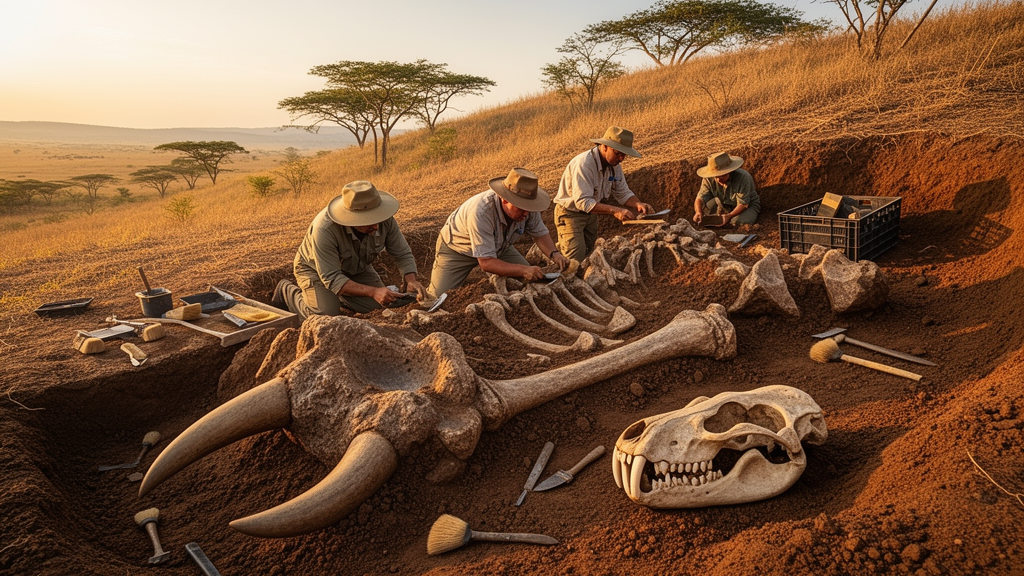
A windswept coastal plain on the Gulf of Venezuela has yielded one of the country’s most intriguing Ice Age assemblages. At a site called Cauca, in western Falcón State, palaeontologists have documented the remains of giant ground sloths, armoured glyptodonts, gomphothere elephants, extinct horses and a medium-sized wild cat, all preserved in a thin layer of ochre sand just beneath the surface. Radiocarbon dating of tooth enamel indicates the deposit is at least 40,000 years old, placing it firmly in the Late Pleistocene, a period when megafauna still dominated South American landscapes and early humans were spreading across the continent.
The site first came to scientific attention in January 2004, when a palaeontologist from the local municipality reported bones weathering out of the ground near the fishing village of Cauca, about 14.6 kilometres northwest of the town of Urumaco. Systematic work had to wait until 2021, when researchers secured permits and launched three excavation seasons across five work areas. The fossiliferous zone covers roughly 1,600 square metres, with eight distinct groupings of bones identified on the surface. Because the bone-bearing layer is only about 40 centimetres thick, excavations were shallow but productive, recovering 41 cranial and postcranial elements now housed in the palaeontological collection of the Urumaco municipality.
The geology of the site tells a story of environmental change. Today the region is semi-arid, buffeted by trade winds and receiving as little as 200 millimetres of rain per year. Yet the oxidation patterns and fine silt-clayey sands that hold the fossils suggest Cauca was deposited in a low-energy, more humid environment, possibly a swampy patch or intermittent body of water. During the Late Pleistocene, the coastal plains of Falcón suffered a negative water balance, and nearby sites such as Muaco and Taima-Taima are interpreted as resurgent springs that formed oases attracting animals during dry spells. Cauca may have offered a similar lifeline, explaining why so many different species died and were buried in one small area.
The star of the assemblage is a giant megatheriine ground sloth assigned to cf. Eremotherium laurillardi, a species that ranged from the southeastern United States to Brazil and could weigh several tonnes. Excavation Cauca B yielded fourteen disarticulated elements, including a partial skull 580 millimetres long, a right hemi-mandible with all four molariform teeth, a complete right radius of 700 millimetres, a clavicle, vertebrae, a metatarsal and part of a pelvis. The researchers believe these bones belong to a single adult individual. A key measurement supported the identification: the ratio of mandible depth below the third tooth to the length of the tooth row came out at 0.77, squarely within the 0.73 to 0.83 range characteristic of Eremotherium.
Other South American natives round out the megaherbivore roster. A thick, short right radius recovered in the same excavation differs markedly from the sloth’s slender radius and is attributed to an indeterminate mylodontid, another family of ground sloths. Two eroded shell osteoderms represent glyptodonts, the tank-like armoured relatives of armadillos, probably related to the genus Glyptotherium, which is well known from other Falcón sites. These finds extend the known geographic distribution of several taxa and reinforce the picture of Falcón as a Pleistocene hotspot where xenarthrans thrived from sea level to mountain areas above 1,200 metres.
The Nearctic contingent of the fauna is equally significant. A mandible with well-preserved molars, a tusk measuring about 1.7 metres long and scattered dental fragments document the gomphothere Notiomastodon platensis, the elephant-like proboscidean that was South America’s last native megaherbivore of this lineage. Wear patterns on the molars and the robust, uncurved, enamel-free tusk distinguish it from the only other South American gomphothere genus, Cuvieronius. An unworn upper second molar found a few metres from one excavation hints at the presence of a juvenile animal. Extinct horses add to the picture: a nearly complete lower third molar shows the occlusal features of Equus, though the researchers conservatively label it Equus sp. because the taxonomy of South American fossil horses remains contested.
Perhaps the most unexpected specimen is a small right ankle bone, an astragalus just over 23 millimetres long, identified as Felidae cf. Leopardus pardalis, the ocelot or cunaguaro. Fossil records of medium-sized cats in the northern neotropics are exceedingly scarce, and this is the first report of the species from northwestern Venezuela. The researchers compared the astragalus with modern specimens of ocelots and bobcats, noting that the bone’s proportions align more closely with Leopardus pardalis than with Lynx rufus, which has never been recorded in South America. An earlier claim of a Pleistocene bobcat-like cat at the nearby Muaco site was never illustrated and cannot be confirmed, making the Cauca astragalus a rare and valuable data point for understanding felid biogeography.
Dating the site required careful laboratory work. Because no bone collagen survived, the team isolated tooth enamel from a gomphothere mandible and a horse tooth, grinding the samples to fine powder and pre-treating them with acetic acid to remove contaminating diagenetic carbonates. Accelerator mass spectrometry produced ages of 33,750 plus or minus 350 years for the gomphothere and 37,050 plus or minus 500 years for the horse, which calibrate to roughly 37,500 to 39,500 and 41,300 to 42,300 calendar years before present respectively. These are among the oldest dates ever produced on bioapatite and sit near the practical limit of radiocarbon dating. Because enamel can exchange carbon with soil carbonates and appear artificially young, the researchers emphasise that the true age of the deposit is likely greater than 40,000 years.
Lithic artefacts found near the excavations add an archaeological dimension, though with important caveats. A chopper, a planoconvex scraper and flakes were recovered on the surface adjacent to the dig areas, and between 100 and 150 metres northeast of the site, prospecting has revealed El Jobo, Clovis and Fish Tail projectile points, technologies associated with the region’s early hunter-gatherers. However, none of these artefacts was found in direct stratigraphic association with the fossils, and decades of laminar erosion have stripped away the upper layers, possibly mixing materials of different ages. The team therefore treats any link between humans and the Cauca megafauna as speculative, in contrast to nearby sites such as Taima-Taima and El Vano, where stone points have been found genuinely associated with butchered gomphothere and sloth remains.
Taphonomic analysis explains both what was found and what was lost. Surface bones had reached the most advanced stage of weathering, fragile and crumbling, while excavated specimens preserved in the second layer retained enough integrity for recovery and plaster-jacketing. The spatial arrangement of the sloth remains, scattered across three excavation areas over roughly a dozen metres, breaks with the anatomical pattern expected in high-energy transport, suggesting the carcass disarticulated in place under low-energy conditions. The scarcity of large, dense limb bones such as humeri and femurs may reflect decades of destruction before the site was documented. Despite these limitations, Cauca joins a growing network of Venezuelan Pleistocene localities along the Coro coastal plain, interpreted as a natural corridor that channelled faunal and human movements during the Great American Biotic Interchange, and it underscores how much of the continent’s Late Pleistocene story, from giant sloths to elusive ocelots, still lies waiting in thin layers of tropical sand.
Subject of Research: Late Pleistocene megafaunal and felid fossils from the new Cauca site in northwest Venezuela
Article Title: Cauca: megafaunal and felid fossils ( Mammalia ) from a Pleistocene site in northwest Venezuela
Article References: Carrillo-Briceño, J. D., Ruiz-Ramoni, D., Sánchez, R., Jaimes, A., Chávez-Aponte, E., Prevosti, F. J., Segura, V., Carlini, A. A., Garbé, L., Tombret, O., Zazzo, A., & Sánchez-Villagra, M. R. (2024). Cauca: megafaunal and felid fossils (Mammalia) from a Pleistocene site in northwest Venezuela. Fossil Record, 27(1), 187-207. https://doi.org/10.3897/fr.27.119967
Image Credits: AI Generated
DOI: 10.3897/fr.27.119967
Keywords: Pleistocene, megafauna, Venezuela, Falcón State, Eremotherium, Notiomastodon, Equus, Leopardus pardalis, glyptodont, radiocarbon dating, paleontology, Gulf of Venezuela
Cite Scienmag News
Pamela Estes. (October 19, 2026). Giant Sloths and Sabre-Toothed Neighbors: New Venezuelan Fossil Site Reveals Ice Age Menagerie. Scienmag. https://scienmag.com/giant-sloths-and-sabre-toothed-neighbors-new-venezuelan-fossil-site-reveals-ice-age-menagerie/
Pamela Estes. "Giant Sloths and Sabre-Toothed Neighbors: New Venezuelan Fossil Site Reveals Ice Age Menagerie." Scienmag, 19 October 2026, https://scienmag.com/giant-sloths-and-sabre-toothed-neighbors-new-venezuelan-fossil-site-reveals-ice-age-menagerie/. Accessed 19 October 2026.
Pamela Estes. "Giant Sloths and Sabre-Toothed Neighbors: New Venezuelan Fossil Site Reveals Ice Age Menagerie." Scienmag. October 19, 2026. https://scienmag.com/giant-sloths-and-sabre-toothed-neighbors-new-venezuelan-fossil-site-reveals-ice-age-menagerie/


