


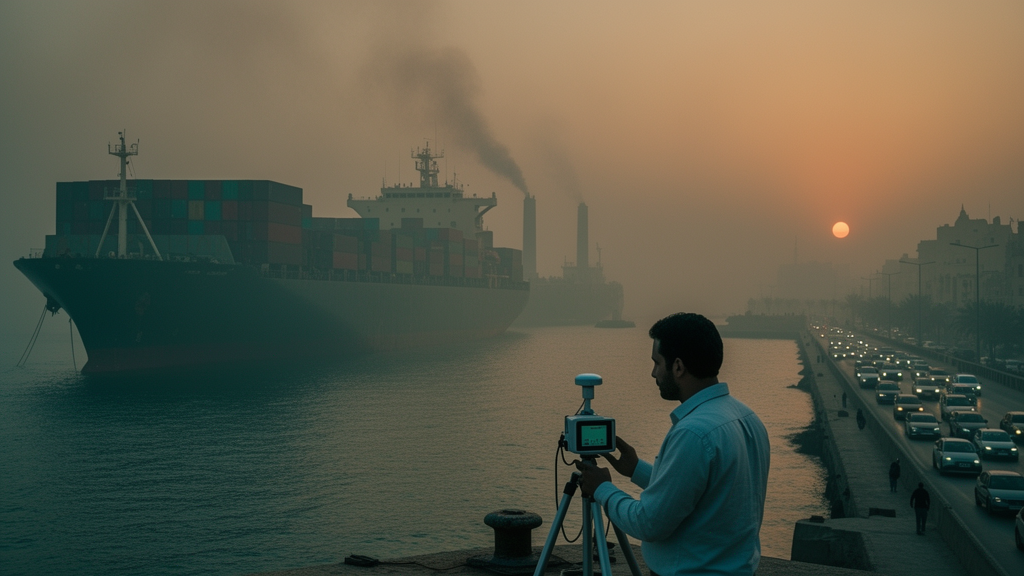
Ports are the beating hearts of global trade, but they are also concentrated sources of greenhouse gases and toxic air pollutants, pumping exhaust into the very neighborhoods where dockworkers, sailors, and city residents live and breathe. A new field study of Alexandria Port in Egypt offers one of the most detailed snapshots yet of how these emissions behave at the sharp edge where maritime industry meets dense urban life. By carrying portable instruments through the port and its surrounding streets over two seasonal campaigns, researchers have mapped which pollutants trace back to ships and cargo handling, and which come from the city’s relentless traffic, revealing a strikingly patchy picture of risk that could reshape how port cities around the world think about clean air.
The research, published in Environmental Monitoring and Assessment by Eslam Saad, Mohamed Elbawab, and Kareem Tonbol of the Arab Academy for Science, Technology and Maritime Transport, focused on what the authors call the port-urban exposure zone. Between May and October 2022, the team ran two monthly monitoring campaigns at a total of 24 sites: 11 inside the port area itself and 13 in the urban district that wraps around it. Armed with a portable multi-gas monitor and particulate sensors, they measured carbon dioxide, carbon monoxide, nitrogen dioxide, sulfur dioxide, ammonia, volatile organic compounds, and particulate matter in two size fractions, PM2.5 and PM10. From these readings they derived air quality index values for selected pollutants, turning raw concentrations into a measure of potential health relevance.
The study’s most provocative finding concerns carbon monoxide and ammonia. Spatial analysis showed that port activities may be associated with elevated concentrations of both gases, with the berths used for fuel handling and bulk fertilizer recording significantly higher levels than the urban sites outside the port fence. That pattern makes chemical sense: fuel transfer operations release combustion byproducts, while the loading and unloading of nitrogen-rich fertilizers can loft ammonia dust and vapor directly into the ambient air. Unlike diffuse urban pollution, these hot spots are tightly tied to specific cargo operations, which means they are also tightly tied to specific, actionable interventions such as vapor recovery systems, enclosed transfer equipment, and stricter handling protocols.
Sulfur dioxide told the opposite story. Concentrations of SO2 and traffic-related pollutants measured outside the port appeared to contribute to the urban background rather than emanating from the docks, suggesting that the city’s vehicle fleet, not ship operations, drives much of the ambient sulfur and traffic-linked pollution that residents experience. This distinction matters enormously for policy. If regulators assume ships are the culprit for every pollutant wafting through a port city, they may pour resources into shore power and cold ironing while the exhaust pipes that matter most are bolted to buses and trucks idling in gridlocked streets. The Alexandria data show that both sources are real, but they leave different fingerprints in different places.
Short-term exposure observations at one site inside the port revealed the single highest carbon monoxide levels recorded in the study, with air quality index values suggesting potentially unhealthy conditions during intensive cargo and ship-handling activities. These are precisely the moments when dockworkers, tugboat crews, and mooring personnel are on the front line, working in close proximity to running diesel engines, auxiliary ship generators, and heavy equipment. While the screening-level nature of the measurements precludes definitive health risk calculations, the finding flags a clear occupational dimension to port air quality that has often been overshadowed by concerns about residential exposure. It also underscores why continuous, real-time monitoring inside working ports could become a standard safety practice.
Not all the news was grim. Particulate matter levels were relatively low across the study area, both for the fine PM2.5 fraction that penetrates deep into the lungs and the coarser PM10 fraction that irritates airways. This is notable given Alexandria’s reputation for dusty coastal conditions and heavy industry, and it suggests that, at least during the monitoring window, the port’s particle emissions were not dominating the local picture. The researchers are careful to frame their results as screening-level spatial evidence rather than definitive exposure assessments, a caveat that reflects both the short campaign duration and the inherent variability of port operations, ship traffic, and weather.
Weather itself plays a starring role in the study’s interpretation. The team compiled hourly meteorological observations from the Ras El-Tin station for each field session, covering the period from 14:00 through 03:00 the following day. The campaigns were dominated by moderate northerly to northwesterly winds, with campaign mean wind speeds ranging from 3.0 to 7.2 meters per second. These steady sea breezes acted as a natural ventilation system, dispersing pollutants and serving as the atmospheric backdrop against which the measurements unfolded. In a port city, such wind regimes determine whether emissions linger over the docks or drift inland over neighborhoods, and understanding them is essential to any dispersion modeling that follows from this work.
The Alexandria study sits within a growing international literature on port emissions, from assessments of cruise ship impacts in Naples to ship emission externalities in Piraeus, and it aligns with toolkits developed by the International Maritime Organization and the International Association of Ports and Harbors for assessing port emissions. What distinguishes the Egyptian work is its dual-domain design, sampling simultaneously inside and outside the port boundary to separate maritime from urban contributions. That approach directly addresses a chronic problem in port-city air quality research, where monitoring stations placed for general urban purposes rarely capture the sharp spatial gradients that exist within a few hundred meters of a working berth.
The authors argue that their findings underline the local air quality processes controlled by both maritime and urban sources, and they point to the efficacy of implementing a green port strategy. Green port concepts, already adopted to varying degrees in leading Asian and European ports and explored in prior studies of Egyptian ports, encompass measures such as shore-side electricity for berthed vessels, low-sulfur fuel requirements, electrified cargo equipment, and emissions monitoring as a management tool. The new data give such strategies an evidence base tailored to Alexandria, identifying fertilizer and fuel berths as priority targets for source-specific controls while confirming that port-wide particulate levels are not the primary concern.
For the roughly 135 million people worldwide who live in port cities, and for the millions more whose goods pass through them, this study offers both a warning and a template. The warning is that the dockside environment can briefly reach potentially unhealthy air quality conditions precisely during peak operations, and that ammonia and carbon monoxide hot spots cluster at specific, identifiable berths. The template is a pragmatic, instrument-driven monitoring campaign that any mid-sized port authority could replicate: modest equipment, a few dozen sites, coordination with national meteorological services, and an analysis framework built around standard air quality indices. As global shipping volumes grow and climate goals tighten, studies like this one make clear that the path to cleaner port cities begins with knowing exactly where the smoke comes from.
Subject of Research: Air pollutant monitoring at the port-urban interface of Alexandria Port, Egypt
Article Title: Short-term monitoring of air pollutants at the port-urban exposure zone: a case study of Alexandria Port, Egypt
Article References: Saad, E., Elbawab, M., & Tonbol, K. (2026). Short-term monitoring of air pollutants at the port-urban exposure zone: a case study of Alexandria Port, Egypt. Environmental Monitoring and Assessment, 198(9), Article 1012. https://doi.org/10.1007/s10661-026-15828-7
Image Credits: AI Generated
DOI: 10.1007/s10661-026-15828-7
Keywords: air quality, Alexandria Port, port emissions, carbon monoxide, ammonia, particulate matter, PM2.5, air quality index, green ports, Egypt, maritime pollution, urban pollution
Cite Scienmag News
Russell Cooper. (October 19, 2026). Inside the Port-City Smog Zone: Alexandria Measurements Reveal Where Ships and Traffic Collide. Scienmag. https://scienmag.com/inside-the-port-city-smog-zone-alexandria-measurements-reveal-where-ships-and-traffic-collide/
Russell Cooper. "Inside the Port-City Smog Zone: Alexandria Measurements Reveal Where Ships and Traffic Collide." Scienmag, 19 October 2026, https://scienmag.com/inside-the-port-city-smog-zone-alexandria-measurements-reveal-where-ships-and-traffic-collide/. Accessed 19 October 2026.
Russell Cooper. "Inside the Port-City Smog Zone: Alexandria Measurements Reveal Where Ships and Traffic Collide." Scienmag. October 19, 2026. https://scienmag.com/inside-the-port-city-smog-zone-alexandria-measurements-reveal-where-ships-and-traffic-collide/


