


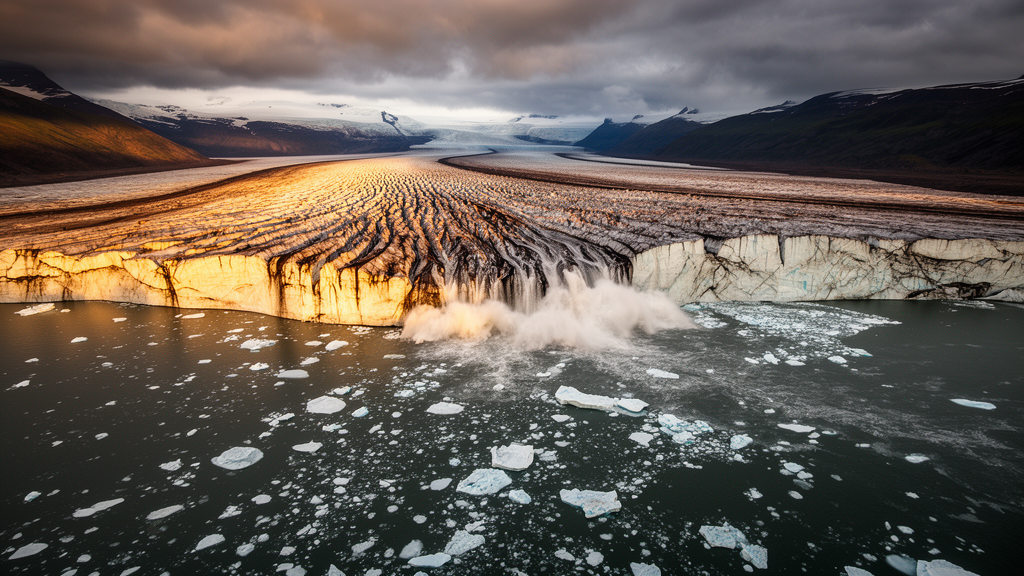
Glaciers around the world could be shrinking faster than scientists have warned, and the reason lies not in the slow creep of average temperatures but in the wild day-to-day swings of weather that most global models have quietly smoothed away. A new study led by researchers at ETH Zurich in Switzerland and the Vrije Universiteit Brussel in Belgium, published in Nature Communications, shows that when daily weather variability is explicitly resolved in glacier simulations, the projected ice loss by the end of the century grows substantially. The finding carries a sobering implication: existing global projections, which typically rely on monthly climate data, may be underestimating how quickly the planet’s glaciers will surrender their ice in a warming world.
The heart of the problem is temporal resolution. Most global glacier models are driven by monthly climate data, which average out short-lived but consequential fluctuations in temperature and precipitation. Yet glaciers respond to weather on timescales of hours and days, not months. A handful of exceptionally warm days can strip away the bright, reflective snow cover that insulates a glacier’s surface, exposing the darker underlying ice, which absorbs more solar radiation and melts faster in a self-reinforcing feedback. Similarly, whether precipitation arrives as rain or snow depends critically on temperatures hovering around the freezing point, and that distinction powerfully shapes both glacier accumulation and downstream runoff. By averaging over a month, models effectively dilute these pivotal moments, blurring the very events that drive the most dramatic melt.
Lead author Lander Van Tricht, affiliated with ETH Zurich, the Swiss Federal Institute for Forest, Snow and Landscape Research WSL, and the Vrije Universiteit Brussel, put the intuition plainly in the study’s announcement. Glaciers, he explained, do not respond to monthly averages but to the weather they experience every single day. A heatwave lasting only a few days can cause enormous amounts of ice to melt, and by averaging weather conditions over an entire month, researchers risk underestimating the impact of these extreme events. The recent record of exceptional melt years across the globe, from the European Alps to Svalbard and Central Asia, underscores how consequential these short bursts of extreme weather have already become.
To capture these processes, the team extended the Global Glacier Evolution Model, known as GloGEM, to operate at daily resolution rather than monthly. They applied the enhanced model to more than 12,500 glaciers, a sample representing 94 percent of the world’s glacier ice volume, providing a genuinely global test of the approach. The comparison against the traditional monthly framework was revealing: the daily model better reproduces observed glacier mass loss, particularly during the extraordinary melt years that have punctuated the last half decade. The model captured the exceptional losses of 2022 in the European Alps, 2023 in Western North America, 2024 in Svalbard, 2025 in Central Asia, and 2026 once again in the European Alps, a sequence of record-setting melt seasons that has unfolded with striking regularity as regional heat extremes intensify.
The consequences of this improved realism compound over time. When projected forward through the twenty-first century, the daily model generally predicts faster glacier retreat and greater total ice loss than its monthly counterpart, with the largest divergence in regions where melting is strongly influenced by short-term temperature fluctuations. The effect also translates directly into the oceans. According to the study, the daily model projects a 5 to 10 percent higher contribution from glaciers to global sea-level rise over the twenty-first century than the monthly version of the same model. That may sound like a modest percentage, but given that glaciers are already among the largest non-ice-sheet contributors to rising seas, the difference represents a substantial additional volume of water entering the ocean by 2100.
Van Tricht, who also co-supervised the work, emphasized that the gradual rise in temperature is not the only variable that matters. Extreme melt events, like those recently witnessed in the European Alps and other glacierised regions, can have lasting consequences for glaciers, and capturing these events is essential to understanding their future. The physical logic is straightforward but powerful. When a heatwave removes snow cover early in the melt season, the exposed ice continues absorbing extra solar energy long after the heatwave itself has passed, so a few days of extreme warmth can effectively amplify melt for weeks. Monthly averaging cannot represent this asymmetry, because it never sees the heatwave in the first place. Over decades of simulation, these missed episodes accumulate, biasing projections toward slower retreat and smaller cumulative losses.
The study’s implications extend well beyond glacier retreat and sea-level rise. The researchers also identified important changes in the timing and intensity of glacier meltwater runoff, a variable with profound consequences for the hundreds of millions of people who depend on glacier-fed rivers for drinking water, agriculture, and hydropower. Co-supervisor Harry Zekollari of the Vrije Universiteit Brussel highlighted that glaciers are an important source of freshwater for millions of people, and that understanding not only how much ice will disappear but also when meltwater becomes available is crucial for anticipating future changes in water availability. Resolving daily weather variability, he noted, can substantially improve understanding of these changes, because the day-to-day sequencing of warm spells and precipitation events determines when water actually arrives downstream.
This timing dimension is often overlooked in public discussion of glacier loss. As glaciers shrink, they typically pass through a phase of increased meltwater availability, sometimes called peak water, before their diminishing ice volumes cause runoff to decline. How quickly a region moves through this trajectory, and how sharply the flow varies from season to season along the way, depends on the very short-term weather processes that the daily model now resolves. In heavily glacierised basins, an earlier loss of protective snow cover in a warm spring can shift the timing of peak runoff, alter summer flow regimes, and change how water is stored and released, with cascading effects for downstream reservoirs, irrigation schedules, and ecosystems adapted to historical flow patterns.
For the scientific community, the study represents a methodological milestone in global glacier modeling. Running a physically based glacier evolution model at daily resolution across more than 12,500 glaciers is computationally demanding, and the fact that the enhanced framework demonstrably outperforms the monthly approach against real-world observations, especially during recent record melt years, gives researchers a stronger foundation for the next generation of projections. The work also connects glacier science to the broader climate modeling landscape, where the treatment of daily variability and extremes has long been recognized as critical for impacts ranging from heat stress to flooding. Bringing that same rigor to glacier evolution closes an important gap between the climate data available from global climate models and the processes glaciers actually experience.
The broader message for a warming world is uncomfortable but clear. The planet’s glaciers are not melting in response to a gentle monthly average; they are melting in response to a climate that increasingly delivers its energy in violent, concentrated bursts. As heatwaves grow more frequent and more intense, the gap between what monthly models project and what glaciers actually lose will likely widen. The study suggests that the ice already committed to disappearing by 2100 is larger than current global assessments indicate, and that the water locked in mountain ice will reach the sea, and the rivers, sooner than many projections have allowed. For coastal planners, water managers, and the millions living in glacier-fed watersheds, the day-to-day weather that once seemed like noise in the climate signal is now revealed as the signal itself.
Subject of Research: Factoring daily weather extremes into glacier models reveals greater glacier loss and faster sea-level rise
Article Title: Factoring daily weather extremes into glacier models reveals greater glacier loss and faster sea-level rise
Article References: Factoring daily weather extremes into glacier models reveals greater glacier loss and faster sea-level rise. Original publication (Bibliographic details unavailable.)
Image Credits: AI Generated
DOI: Not provided
Keywords: Factoring, daily, weather, extremes, glacier, models, reveals, greater, loss, faster, sea-level, rise
Cite Scienmag News
Russell Cooper. (October 19, 2026). Daily Weather Extremes Drive Faster Glacier Loss and Rising Seas Than Models Predicted. Scienmag. https://scienmag.com/daily-weather-extremes-drive-faster-glacier-loss-and-rising-seas-than-models-predicted/
Russell Cooper. "Daily Weather Extremes Drive Faster Glacier Loss and Rising Seas Than Models Predicted." Scienmag, 19 October 2026, https://scienmag.com/daily-weather-extremes-drive-faster-glacier-loss-and-rising-seas-than-models-predicted/. Accessed 19 October 2026.
Russell Cooper. "Daily Weather Extremes Drive Faster Glacier Loss and Rising Seas Than Models Predicted." Scienmag. October 19, 2026. https://scienmag.com/daily-weather-extremes-drive-faster-glacier-loss-and-rising-seas-than-models-predicted/


