


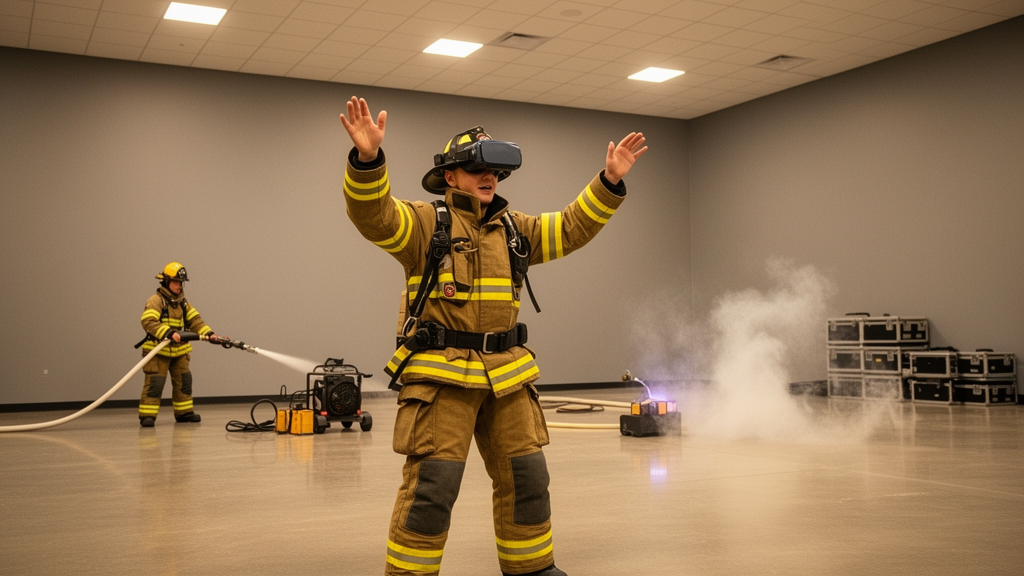
When an earthquake levels a city block or a chemical plume drifts across a hospital parking lot, the professionals who run toward the chaos rarely get a second chance to practice their first decisions. A systematic review now published in BMC Medical Education suggests that virtual reality can give them that rehearsal safely and repeatedly, but the technology is not yet the silver bullet its champions might hope for. Ali Şir Attila and Şehnaz Baltacı of Bursa Uludağ University in Türkiye synthesized 54 studies, represented by 59 reports, spanning health professions education, emergency response, disaster management, and educational technology, and their verdict is carefully measured: VR is a promising adjunct to disaster preparedness training, not a demonstrated replacement for live drills and mannequin-based simulation.
The review, conducted according to PRISMA 2020 reporting standards, covered literature published between 1 January 2000 and 31 December 2025, with retrospective searches of PubMed/MEDLINE and CINAHL run on 12–13 September 2026 using the same cutoff. The original corpus of 25 studies was expanded through update searches of Web of Science, Scopus, and Google Scholar: of 638 update records, 572 unique records were screened, 50 reports were sought, and 33 database reports ultimately proved eligible, with citation checking adding one companion article. The final synthesis comprised 54 studies in 59 included reports. Update-stage title and abstract screening used separate blinded worksheets, reconciliation, and a criteria-consistency audit, a methodological rigor designed to keep subjective judgment out of study selection. The authors appraised each study with the Mixed Methods Appraisal Tool and synthesized findings narratively, applying GRADE to grade the certainty of evidence without meta-analysis.
What emerges from the evidence base is a picture of remarkable breadth. Participants included health-professions learners and personnel, first responders, community volunteers, and other adults, with analytic samples ranging from as few as 6 to as many as 739. The applications were equally varied: triage training using protocols such as Simple Triage and Rapid Treatment (START), the Sort, Assess, Lifesaving Interventions, Treatment/Transport (SALT) scheme, and the Sacco Triage Method; evacuation exercises; disaster decision-making; psychological first aid; clinical reasoning; and team or command rehearsal for mass-casualty incidents. Some studies deployed head-mounted displays (HMDs), while others used cave automatic virtual environments (CAVEs), projecting immersive scenes onto surrounding walls so that teams could move through a virtual disaster zone together.
The technical logic behind VR disaster training is straightforward but compelling. Real disasters are rare, dangerous, and expensive to simulate; a mass-casualty drill involving hundreds of volunteer patients, ambulances, and closed streets can cost enormous sums and still expose trainees to real hazards. A virtual environment, by contrast, can collapse a hospital under simulated rubble an unlimited number of times, at near-zero marginal cost, with zero physical risk. Trainees can fail catastrophically in the simulation, watch the consequences unfold, and then reset the scenario and try again, a form of fear conditioning and mental training that live exercises simply cannot offer at scale. This is why VR has attracted attention not only from medical educators but also from emergency management agencies and educational technologists, fields that the review deliberately spans.
On outcomes, the review found a consistent pattern. Objective measures, such as triage accuracy, decision speed, and knowledge test scores, often improved from baseline or proved comparable with active alternatives like classroom instruction or traditional simulation. But superiority over those alternatives was inconsistent across studies. Meanwhile, confidence, self-efficacy, immersion, and acceptability were frequently favorable, with trainees reporting that they felt more prepared and more willing to engage with VR scenarios than with conventional methods. The catch, the authors note, is that these favorable psychological outcomes were mainly self-reported, which is precisely the kind of evidence that GRADE grades most harshly. Certainty was low for objective performance and knowledge outcomes and very low for self-reported, implementation, and stress-related outcomes, meaning that even the most encouraging findings rest on foundations that could shift with better-designed research.
The limitations the review identified are not trivial. Small convenience samples, nonrandomized or uncontrolled designs, sparse long-term follow-up, variable measurement instruments, and incomplete reporting all limited what could be inferred from the 54 studies. A study with 6 participants cannot tell us whether a VR triage module works for the profession at large, and a study that measures outcomes immediately after training cannot tell us whether those gains persist when a real disaster strikes months or years later. The review also found that physiological measures such as heart-rate variability (HRV) and electrodermal activity (EDA), which could objectively capture stress responses during virtual scenarios, appeared in the literature but were underused, leaving the stress-related outcomes with the lowest certainty of all.
What the review does endorse is a specific set of strongest roles for VR. It excels at repeatable rehearsal, allowing trainees to run the same scenario until the decisions become automatic. It supports formative assessment, giving instructors a window into how learners reason under simulated pressure. And it prepares participants before resource-intensive live exercises, so that expensive full-scale drills can focus on teamwork, communication, and command coordination rather than on basic procedural familiarity. In this framing, VR is not trying to replace the mannequin or the live field exercise; it is trying to make sure that when trainees arrive at those exercises, they already know where the doors are.
The authors are explicit about what would need to change before stronger claims could be made. Standardized outcomes are needed so that studies measure the same things in the same ways, allowing findings to accumulate rather than scatter. Psychologically safe implementation is required, since immersive disaster scenarios can expose trainees to distressing content and must be designed with that risk in mind. Adequately powered comparisons, presumably randomized controlled trials with sufficient sample sizes, are needed to test VR against active alternatives rather than against no training at all. And longer follow-up is essential to establish whether virtual rehearsal transfers to real-world performance, the ultimate question that the entire enterprise hinges on.
It is worth noting that the review was not prospectively registered, a transparency gap that the authors disclose in the registration section of the paper. The research received no external funding, and the authors declare no competing interests. The review analyzed published literature only and did not involve human participants, human data, or human tissue, so ethics approval was not applicable. These disclosures, alongside the open-access licensing under Creative Commons Attribution 4.0, mean that the findings are available for anyone to scrutinize, reproduce, or build upon, which matters for a field where the evidence base is still maturing and where independent verification is the only path to consensus.
For the health professionals, first responders, and emergency managers reading the review’s conclusions, the practical message is one of calibrated optimism. Virtual reality can collapse a burning hospital, a flooded subway, or a mass-casualty incident into a headset or a projected room, and it can do so safely, cheaply, and on demand. Trainees who practice triage decisions in virtual environments appear to learn, and they appear to enjoy learning. But the evidence that VR outperforms what already exists, or that virtual competence survives contact with real chaos, remains thin and graded with low certainty. Until standardized outcomes, adequately powered trials, and longer follow-up fill those gaps, the review’s verdict stands: VR belongs in the disaster preparedness toolkit, but as a rehearsal space, not yet as the final exam.
Subject of Research: Health
Article Title: Virtual reality-based disaster preparedness training for health professionals and first responders
Article References: Attila, A. Ş., & Baltacı, Ş. (2026). Virtual reality-based disaster preparedness training for health professionals and first responders. BMC Medical Education. https://doi.org/10.1186/s12909-026-10651-7
Image Credits: AI Generated
DOI: 10.1186/s12909-026-10651-7
Keywords: virtual reality, disaster preparedness, medical education, first responders, systematic review, simulation training, Virtual, reality-based, disaster, preparedness, training, health
Cite Scienmag News
Courtney Benton. (October 19, 2026). VR Disaster Training Shows Promise but Falls Short as a Replacement for Live Drills. Scienmag. https://scienmag.com/vr-disaster-training-shows-promise-but-falls-short-as-a-replacement-for-live-drills/
Courtney Benton. "VR Disaster Training Shows Promise but Falls Short as a Replacement for Live Drills." Scienmag, 19 October 2026, https://scienmag.com/vr-disaster-training-shows-promise-but-falls-short-as-a-replacement-for-live-drills/. Accessed 19 October 2026.
Courtney Benton. "VR Disaster Training Shows Promise but Falls Short as a Replacement for Live Drills." Scienmag. October 19, 2026. https://scienmag.com/vr-disaster-training-shows-promise-but-falls-short-as-a-replacement-for-live-drills/


