


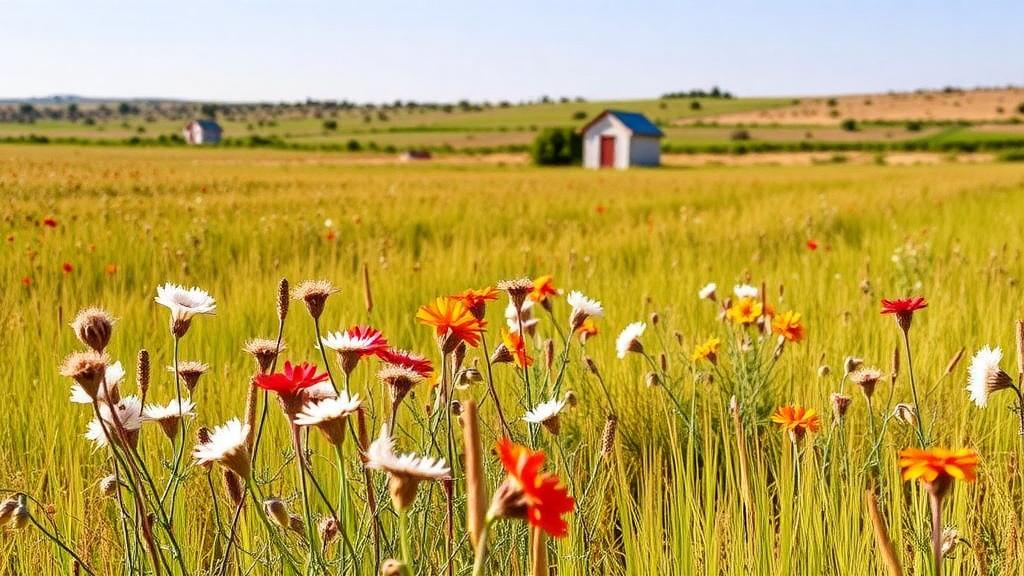
In the hillside fields of northwestern Morocco, where farmers still plough with mules and donkeys and sow seed saved from their own harvests, the wild plants growing among the cereal crops tell a remarkable story. A new survey of traditional agroecosystems on the Tingitane Peninsula, in the foreland of the Rif Mountains, has documented one of the richest arable floras recorded in the Mediterranean region, underscoring how low-intensity farming can sustain biodiversity that intensive agriculture destroys.
The study, published in Vegetation Classification and Survey, involved 94 vegetation relevés collected across six areas of traditional agriculture between April and June 2017. Researchers recorded 209 vascular plant species belonging to 150 genera and 41 families, with a mean of 22 species per field and a Shannon diversity index of 3.04. Five families dominated the spectrum: Asteraceae, Poaceae, Fabaceae, Caryophyllaceae and Brassicaceae together accounted for 55 percent of the recorded diversity, a pattern that mirrors the composition of the Moroccan flora as a whole.
Segetal plants, the wild species that grow unsown in cereal fields, have long been dismissed as weeds that compete with crops for water and nutrients. But ecologists increasingly recognize them as a vulnerable component of farmland biodiversity. Across Europe, herbicide use and agricultural intensification have made obligate arable plants one of the most threatened groups of flora, prompting conservation programs such as nationwide networks of protected fields in Central Europe and the concept of High Nature Value farming.
The Moroccan fields studied here operate under very different conditions. Farmers practice shallow tillage with animal-drawn swing ploughs or, on steep slopes, by hand with picks and hoes. Fields are small, averaging around a quarter of a hectare, and rotations include fallow periods that feed livestock, since weeds are an important fodder resource. Chemical herbicides are generally absent, and some wild plants are even gathered for traditional dishes such as Bekoule, which contains species of mallow, sorrel and sow-thistle.
The life-form spectrum of the flora reflected these practices. Therophytes, annual plants that complete their life cycle within a single season, dominated with 75 percent of species, as expected in cultivated fields. But biennial and perennial herbs were surprisingly well represented, making up a notably larger share than in comparable surveys elsewhere in the Maghreb. The researchers attribute this to shallow tillage and regular fallowing, which allow perennating structures to survive between crops. Even chamaephytes and phanerophytes, woody plants rarely tolerated in intensive systems, accounted for about 6.6 percent of the flora, including relicts of former woodlands such as mastic trees and dwarf palms.
Chorological analysis showed that species with broad Mediterranean distributions accounted for 44 percent of the flora, while cosmopolitan species ranked second at about 20 percent. Crucially, the flora was overwhelmingly native: almost half of the species were agrestal, meaning they are confined to arable fields, and nearly a third were apophytes, native plants that occur both in natural habitats and in fields. Neophytes, recently introduced alien species, were almost entirely absent, appearing only in a single cluster of fields associated with cannabis cultivation on cleared woodland.
The conservation value of this flora is considerable. The survey recorded 29 regional endemics, representing 14 percent of the segetal flora, along with species of national rarity, including two considered very rare in Morocco, Brassica barrelieri and Echinops spinosissimus, and others classified as rare or suspected rare. The researchers argue that these fields fulfil the criteria of High Nature Value agriculture, a European framework recognizing farmland that combines low-input management with landscape-scale habitat diversity, and they suggest developing comparable evaluation systems for Moroccan arable land.
A numerical classification of the vegetation data using modified TWINSPAN separated the relevés into four clusters corresponding largely to the sampled areas, revealing that local conditions of climate, soil and land use shape species composition more than broad regional patterns. The communities belong to the order Brometalia rubenti-tectorum, the thermomediterranean arable vegetation of the western Mediterranean, but their alliance-level assignment remains open. Distinctive species combinations pointed to environmental gradients: slightly acidic sandy soils supported plants such as Rumex bucephalophorus and Silene gallica, while nutrient-rich clayey fields favored a different set of indicators. The presence of perennials such as Dittrichia viscosa and Helminthotheca echioides signaled the fallow phases of the rotation.
Comparisons with other Mediterranean studies place the Rif findings in context. Surveys of comparable numbers of fields in northeastern Spain, southern Spain, Greece and Turkey recorded between 71 and 175 species, well below the 209 found here. Studies in Crete, Portugal, Algeria and other parts of northwestern Morocco reported higher totals, but those involved more sampled plots. The high field-scale diversity of the Moroccan traditional systems stems from moderate land-use intensity, the absence of herbicides and rotations that include fallow, the authors conclude.
Yet this biodiversity is under threat. Northwestern Morocco is undergoing rapid landscape change driven by socio-economic pressures: small fields on poor, eroded soils no longer sustain subsistence farming, prompting rural exodus, land abandonment, intensification with synthetic fertilizers, and in places the expansion of cannabis cultivation. Structural features that once enriched the fields, such as patches of the dwarf palm Chamaerops humilis spared from tillage, have largely disappeared in recent decades. The authors warn that without policy support for the farmers who maintain these systems, both the traditional agroecosystems and their rare segetal species could vanish. They call for a national red list of arable plants and for conservation measures that simultaneously strengthen the socio-economic position of local communities, arguing that the survival of this living heritage depends on the survival of the farming culture that created it.
Subject of Research: Segetal plant diversity in traditional cereal agroecosystems of the Rif Mountains, Morocco
Article Title: Plant diversity in traditional agroecosystems of North Morocco
Article References: Chakkour, S., Bergmeier, E., Meyer, S., Kassout, J., Kadiri, M., & Ater, M. (2023). Plant diversity in traditional agroecosystems of North Morocco. Vegetation Classification and Survey, 4, 31-45. https://doi.org/10.3897/vcs.86024
Image Credits: AI Generated
DOI: 10.3897/VCS.86024
Keywords: agrobiodiversity, segetal flora, Morocco, Rif Mountains, traditional agriculture, High Nature Value farming, plant communities, endemic species, Mediterranean flora, weed ecology, agroecosystems, conservation
Cite Scienmag News
Margaret Porter. (October 19, 2026). Wild Flora of Morocco’s Traditional Cereal Fields Reveals Remarkable Plant Diversity. Scienmag. https://scienmag.com/wild-flora-of-moroccos-traditional-cereal-fields-reveals-remarkable-plant-diversity/
Margaret Porter. "Wild Flora of Morocco’s Traditional Cereal Fields Reveals Remarkable Plant Diversity." Scienmag, 19 October 2026, https://scienmag.com/wild-flora-of-moroccos-traditional-cereal-fields-reveals-remarkable-plant-diversity/. Accessed 19 October 2026.
Margaret Porter. "Wild Flora of Morocco’s Traditional Cereal Fields Reveals Remarkable Plant Diversity." Scienmag. October 19, 2026. https://scienmag.com/wild-flora-of-moroccos-traditional-cereal-fields-reveals-remarkable-plant-diversity/


