


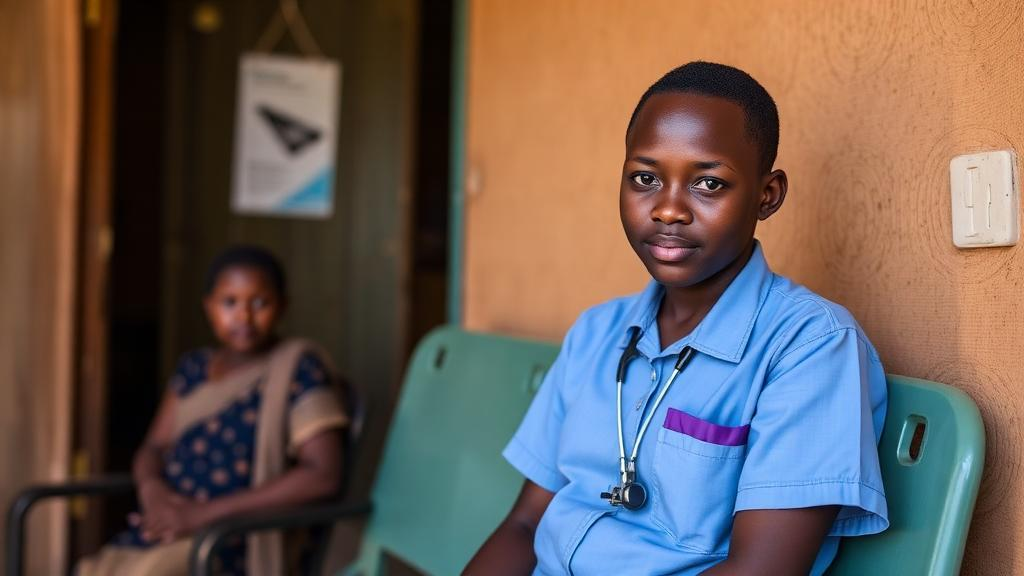
In Burkina Faso, where adolescents make up nearly a quarter of the population, the clinics that are supposed to be their first point of contact with the health system are falling short. A new cross-sectional study, published in BMC Health Services Research, surveyed 152 primary healthcare facilities in two regions of the country and found that although almost every facility reported offering some form of adolescent sexual and reproductive health service, only 30.3 percent offered the full range. The figure is deliberately conservative, but it exposes a structural weakness in a health system that millions of young people depend on.
The research team, led by Ludovic Deo Gracias Tapsoba of Joseph Ki-Zerbo University in Ouagadougou and including collaborators from Ghana, the United Kingdom and Canada, set out to fill a stubborn evidence gap. Burkina Faso has national policies on adolescent health, but little facility-level data existed on whether the primary healthcare facilities that serve as the main entry point for these services actually have the staff, equipment and medicines to deliver them. The study focused on two purposively selected regions, Centre-Ouest and Hauts-Bassins, chosen to capture different geographic and epidemiological contexts in the western and southwestern parts of the country.
Within those regions, the researchers randomly selected health districts and then sampled facilities by systematic random sampling proportional to size, a design intended to give larger facility networks a fair chance of inclusion while preserving statistical representativeness. The final sample of 152 facilities was dominated by Health and Social Promotion Centers, the community-level facilities that constitute the backbone of Burkina Faso’s primary care system, which accounted for 77.6 percent of the surveyed sites. Medical centers and medical centers with surgical units made up the remainder, alongside a small number of private and faith-based facilities.
To measure capacity, the team adapted the World Health Organization’s Service Availability and Readiness Assessment tool, a standardized instrument used across low- and middle-income countries to benchmark health facility performance. Availability was assessed across three service domains: family planning, sexual health education and rights, and antenatal care. Readiness was measured across three parallel dimensions: trained personnel, diagnostic capabilities and essential medicines. The study’s headline metric, full availability, was an all-or-nothing composite requiring every component across all three domains to be present in a single facility. That conservative construction means the 30.3 percent figure should be read as a floor for comprehensive service delivery rather than a conventional coverage indicator.
The urban-rural divide was the study’s most statistically robust finding. Full availability was significantly higher in urban facilities than in rural ones, at 46.5 percent versus 23.9 percent, a between-group difference with a 95 percent confidence interval of 5.7 to 39.6 and a p-value of 0.006. In a country where the majority of adolescents live outside cities, that gap matters. A teenager in a rural village is roughly half as likely to find a clinic equipped to provide the complete package of adolescent sexual and reproductive health services as a teenager in an urban center, even when both clinics report offering some services.
Readiness gaps were even more pronounced than availability gaps, particularly for diagnostic capacity and staff training. Syphilis-testing capacity was very low overall and significantly higher in urban than rural facilities, at 23.2 percent versus 4.6 percent, with a 95 percent confidence interval of 7.1 to 33.4 and a p-value of 0.001. Congenital syphilis remains a preventable cause of stillbirth and neonatal death across sub-Saharan Africa, so the near-absence of testing capacity in rural clinics represents a concrete clinical risk. Staff recently trained in refocused antenatal care, a WHO-endorsed model that concentrates visits around evidence-based interventions, were also more common in urban areas, at 53.4 percent versus 33.0 percent, with a 95 percent confidence interval of 3.1 to 37.8 and a p-value of 0.020.
Not every comparison reached statistical significance. Full availability did not differ significantly between the two regions, at 28.6 percent in Centre-Ouest versus 32.0 percent in Hauts-Bassins, with a p-value of 0.65, suggesting the problem is systemic rather than confined to one geographic area. Differences across facility types were based on small subgroups and should be interpreted with caution, the authors note. The broader pattern, however, points to particular weakness in Health and Social Promotion Centers and in private and faith-based facilities, which are precisely the sites that rural adolescents are most likely to encounter first.
The study’s implications reach beyond Burkina Faso. Across West Africa, adolescent sexual and reproductive health remains one of the most politically and culturally contested areas of public health, and facility-level evidence of this kind is rare. The research was supported by a grant from the UK Medical Research Council and the Foreign, Commonwealth and Development Office, in collaboration with the UK Department of Health and Social Care, reflecting growing international investment in the ADOWA initiative, which examines adolescent mental, sexual and reproductive health policy and primary care implementation priorities across the region. Ethical approval was granted by Burkina Faso’s National Ethics Committee for Health Research, and all facility data were anonymized before analysis.
What makes the findings actionable is the specificity of the readiness gaps. The authors identify in-service training, particularly in refocused antenatal care, as a priority, alongside strengthening the availability of family planning methods and adolescent education activities in rural areas. For Health and Social Promotion Centers and private facilities, the priorities are more infrastructural: clinical guidelines, diagnostic capacity and reliable supply chains. These are not exotic interventions. They are the unglamorous plumbing of a health system, and the study suggests that in Burkina Faso that plumbing is leaking at exactly the joints where adolescent patients pass through.
The timing is significant. Burkina Faso’s adolescent population is growing, and the country faces overlapping pressures from insecurity and displacement that strain rural health services. As the authors conclude, availability and readiness of primary healthcare facilities to provide full adolescent sexual and reproductive health services remain limited, especially in rural facilities and in the community-level centers that dominate the primary care landscape. For a health system built on the promise that every clinic is a doorway to care, the study is a reminder that a doorway is only useful if the room behind it is equipped. The full open-access article, with complete subgroup comparisons by region, facility type and residence, is available online.
Subject of Research: Health Services Research
Article Title: Availability and readiness of primary healthcare facilities in the provision of adolescent sexual and reproductive health services in two regions of Burkina Faso: a cross-sectional study
Article References: Tapsoba, L. D. G., Amenah, M. A., Traoré, S., Da Silva, R. B., & Meda, Z. C. (2026). Availability and readiness of primary healthcare facilities in the provision of adolescent sexual and reproductive health services in two regions of Burkina Faso: a cross-sectional study. BMC Health Services Research. https://doi.org/10.1186/s12913-026-15649-x
Image Credits: AI Generated
DOI: 10.1186/s12913-026-15649-x
Keywords: Burkina Faso, adolescent health, primary healthcare, reproductive health, family planning, health facilities, rural health, West Africa, Availability, readiness, primary, healthcare
Cite Scienmag News
Ophelia Keating. (October 19, 2026). Only 30% of clinics in Burkina Faso offer full adolescent reproductive health care, study finds. Scienmag. https://scienmag.com/only-30-of-clinics-in-burkina-faso-offer-full-adolescent-reproductive-health-care-study-finds/
Ophelia Keating. "Only 30% of clinics in Burkina Faso offer full adolescent reproductive health care, study finds." Scienmag, 19 October 2026, https://scienmag.com/only-30-of-clinics-in-burkina-faso-offer-full-adolescent-reproductive-health-care-study-finds/. Accessed 19 October 2026.
Ophelia Keating. "Only 30% of clinics in Burkina Faso offer full adolescent reproductive health care, study finds." Scienmag. October 19, 2026. https://scienmag.com/only-30-of-clinics-in-burkina-faso-offer-full-adolescent-reproductive-health-care-study-finds/


