


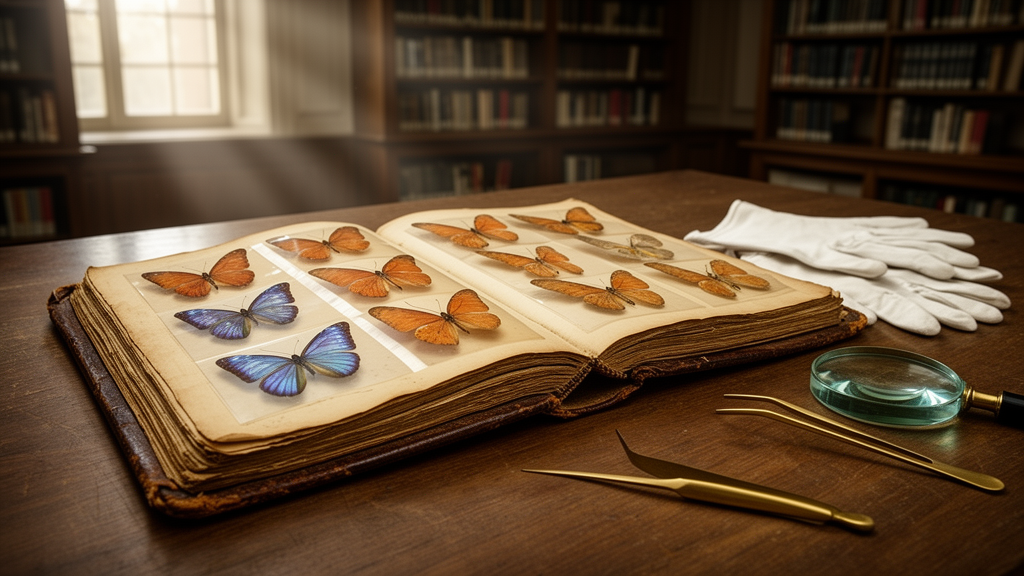
Deep in the historical archives of the Museu Nacional de História Natural e da Ciência da Universidade de Lisboa sits a book that is not really a book at all. Its 172 pages do not contain printed text or painted illustrations in the conventional sense. Instead, they hold the actual wings of butterflies and moths collected in Brazil before the country declared independence in 1822, pressed onto paper with a technique so obscure that it has all but vanished from scientific practice. The work, known as “Lepidoptera Fluminensis”, has now been given its first full scholarly treatment, revealing a forgotten masterpiece of eighteenth-century natural history and rewriting what we thought we knew about its creation.
The study, published in the journal Natural History Collections and Museomics, documents two nearly identical copies of the work: one held in Lisbon, bound in luxurious reddish leather stamped with the Portuguese crown, and a second that surfaced at the New York Antiquarian Book Fair in April 2013, where it sold for 117,000 US dollars to the Brazilian collector António Bonchristiano. Both volumes were prepared using lepidochromy, sometimes called “nature printing”, a method in which the scales of a butterfly’s wings are transferred directly onto paper or canvas, preserving their true colors and patterns at a time when no painter or printer could reproduce such brilliance by other means.
The technique’s origins are murky and colorful. The Dutch painter Otto Marseus van Schrieck pressed butterfly wings onto his canvases in the seventeenth century, and the British artist John Peele described the method in a 1735 manual on watercolor painting. The first scientific description came from the British naturalist George Edwards, who in 1747 briefly explained the process and later published a “receipt for taking the figures of butterflies on thin gummed paper”. The French clergyman Jean-Baptiste-Gabriel-Alexandre Rozier published a similar account in 1771, attributing the discovery to an unnamed French friar who noticed that a butterfly landing on freshly varnished barometer left its scales stuck to the varnish. The method flourished in nineteenth-century France, where it acquired the name lepidochromy, and lingered into the twentieth century in works from North America, Venezuela, Japan and Ceylon before being abandoned entirely by entomologists.
What makes the Brazilian volumes extraordinary is their age and provenance. The Lisbon copy was originally held in the library of the Royal Cabinet of Natural History of Ajuda, the most important natural history collection in eighteenth-century Portugal. When French naturalist Étienne Geoffroy Saint-Hilaire visited Lisbon in 1808 during the French invasions, he shipped the book, along with hundreds of other specimens, to the Muséum national d’Histoire naturelle in Paris; it was returned to Lisbon in 1814. Its frontispiece bears a lavish dedication to Queen Maria I of Portugal, ending with a single letter “S.”, while the Bonchristiano copy is dedicated to Luis Vasconcelos de Sousa, Viceroy of Brazil, and explicitly states that it was offered by Father Francisco Solano.
That dedication is the key to a major revision of the book’s authorship. Historians had long attributed the work solely to Friar José Mariano da Conceição Veloso, one of the founding figures of Brazilian natural history, who led the first official botanical survey of Rio de Janeiro between 1783 and 1790 under the Viceroy’s patronage. But the new analysis argues that the work should be credited to two authors: Veloso, who directed the science and identified the species, and Francisco Solano, the expedition’s illustrator and preparator, who was almost certainly the hands behind the delicate lepidochromy transfers. A 1797 report by Veloso to Portugal’s prime minister describes “one collection of butterflies pressed by the colored dye with which the membranes of their wings are covered, a work so rare and valuable that the supplicant attests that no such work exists in any other royal cabinets in Europe”, confirming the book was completed before Veloso left Brazil for Lisbon in 1790.
Each volume contains 172 plates depicting 338 individual lepidopterans at life size, each shown in dorsal and ventral views. The wings are genuine lepidochromy transfers, but the bodies are painted in watercolor, with four plates painted entirely by hand. Every page is framed with a border of red ink and gold leaf, and the species are organized according to Linnaeus’s tenth edition of Systema Naturae, grouped into categories with Homeric names such as Equites Troiani and Equites Achivi, honoring the defenders and attackers of Troy. The researchers’ taxonomic review shows that the 169 taxa the authors believed they were depicting actually represent 145 currently recognized species from nine families, with Nymphalidae the best represented. Because males and females of the same species were often given different names, and because eighteenth-century descriptions were vague, the authors coined entirely new Latin names even for species Linnaeus himself had already described.
The book is also a window into the Atlantic Forest of the late 1700s. Most of the species depicted are still found around Rio de Janeiro today, including the endangered Parides ascanius. One plate, however, remains a genuine mystery: a yellow, orange and black moth labeled “Papilio Heliconii Saphus” that cannot be matched to any known species of the moth subfamilies Sterrhinae or Dioptinae, possibly because several mimetic species share that warning coloration. Remarkably, one specimen depicted in the book, the butterfly Pierella keithbrowni, was not formally described by science until 2016, more than two centuries after its wings were pressed onto paper.
Conservation analysis of the Lisbon copy reveals the physical toll of centuries. The gold leaf borders are torn and fractured, particularly near the spine, because the rigid adhesives used to fix the gold, likely natural glues such as hide glue or egg white, do not flex with paper as it swells and shrinks with humidity. Small black spots of fungal growth dot the damaged areas, evidence of fluctuating environmental conditions over the decades. The researchers recommend stable storage at temperatures between 16 and 19 degrees Celsius and relative humidity between 45 and 60 percent to halt further deterioration.
Perhaps the most provocative conclusion of the study is that “Lepidoptera Fluminensis” should not be thought of as a book at all. It was never printed, mass-produced or distributed, and none of its plates carried descriptions, so none of the names proposed by Veloso and Solano carries formal nomenclatural weight. Instead, the authors argue, each page is effectively a bound collection of scientific specimens: the actual scales of actual animals, collected in a defined region between roughly 1780 and 1790, labeled under the Linnean system. Because the biological material survives, the plates could conceivably yield DNA, making lepidochromy specimens something close to tissue samples with the bonus of an exact visual record of the individual animal.
The work also blurs the line between art and science in ways that resonate today. Lepidochromy began as an artistic trick, was adopted for scientific documentation, and ended as a curiosity, yet the volumes it produced were simultaneously artworks, diplomatic gifts to royalty, and serious biodiversity surveys. Together with Veloso’s “Flora Fluminensis” and the unpublished “Ichthyologia Fluminensis”, the butterfly book testifies to a remarkable flowering of natural history in colonial Brazil, and to a naturalist whose Homeric ambitions, like the defenders of Troy he honored in his species names, were ultimately frustrated, his contributions losing priority to later naturalists. Two and a half centuries later, the butterflies themselves have outlasted the neglect, their colors still glowing on the page.
Subject of Research: History and taxonomic review of the eighteenth-century lepidochromy book Lepidoptera Fluminensis on Brazilian butterflies and moths
Article Title: “Lepidoptera Fluminensis”, a forgotten eighteenth-century lepidochromy book on Brazilian moths and butterflies
Article References: Ceríaco, L. M. P., Zacca, T., de Menezes, H. F., Perestrelo, S., Santos, B. S., Ferreira, R. N., Bívar-de-Sousa, A., & Mielke, O. H. H. (2025). “Lepidoptera Fluminensis”, a forgotten eighteenth-century lepidochromy book on Brazilian moths and butterflies. Natural History Collections and Museomics, 2, 1-102. https://doi.org/10.3897/nhcm.2.153540
Image Credits: AI Generated
Keywords: lepidochromy, Lepidoptera Fluminensis, Brazilian butterflies, natural history, José Mariano da Conceição Veloso, Francisco Solano, eighteenth century, Linnaeus, Museu Nacional de História Natural e da Ciência, nature printing, Atlantic Forest, taxonomy
Cite Scienmag News
Margaret Porter. (October 19, 2026). Lost 18th-century book of pressed Brazilian butterflies resurfaces as scientific treasure. Scienmag. https://scienmag.com/lost-18th-century-book-of-pressed-brazilian-butterflies-resurfaces-as-scientific-treasure/
Margaret Porter. "Lost 18th-century book of pressed Brazilian butterflies resurfaces as scientific treasure." Scienmag, 19 October 2026, https://scienmag.com/lost-18th-century-book-of-pressed-brazilian-butterflies-resurfaces-as-scientific-treasure/. Accessed 19 October 2026.
Margaret Porter. "Lost 18th-century book of pressed Brazilian butterflies resurfaces as scientific treasure." Scienmag. October 19, 2026. https://scienmag.com/lost-18th-century-book-of-pressed-brazilian-butterflies-resurfaces-as-scientific-treasure/


