


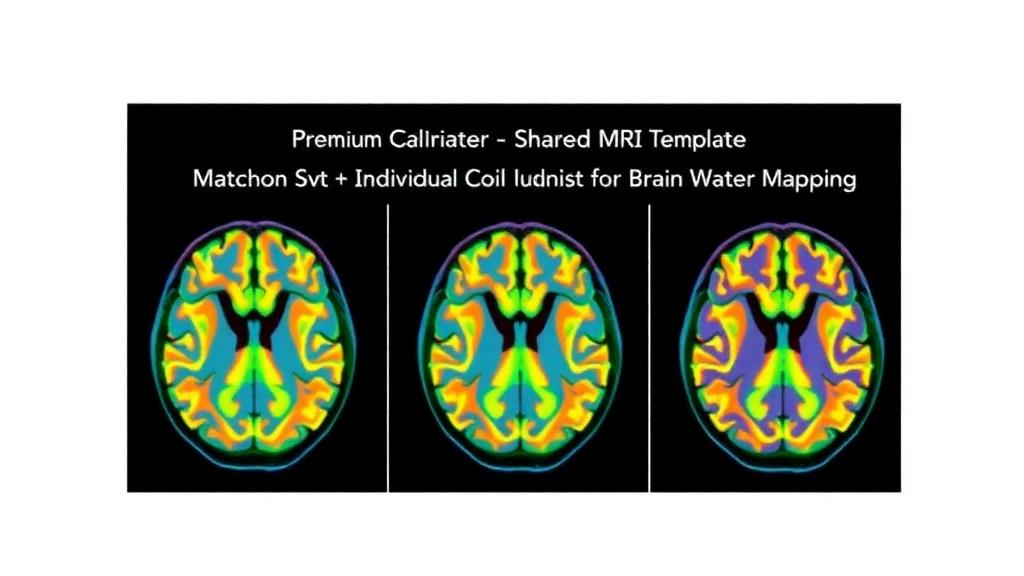
Quantitative maps of brain water content promise a way to track subtle changes tied to edema, inflammation, and neurodegeneration, but the technique has long carried an awkward price: every scan needs an extra, participant-specific reference acquisition to correct for the uneven sensitivity of the MRI receiver coil. A new study from Forschungszentrum Jülich and RWTH Aachen University now reports that a template built from other volunteers can stand in for that individual calibration, with errors small enough to matter for the field’s future. The work, published in Frontiers in Neuroscience, was evaluated with a strict leave-one-participant-out design on a 3 Tesla scanner, meaning the person being measured never contributed to the template used to measure them.
The challenge stems from how modern MRI works. Head receiver coils are made of many small detector elements whose sensitivity varies smoothly across space, modulating the raw signal in ways that can masquerade as genuine differences in tissue water. The established solution is to acquire matched images with both the phased-array head coil and the scanner’s body coil, then derive a smooth correction field unique to each participant. That extra acquisition takes only about 64 seconds, but it also requires participant-specific processing, and crucially, it cannot be recovered after the fact. Archived datasets that lack the matched pair are effectively locked out of the most rigorous water-content quantification.
The research team, led by Zaheer Abbas, tested whether a fixed, configuration-specific template could replace that individual reference. Using data from 25 healthy male volunteers aged 21 to 44, they built a degree-3 polynomial template of the effective relative receive field from 24 participants and deployed it on the 25th, rotating through the cohort so every participant was held out exactly once. The template was constructed in a brain-relative coordinate frame, with each participant’s brain bounding box normalized to a common grid, allowing approximately corresponding locations to be pooled without scanner-space registration.
How closely did the borrowed template reproduce each individual’s own receive field? The median relative mismatch averaged 2.273 percent, with a standard deviation of 0.568 percent and a range from 1.431 to 3.615 percent across the cohort. That figure sounds modest, but the authors are careful to note that receive-field fidelity and final water-content agreement are distinct questions. A single global fidelity metric cannot simply be propagated as a bound on the error in the final quantitative maps, particularly because the mismatch statistic is computed after independent median normalization and is therefore blind to differences in overall scale.
The real test came downstream. Each arm of the comparison—the explicit individual reference (Arm E) and the template substitution (Arm T)—underwent its own independently estimated residual calibration, including a spatially regularized intercept field and a ventricular cerebrospinal fluid calibration step. The primary outcomes were participant-level median water content in white and gray matter, expressed in percentage units relative to pure water. The results were striking: mean differences between the two arms were just −0.04 percentage units in white matter and −0.17 in gray matter, with mean absolute errors of 0.17 and 0.22 units and concordance correlation coefficients of 0.991 and 0.989 respectively. Whole-brain bias was −0.12 units, and all Bland–Altman agreement widths stayed below one percentage unit.
Perhaps the most mechanistically interesting finding concerns why the agreement was so good despite the template’s imperfection. Decomposing the processing chain revealed that the template substitution raised the pre-calibration proton-density proxy by roughly 6.5 percent on average—but the independently estimated CSF calibration scalar rose by a nearly matching 6.35 percent. Because that scalar enters the final water-content denominator, the two shifts largely cancelled, leaving only small residual differences. The authors stress this is a descriptive consistency with a calibration-coupling interpretation, not proof that CSF calibration uniquely causes the residual difference, and they caution that the same buffering may not occur on other scanners or configurations.
Two deliberately sabotaged control conditions sharpened the picture. When the receive correction was replaced with a uniform divisor of one—discarding receive information entirely—regional errors grew roughly five-fold in white matter and whole brain, and concordance dropped to the 0.81 to 0.89 range. A mirrored template, reflected along one normalized axis, performed worse than the correct template as well, though somewhat better than the no-receive control. The downstream pipeline is therefore not indifferent to receive information: the template carries spatial structure that genuinely matters, even as the calibration chain absorbs much of the error.
The agreement at the level of regional medians conceals larger local discrepancies. Dividing each brain into central and peripheral rim zones, the team found that disagreement grew toward the brain’s edge, most clearly in gray matter, where the rim 95th-percentile absolute difference reached 3.183 percentage units and the rim spatial standard deviation 1.375 units. Those figures brush up against the few-percentage-point changes that can accompany pathology, which is why the authors explicitly decline to claim suitability for voxel- or lesion-level measurement, particularly in cortical and peripheral regions. The small regional-median biases should not be read as evidence of spatial interchangeability.
The limitations are candidly enumerated. The cohort comprised 25 male participants at a single site, on one 3 Tesla MAGNETOM Prisma, with one receive configuration; there was no independent deployment cohort. The explicit individual reference strategy is itself a body-coil-referenced relative approach, not biological ground truth, so the results speak to agreement rather than accuracy. No equivalence or noninferiority margin was prespecified. External transfer across scanners, coils, vendors, or field strengths was never tested, and same-pipeline scan–rescan repeatability was not measured in this study. An exploratory image-derived geometry proxy showed a modest descriptive association with rim mismatch, hinting that head positioning relative to the coil may matter, though the confidence intervals were broad.
The practical payoff is real but bounded. For a previously established scanner and coil configuration, the template eliminates roughly 1.1 minutes of acquisition time per participant plus the associated receive-field derivation, opening the door to rigorous water-content quantification in retrospective datasets and large cohorts where the matched reference pair was never acquired. The authors frame their conclusion with appropriate restraint: the evidence supports technical feasibility within the evaluated configuration, not universal replacement of participant-specific referencing. Future work, they argue, should test prospectively acquired external cohorts, varied repositioning, and diverse populations, with any clinically meaningful agreement margin defined before outcomes are inspected. For now, the study offers a carefully quantified demonstration that a crowd-sourced calibration can nearly match an individual one—provided you stay on the scanner it was built for.
Subject of Research: Inter-subject receive-template substitution for quantitative brain water content mapping at 3 Tesla
Article Title: Inter-subject receive-template substitution for quantitative brain water content mapping at 3 T: a leave-one-out evaluation
Article References: Abbas, Z., Ullah, F., Gegechkori, S., Worthoff, W. A., & Shah, N. J. (2026). Inter-subject receive-template substitution for quantitative brain water content mapping at 3 T: a leave-one-out evaluation. Frontiers in Neuroscience, 20, Article 1986813. https://doi.org/10.3389/fnins.2026.1986813
Image Credits: AI Generated
DOI: 10.3389/fnins.2026.1986813
Keywords: quantitative MRI, brain water content, receive sensitivity correction, leave-one-out evaluation, proton density mapping, 3 Tesla, inter-subject template, Bland-Altman agreement, CSF calibration, Frontiers in Neuroscience, Inter-subject, receive-template
Cite Scienmag News
Cassandra Pierce. (October 19, 2026). Shared MRI Template Matches Individual Coil Calibration for Brain Water Mapping. Scienmag. https://scienmag.com/shared-mri-template-matches-individual-coil-calibration-for-brain-water-mapping/
Cassandra Pierce. "Shared MRI Template Matches Individual Coil Calibration for Brain Water Mapping." Scienmag, 19 October 2026, https://scienmag.com/shared-mri-template-matches-individual-coil-calibration-for-brain-water-mapping/. Accessed 19 October 2026.
Cassandra Pierce. "Shared MRI Template Matches Individual Coil Calibration for Brain Water Mapping." Scienmag. October 19, 2026. https://scienmag.com/shared-mri-template-matches-individual-coil-calibration-for-brain-water-mapping/


