


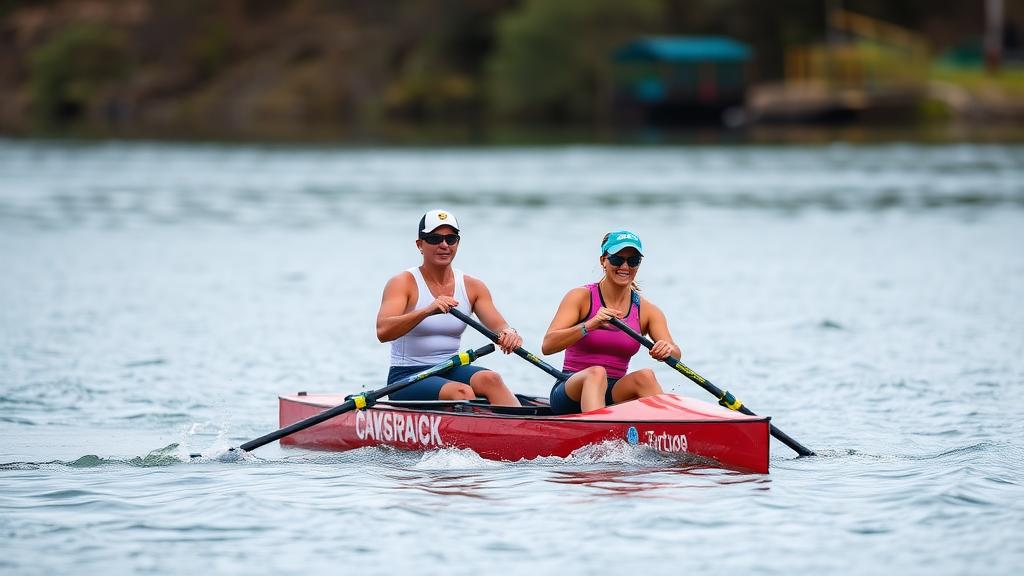
A team of Spanish sport scientists has turned machine learning loose on one of the most exclusive populations in sport: internationally competitive flatwater canoeists. By feeding 281 laboratory measurements from 21 elite C1 paddlers into unsupervised clustering algorithms, and deliberately withholding every performance outcome such as race times and rankings, the researchers uncovered a tripartite phenotypic structure in which sport-specific neuromuscular capacity, measured with an unusual device called functional electromechanical dynamometry, emerged as the dominant axis of difference. The findings, published in Frontiers in Physiology, suggest that the bodies of elite canoeists organize themselves into three distinct profiles, and that a shockingly simple two-threshold rule can classify most of them correctly.
The study, led by Tania Álvarez-Yates of the University of A Coruña and Óscar García-García of the University of Vigo, tackled a persistent methodological problem in athlete profiling. Most existing models are supervised: they train algorithms to predict performance, which conflates what an athlete is with what an athlete achieves. The team instead banned all outcome variables from the analysis. Race times over 1000, 500 and 200 metres, rankings, and medal standings were stripped out before clustering began, leaving a purely phenotypic feature space of body composition, muscle contractile properties, mobility, maximal and explosive strength, and canoe-specific neuromuscular data. Any structure the algorithms found would therefore reflect intrinsic biological variation rather than who happened to win.
The participants, twelve men and nine women aged 15 to 36, all competed at international level in the C1 category, the demanding single-blade canoe class where athletes kneel on one knee and paddle exclusively on one side. Their laboratory battery was exhaustive: bioelectrical impedance analysis for body composition, tensiomyography for the contractile properties of key paddling muscles, one-repetition maximum bench press and bench pull, shoulder and hamstring mobility tests, the Upper Quarter Y-Balance Test, and single-arm explosive rowing in a canoe-specific posture. The centrepiece was functional electromechanical dynamometry, or FEMD, a technique that measures force, power, work and impulse in positions that mimic the actual paddle stroke, including a maximal isometric test and an incremental resistance test taken to voluntary failure.
Before any clustering could happen, the raw data demanded careful handling. The researchers applied asymmetric winsorization, capping low values at the 10th percentile and high values at the 95th to preserve genuinely exceptional athletes while damping measurement artifacts, followed by a Yeo-Johnson power transformation to reduce skew and robust scaling based on medians and interquartile ranges. Two complementary algorithms, K-Means and hierarchical clustering with Ward linkage, were then run on the full scaled matrix, with exploratory PCA and t-SNE projections used only for visualization. Internal validation metrics, including the silhouette coefficient, the Davies-Bouldin index and the elbow method, converged on three clusters as the most defensible partition, and the two algorithms agreed moderately, with an Adjusted Rand Index of 0.591.
The three clusters that emerged were striking. The largest, containing ten athletes, was 90 percent female and was labelled the Female-Dominant Phenotype. The other two, comprising seven and four athletes respectively, were exclusively male. The sex-cluster association was overwhelming, with a chi-square statistic of 18.90 and a Cramér’s V of 0.949, indicating near-perfect coupling. The researchers are careful to frame this as normative sexual dimorphism rather than a performance hierarchy: the female-dominant cluster showed higher body fat, lower muscle mass, lower bone mass and reduced absolute force output, all consistent with well-established physiological differences between the sexes.
Yet the more intriguing story lies within the male subgroup. The High-Neuromuscular Male Phenotype and the Moderate-Neuromuscular Male Phenotype were statistically indistinguishable across all fifteen top discriminant variables, from peak eccentric force to mechanical work to repetitions to failure. The single variable that separated them was the sustain time of the latissimus dorsi on the non-paddle side, a tensiomyography measure of muscle contraction duration. Athletes with sustain times at or below roughly 152 milliseconds fell into the high-neuromuscular group, hinting at faster, more explosive contractile properties in the key pulling muscle of the non-dominant side, an asymmetry directly attributable to the unilateral demands of C1 technique.
Across the full 281-variable battery, neuromuscular FEMD measurements dominated the discrimination between clusters, accounting for 75.9 percent of the cumulative importance among the top fifteen features identified by a Random Forest Classifier. Peak force in the incremental test was the single most powerful discriminator, followed by repetitions to failure and total mechanical work. The female-dominant cluster produced roughly 40 percent less peak force and 63 percent less total work than the male clusters, and these gaps persisted, though attenuated, even after normalizing to body weight, consistent with sex-dependent differences in muscle fibre composition and hormonal milieu that mass scaling cannot erase.
The team then distilled the entire analysis into an interpretable decision tree with just two thresholds. First, any athlete producing peak eccentric force of 39.48 newtons or less in the canoe-specific test was assigned to the female-dominant cluster. Athletes clearing that bar were then split on latissimus dorsi sustain time, with faster contractions indicating the high-neuromuscular male phenotype. This shallow rule achieved 100 percent accuracy on the training subset and 71.4 percent on the held-out test cases, significantly above the 33.3 percent expected by chance, and correctly classified 19 of 21 athletes overall. The two misclassifications involved athletes sitting near the decision boundaries, which the authors interpret as genuine phenotypic ambiguity rather than model failure.
The caveats are substantial, and the authors are unusually candid about them. The silhouette coefficient of 0.056 is far below conventional thresholds for well-defined clusters, meaning the three groups describe overlapping gradients rather than discrete categories. The seven-athlete test partition yields a confidence interval stretching from 29 to 96 percent accuracy, so no strong claim of prospective generalization is statistically justified. Sex is structurally confounded with cluster membership, the age range spans markedly different developmental stages, and the smallest cluster contains only four athletes, raising the possibility that it is an algorithmic artifact rather than a true subtype. Bootstrap resampling further showed that fewer than half of the top-ranked discriminant variables kept their ranking under resampling, a hallmark of high-dimensional, small-sample instability.
Even so, the work points toward a compelling future for talent identification and training individualization in canoeing. A laboratory protocol that classifies an athlete into a phenotypic profile using just two metrics, eccentric force and a muscle contraction timing measure, could eventually inform sex-stratified benchmarks, cluster-specific strength programming, and longitudinal monitoring of how athletes move between profiles across training macrocycles. The researchers stress that external validation with larger, sex-balanced cohorts is required before any consequential decisions rest on these rules. But the core demonstration stands: even among athletes already good enough to represent their countries, hidden structure exists in the body that has nothing to do with race results, and unsupervised machines can find it.
Subject of Research: Unsupervised machine learning phenotypic clustering of elite flatwater canoeists based on neuromuscular and anthropometric variables
Article Title: Unsupervised phenotypic clustering, inferential characterization, and discriminant classification of elite flatwater canoeists: neuromuscular and anthropometric determinants
Article References: Álvarez-Yates, T., García-García, Ó., Cuba-Dorado, A., Bouza-Rodríguez, J.-B., Comesaña-Campos, A., & Cerqueiro-Pequeño, J. (2026). Unsupervised phenotypic clustering, inferential characterization, and discriminant classification of elite flatwater canoeists: neuromuscular and anthropometric determinants. Frontiers in Physiology, 17, Article 1949031. https://doi.org/10.3389/fphys.2026.1949031
Image Credits: AI Generated
DOI: 10.3389/fphys.2026.1949031
Keywords: elite canoeists, flatwater sprint canoeing, unsupervised machine learning, phenotypic profiling, functional electromechanical dynamometry, neuromuscular capacity, sexual dimorphism, cluster analysis, talent identification, tensiomyography, body composition, exercise physiology
Cite Scienmag News
Teresa Odom. (October 19, 2026). Machine Learning Reveals Three Body Types Among Elite Canoeists. Scienmag. https://scienmag.com/machine-learning-reveals-three-body-types-among-elite-canoeists/
Teresa Odom. "Machine Learning Reveals Three Body Types Among Elite Canoeists." Scienmag, 19 October 2026, https://scienmag.com/machine-learning-reveals-three-body-types-among-elite-canoeists/. Accessed 19 October 2026.
Teresa Odom. "Machine Learning Reveals Three Body Types Among Elite Canoeists." Scienmag. October 19, 2026. https://scienmag.com/machine-learning-reveals-three-body-types-among-elite-canoeists/


