


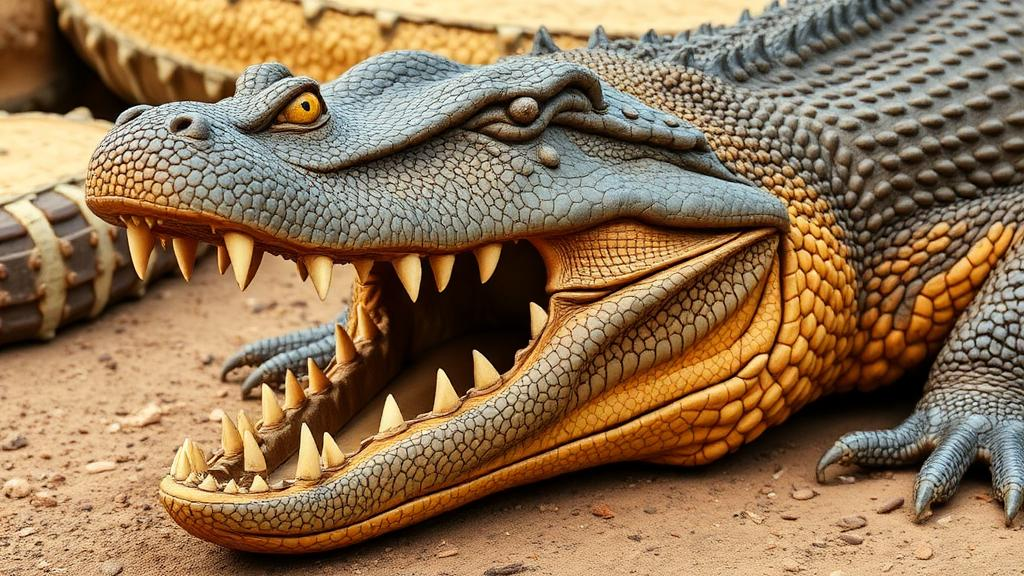
A trove of fossilized jawbones collected more than half a century ago from a quarry in northern Arizona has yielded a surprise: an entirely unknown species of large amphibian-like predator that once patrolled the rivers of the Middle Triassic. The fossils, previously lumped in with a known temnospondyl called Hadrokkosaurus bradyi, belong instead to a distinct brachyopoid temnospondyl characterized by a smaller number of unusually large, robust mandibular teeth, according to a new study published in Fossil Record. The finding adds a third brachyopoid taxon to the Moenkopi Formation and underscores how much unrecorded diversity may still be hiding in museum drawers.
Temnospondyls are an ancient order of amphibians that flourished for roughly 200 million years, from the Carboniferous through the Early Cretaceous. They are central to one of paleontology’s most important debates, because the prevailing consensus holds that modern frogs, salamanders and caecilians, the lissamphibians, are the surviving descendants of temnospondyl lineages. Brachyopoids, a subgroup comprising the families Brachyopidae and Chigutisauridae, were among the most durable of these animals. They appeared and spread across both hemispheres after the Permo-Triassic mass extinction and endured until the Early Cretaceous, when the chigutisaurid Koolasuchus cleelandi of Australia represented the last of the stereospondyl clade.
In Triassic North America, brachyopoids were known from only two species: Hadrokkosaurus bradyi and Vigilius wellesi. Both come from the Holbrook Member of the Moenkopi Formation in Arizona, deposited during the early Anisian stage of the lowermost Middle Triassic. Hadrokkosaurus was originally described from material at two quarries, UCMP localities V3922 and V4207, roughly 160 kilometres apart. The holotype mandible, UCMP 36199, was excavated at V3922, the Geronimo fossil vertebrate quarry near Holbrook, while the skull later established as Vigilius wellesi came from V4207. Complicating matters, several mandibular, cranial and postcranial elements from V3922 were also assigned to Vigilius when that genus was erected in 2000.
The new study presents a detailed redescription of the V3922 material, and the anatomy proved revealing. The holotype mandible of Hadrokkosaurus preserves the full plesiomorphic complement of ten bones typical of temnospondyls, including a thin dentary with a narrow dental shelf, a long postglenoid area, and a count of 32 small, lingually recurving tooth positions. The teeth are labiolingually compressed and carinated toward their tips, and the mandible’s curvature fits a broad, short-snouted aquatic predator. A deep groove running along the labial side of the dentary, widely discussed in descriptions of stereospondyls, was interpreted as a lateral line sulcus, a sensory canal feature consistent with the group’s aquatic lifestyle.
But several specimens from the same quarry did not match this anatomy. Welles had noted as early as 1947 that some dentaries referred to Hadrokkosaurus possessed different tooth morphology than the type, and the new analysis confirmed that these differences are consistent and significant. The key specimen, UCMP 36833, is a well-preserved anterior right mandible, and UCMP 36834 is a nearly complete right dentary. Together with additional dentary fragments, they define a novel brachyopoid taxon with noticeably wider, rounder teeth that are fewer in number, only about 21 tooth positions compared with 32 in Hadrokkosaurus and 40 in Koolasuchus. The teeth lack carinae, a feature the authors showed is not an artifact of erosion, and the dental shelf is entirely occupied by the dentition, leaving no dorsally exposed bone surface, unlike in Hadrokkosaurus.
The mandible’s curvature suggests the new animal had a very wide, parabolic skull typical of brachyopoids, which are brevirostrine, or short-snouted, stereospondyls. The authors systematically ruled out alternative identities: most capitosauroids and trematosauroids of the Middle Triassic had longirostrine skulls that would not match the sharply curving mandibles, plagiosaurids are limited in North America to Greenland and lack the large symphyseal fangs seen in the new specimens, and the short-skulled capitosauroid Sclerothorax lacks the mandibular proportions preserved here. The absence of continuous coronoid tooth rows further excludes plagiosaurids such as Gerrothorax. Based on these observations and phylogenetic results, the team provisionally assigned the unidentified temnospondyl to Brachyopoidea.
To test these relationships, the researchers built a phylogenetic matrix derived from the dataset of Ruta and Bolt, adding UCMP 36833 as an operational taxonomic unit along with Keratobrachyops australis and Plagiosuchus pustuliferus, and introducing three new characters concerning the postsymphyseal foramen and Meckelian canal. Analyses run in TNT under equal weights and implied weights recovered 328 most-parsimonious trees of 757 steps under equal weights, and the new taxon was consistently placed within Brachyopoidea. Using exclusively mandibular characters, the analyses recover the new brachyopoid in a polytomy with Hadrokkosaurus and Vanastega at the base of Brachyopoidea, though the authors caution that excluding skull roof characters warrants skepticism about some resolved relationships, and highlight a need to refine mandibular characters for better homology testing.
The study also revisited a partial right angular, UCMP 36210, previously referred to Hadrokkosaurus. Ruta and Bolt had noted that this bone bears a boss-like process on the adductor chamber floor that is absent in Hadrokkosaurus, and the new work confirms it belongs to a different temnospondyl. Such processes are known in a broad range of taxa, from plagiosaurids like Plagiosternum and Gerrothorax to trematosauroids like Aphaneramma and even non-stereospondyl forms like Archegosaurus and Trimerorhachis, suggesting the feature may reflect ecology, perhaps a strong adductor muscle for a more powerful bite, rather than phylogeny. For now, the specimen can only be assigned to Temnospondyli indeterminate, but its presence signals yet another temnospondyl taxon at the locality.
The ecological implications are striking. Tooth morphology in tetrapods is widely considered to correlate with diet, and the robust dentition of the new brachyopoid represents a novel dental ecomorphotype in this ecosystem, comparable to the few-but-large teeth of Koolasuchus and a likely brachyopoid from the Late Triassic of Brazil. This condition appears in only one other brachyopoid, and the tooth count is far fewer than in coeval Moenkopi stereospondyls such as Eocyclotosaurus, which bore 98 to 100 teeth. The differentiation between Hadrokkosaurus, Vigilius and the new taxon may reflect partitioning into distinct ecological niches, allowing multiple large-bodied aquatic predators to coexist without competing for the same resources. Such niche expansion, the authors suggest, could have contributed to the post-Triassic success of brachyopoids, enabling Northern Hemisphere brachyopids to coexist with phytosaurs and sphenosuchian crocodiles and to survive the end-Triassic mass extinction.
The Moenkopi Formation spreads widely across the southwestern United States, and its channel sandstone deposits, laid down by meandering rivers across floodplains nourished by seasonal floods, supported brachyopids, trematosauroids and capitosauroids. Yet plagiosaurids, abundant at higher latitudes of northern and southern Pangea, are conspicuously absent near the palaeoequator, despite their capacity to endure salinity fluctuations and low nutrient levels. The authors note that overlapping brevirostrine morphology between brachyopoids and plagiosaurids may limit co-occurrence, though evidence shows they did coexist in some localities, and a preference for marginal habitats not preserved in these systems may explain the gap. The broader message is clear: critically re-examining closely collected museum material can uncover unobserved diversity, and the specialized mandibular morphology of brachyopoids may be the very clue to how this clade explored different roles in ancient ecosystems and outlasted its contemporaries.
Subject of Research: A large brachyopoid from the Middle Triassic of northern Arizona and the diversity of brachyopoid temnospondyls from the Moenkopi Formation
Article Title: A large brachyopoid from the Middle Triassic of northern Arizona and the diversity of brachyopoid temnospondyls from the Moenkopi Formation
Article References: So, C., & Mann, A. (2024). A large brachyopoid from the Middle Triassic of northern Arizona and the diversity of brachyopoid temnospondyls from the Moenkopi Formation. Fossil Record, 27(1), 233-245. https://doi.org/10.3897/fr.27.117611
Image Credits: AI Generated
DOI: 10.3897/fr.27.117611
Keywords: paleontology, Triassic, temnospondyls, brachyopoids, Moenkopi Formation, Arizona, fossils, Hadrokkosaurus, amphibian evolution, Middle Triassic, large, brachyopoid
Cite Scienmag News
Gavin Prescott. (October 19, 2026). Giant Ancient Amphibian With Robust Teeth Rewrites Triassic Diversity in Arizona. Scienmag. https://scienmag.com/giant-ancient-amphibian-with-robust-teeth-rewrites-triassic-diversity-in-arizona/
Gavin Prescott. "Giant Ancient Amphibian With Robust Teeth Rewrites Triassic Diversity in Arizona." Scienmag, 19 October 2026, https://scienmag.com/giant-ancient-amphibian-with-robust-teeth-rewrites-triassic-diversity-in-arizona/. Accessed 19 October 2026.
Gavin Prescott. "Giant Ancient Amphibian With Robust Teeth Rewrites Triassic Diversity in Arizona." Scienmag. October 19, 2026. https://scienmag.com/giant-ancient-amphibian-with-robust-teeth-rewrites-triassic-diversity-in-arizona/


