


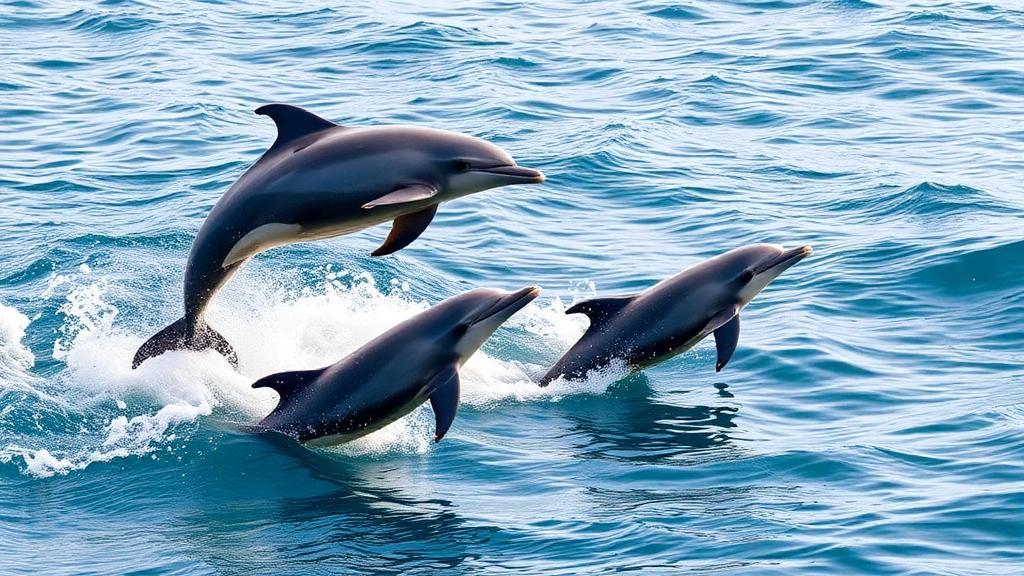
In the crowded waters of Xiamen Bay, one of China’s busiest maritime corridors, Indo-Pacific humpback dolphins are living their lives in the shadow of more than a thousand vessel transits a day. A new study published in the journal Nature Conservation offers the most detailed picture yet of how these endangered marine mammals dive, forage, and react to the constant churn of boat traffic around them. Drawing on three years of boat-based surveys and more than four thousand recorded dives, the research reveals a population whose underwater behavior is shaped as much by physiology and age as by the presence of fast-moving ships, and it delivers concrete recommendations for how humans could share the bay more safely with one of its most charismatic residents.
The Indo-Pacific humpback dolphin, Sousa chinensis, ranges along the southeastern coast of China, through Southeast Asia, and along the coastal margins of the Bay of Bengal to the coast of Odisha in India. Yet some of its most important populations, including those in Xiamen Bay, the eastern Taiwan Strait, and the waters around Hong Kong, face intense anthropogenic pressure. Xiamen Bay is a particularly striking case: the region combines large-scale cargo transportation, extensive fishing operations, and routine channel dredging, all overlaid on a dynamic estuarine environment where freshwater from the Jiulongjiang River system meets strong tidal currents from the Taiwan Strait. Ferry traffic along the route to Gulangyu Island alone averages roughly five ships every twenty minutes, making the bay a natural laboratory for studying how coastal cetaceans cope with chronic disturbance.
Between 2017 and 2019, researchers completed 181 survey days across Xiamen Bay, Zhangzhou, Quanzhou, and Kinmen, accumulating 52,092 minutes of effective observation effort. Working from a survey vessel that followed predetermined transect lines, pairs of observers scanned the water with the naked eye or with 10×50 binoculars, rotating roles every thirty minutes to minimize fatigue. When dolphins were encountered, the team photographed individuals with a Canon EOS 1Dx Mark II and recorded behavior on video for later laboratory analysis. Dive duration was defined precisely as the time elapsed from the end of one surfacing event to the start of the next, measured with a handheld stopwatch and supplemented by video review. In total, the dolphins were tracked for 5,319 minutes, yielding 4,408 recorded dives, of which 893 occurred during traveling and 1,843 during foraging.
The headline finding from the diving data is that humpback dolphins are, by cetacean standards, shallow and short divers. Across all recorded dives, the mean duration was 20.41 seconds, and the overwhelming majority of dives, roughly 75 percent of both individual and synchronous diving events, lasted less than twenty seconds. Individual dives averaged 20.36 seconds while synchronous breathing events averaged 20.56 seconds, a statistically indistinguishable difference. Dive durations during traveling averaged 24.96 seconds compared with 21.31 seconds during foraging, but this difference also failed to reach statistical significance, suggesting that within this population the basic rhythm of surfacing remains remarkably stable regardless of what the animals are doing beneath the surface.
Age, however, told a more interesting story. Because Indo-Pacific humpback dolphins change color dramatically as they mature, from dark gray or nearly black calves to whitish adults with few remaining dark markings, the researchers were able to classify individuals into juveniles, subadults, and adults based on body size and pigmentation. Juveniles averaged just 15.43 seconds per dive, while subadults averaged 20.54 seconds and adults 20.64 seconds. When diving was analyzed by both age and behavior, juveniles were significantly shorter divers than subadults during travel, a difference that was statistically robust. The pattern fits a well-established principle in marine mammal biology: diving capacity depends on the maturation of oxygen stores in blood and muscle, which develop gradually with age and body size. Bottlenose dolphins, for example, reach near-adult levels of blood oxygen reserves at around three years of age, and humpback dolphins, which wean at roughly four years, may attain near-adult oxygen capacity by the subadult stage, consistent with the near-identical dive durations recorded for Xiamen’s subadults and adults.
The study also uncovered a curious interaction between age, behavior, and dive time. Among subadults, foraging dives were significantly shorter than traveling dives, averaging 19.89 seconds against 24.48 seconds. The authors speculate that this may reflect an age-specific trade-off between attention and foraging efficiency, with younger dolphins navigating the demands of hunting while still refining their skills. Juvenile dolphins in Xiamen showed shorter mean foraging dives than either subadults or adults, echoing observations from Shark Bay, Australia, where bottlenose dolphin calves begin foraging in shallow water within months of birth and only graduate to deeper, more demanding dives as their physiological capacity matures. Intriguingly, the mean dive duration of Xiamen’s dolphins, 20.41 seconds, closely matches the 20.89 seconds recorded for the Hong Kong population through land-based observations, hinting at common underlying mechanisms that the authors say warrant further investigation of environmental covariates.
The most consequential results concern vessels. Over the study period, researchers documented 197 instances of dolphins responding to boats, and statistical analysis revealed significant associations between dolphin responses and both vessel type and vessel distance. Speedboats proved the most alarming, eliciting negative responses, defined as active avoidance or fleeing, in 68.18 percent of encounters, typically involving abrupt directional changes or deep-diving behavior. Positive responses, in which dolphins actively approached or chased boats, were rare across all vessel types. Distance mattered just as much: negative responses occurred only when vessels came within 200 meters, and avoidance behavior rose sharply inside 100 meters, while positive responses were recorded only within 200 meters. Notably, unlike dolphins in Hong Kong waters, which frequently associate with double-trawl fishing vessels, the Xiamen animals showed no attraction to fishing boats, possibly because fishery resources in the bay are limited and the local fleet consists exclusively of small-scale gillnetters that hold little appeal.
Perhaps the most worrying pattern is what the dolphins did not do. Negative reactions accounted for only 22 percent of all documented responses, and even when vessels closed to within 100 meters, only 27 percent of individuals showed clear avoidance. The authors caution strongly against reading this apparent tolerance as adaptation. Neutral responses may mask hidden costs, including interference with acoustic communication, resting, and other vital behaviors that underpin individual health, reproductive success, and long-term population viability. Comparable studies of bottlenose dolphins have shown substantial reductions in feeding and resting when dolphin-watching boats approached within 50 meters, and dolphins that fail to flee a fast-approaching speedboat face elevated risks of collision and injury. In other words, a dolphin that seems unbothered may simply be unaware of the danger accumulating around it.
From these findings flow a set of practical conservation recommendations. The study’s authors urge that vessels maintain a minimum buffer zone of 100 meters from dolphins, comply with a strict speed limit of 10 knots in dolphin habitats, and adopt proactive avoidance practices when transiting areas where the animals are present. Because Xiamen’s humpback dolphins move across waters administered by multiple jurisdictions, including Xiamen, Zhangzhou, Quanzhou, and Kinmen, the researchers stress that coordinated regional management and stronger enforcement of existing protective regulations will be essential. The recommendations are deliberately concrete, translating behavioral thresholds measured in the field directly into operational rules for the shipping, ferry, and fishing industries that share the bay.
The authors are candid about the study’s limits. Behavioral recording of such a versatile species inevitably carries some observational error, and the research did not quantify how vessel noise or speed specifically influenced dolphin responses, leaving open questions about the mechanisms behind the avoidance patterns. They also emphasize that the long-term consequences of neutral responses remain uncertain and deserve focused study, particularly regarding acoustic masking and disruption of resting. Even so, the work represents a significant advance for a species about which knowledge of diving behavior and vessel sensitivity has, outside Hong Kong, remained scarce. For a population clinging to the edges of one of the world’s most industrialized coastlines, the message of the study is clear: the dolphins’ short, frequent surfacing makes them perpetually visible at the surface, and it falls to the operators of the bay’s thousand daily transits to give them the space and slow speeds they need to survive.
Subject of Research: Diving behavior and vessel-traffic responses of Indo-Pacific humpback dolphins in Xiamen Bay
Article Title: Diving pattern and behavioral response to vessel traffic of Indo-Pacific humpback dolphins ( Sousa chinensis ) in Xiamen, China: implications for conservation
Article References: Lu, Y., Zhuo, H., Li, H., Xu, X., & Yang, G. (2025). Diving pattern and behavioral response to vessel traffic of Indo-Pacific humpback dolphins (Sousa chinensis) in Xiamen, China: implications for conservation. Nature Conservation, 60, 125-138. https://doi.org/10.3897/natureconservation.60.162175
Image Credits: AI Generated
DOI: 10.3897/natureconservation.60.162175
Keywords: Indo-Pacific humpback dolphin, Sousa chinensis, Xiamen Bay, diving behavior, vessel traffic, speedboats, age classes, foraging, conservation, marine mammals, China, boat disturbance
Cite Scienmag News
Margaret Porter. (October 19, 2026). Humpback Dolphins Dive Short and Flee Fast: Vessel Traffic Alarms Xiamen Bay. Scienmag. https://scienmag.com/humpback-dolphins-dive-short-and-flee-fast-vessel-traffic-alarms-xiamen-bay/
Margaret Porter. "Humpback Dolphins Dive Short and Flee Fast: Vessel Traffic Alarms Xiamen Bay." Scienmag, 19 October 2026, https://scienmag.com/humpback-dolphins-dive-short-and-flee-fast-vessel-traffic-alarms-xiamen-bay/. Accessed 19 October 2026.
Margaret Porter. "Humpback Dolphins Dive Short and Flee Fast: Vessel Traffic Alarms Xiamen Bay." Scienmag. October 19, 2026. https://scienmag.com/humpback-dolphins-dive-short-and-flee-fast-vessel-traffic-alarms-xiamen-bay/


