


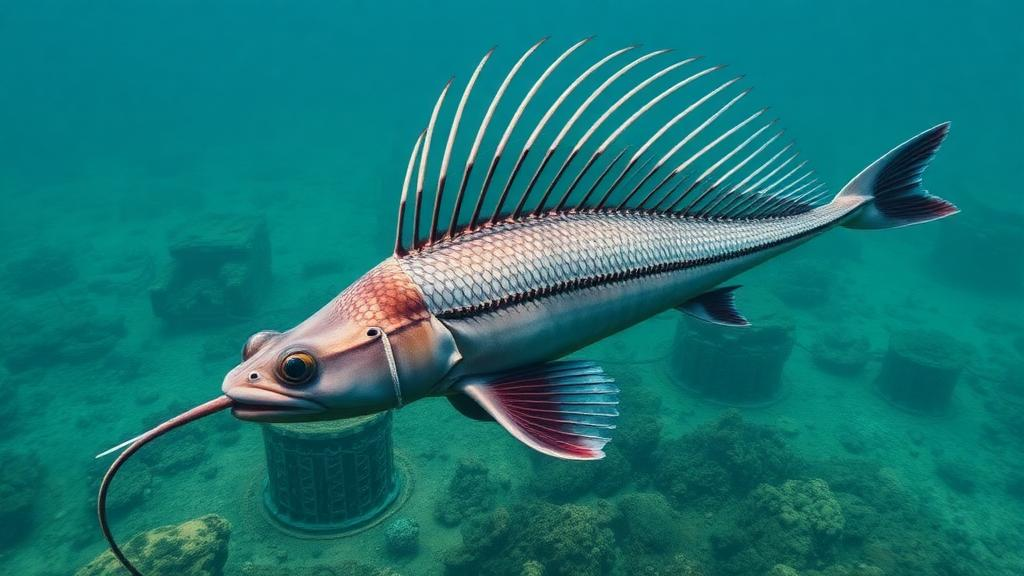
The deep sea has a way of reminding us how little we know about its inhabitants, and few fish embody that mystery better than the oarfish. Now, a remarkable specimen has surfaced from Sri Lankan waters, marking the first confirmed record of the oarfish species Regalecus russellii from the island nation and providing vital new information about the distribution of these enigmatic ribbon-like fish in the tropical Indian Ocean.
The specimen, measuring an impressive 2580 millimeters in total length, was caught by a surface tuna gillnet operated from a multiday fishing boat off the western coastal waters of Sri Lanka on 27 October 2021. The fish was landed at Beruwala Fishery Harbor and subsequently preserved in 5% formaldehyde before being deposited in the National Faunal Repository at the Colombo National Museum, Sri Lanka. This single, fresh, complete specimen now represents the first detailed morphological description of R. russellii from Sri Lankan waters.
Oarfishes, belonging to the family Regalecidae, are among the most extraordinary creatures in the ocean. Characterized by an extremely slender, laterally compressed, and very elongated ribbon-like body, they hold the distinction of being the longest bony fish in the world. The family is classified into just two genera, Regalecus and Agrostichthys, with three known species: Agrostichthys parkeri, Regalecus glesne, and Regalecus russellii. These oceanic fishes occur from surface waters to greater depths in temperate and tropical waters, yet they are exceptionally rare in nature, making every confirmed sighting scientifically significant.
The limited number of sightings, incomplete notes on encounters, scarce voucher specimens, and frequent misidentifications have all contributed to inadequate knowledge about the diversity, taxonomy, ecology, and distribution of oarfish species. This scarcity of information makes the Sri Lankan specimen particularly valuable, as it allows researchers to conduct a thorough morphological analysis that can be compared with confirmed records from other ocean basins.
The research team employed rigorous morphological methodologies to document the specimen. Measurements were collected to 1 millimeter precision using calibrated tape and Vernier calipers, while the specimen’s weight was measured to the nearest gram using a digital weighing balance. The fish was radiographed by dividing it into six overlapping sections using a static X-ray machine at the Faculty of Veterinary Medicine and Animal Science, University of Peradeniya. The X-radiograph images of all six sections were then processed to create a complete image, enabling researchers to count vertebrae and examine the dorsal fin ray arrangement.
The morphological examination revealed fascinating details about the specimen. The dorsal fin contained 337 total soft dorsal rays, with two distinctive dorsal crests: the first crest bearing five rays united by fin membranes and the second crest consisting of a single ray free from other rays. The body was long, deeply compressed, and ribbon-like, tapering towards the tail without scales but covered with dermal tubercles with circular bases. These tubercles became more prominent towards the tail end and lower sides of the body. The head was small, measuring just 9.1% of total length, with an almost vertical profile prior to the dorsal fin origin. The mouth was small, vertical, and protractible, with teeth entirely absent.
The coloration of the fresh specimen was equally striking. The body displayed a silvery-grey base with amorphous oblique dark streaks and blotches distributed across the body, most distinct in the first third. The forehead, mouth, preopercle, opercle, and lower margin of the head appeared greyish black. Perhaps most notably, the upper and lower body margins exhibited a crimson red luster, especially in the first half of the body, while the dorsal and ventral fins were entirely dark crimson red. When preserved, the body coloration shifted to yellowish brown with the same dark streaks and blotches.
The morphological characters of the Sri Lankan specimen matched well with key identification features of R. russellii previously reported from the eastern and western Pacific Ocean and the Atlantic Ocean. This consistency across ocean basins provides important confirmation of the species’ identity and extends its known range into the northern tropical Indian Ocean. The vertebral count of 114 and the gill raker arrangement on the first gill arch, numbering 55 in total with 12 on the upper portion and 43 on the lower, further supported the identification.
The significance of this record extends beyond simple range extension. Regalecus russellii was originally described as Gymnetrus russelii by Cuvier in 1816 from Vizagapatam, now Visakhapatnam, on the eastern coast of India in the Bay of Bengal. The first documentation of a Regalecus species from the Indian Ocean actually dates back to 1788, when Patrick Russell recorded a specimen from Visakhapatnam, though that juvenile specimen was not retained after drawing. Despite numerous scattered records of Regalecus from the Indian Ocean over the centuries, only two specimens had been identified to species level as R. russellii prior to this report, and no single specimen from the Indian Ocean has been accepted as a neotype for the species.
The two Regalecus species exhibit contrasting distribution patterns across the world’s oceans. In the Pacific Ocean, numerous records of R. russellii are documented from the North Pacific, while all records of R. glesne are concentrated in the South, with the exception of one R. russellii record from northern New Guinea. In the Atlantic Ocean, R. glesne has been documented exclusively in the North Atlantic and Mediterranean, while both species occur in the South Atlantic. The two species also show distinct habitat preferences related to water temperature and ocean currents: R. glesne is typically associated with colder waters, whereas R. russellii is commonly found in warmer regions. The Sri Lankan record, coming from the warm tropical waters of the northern Indian Ocean, aligns perfectly with these thermal preferences.
Interestingly, the spawning grounds of both Regalecus species occur at the extreme western end of the Indian Ocean, on the southern coast of South Africa, with R. glesne spawning also documented at the eastern end of the Indian Ocean on the coast of Western Australia. According to Roberts, the adults and early life stages of Regalecus found on the south coast of South Africa could be part of populations from the South Atlantic. The presence of a mature specimen in Sri Lankan waters raises intriguing questions about whether resident populations exist in the northern Indian Ocean or whether individuals occasionally venture far from known population centers.
The association of Regalecus with upwelling zones is particularly noteworthy. These areas feature surface cold water rich in biological productivity, which can serve as feeding grounds with optimum environmental conditions close to surface waters. The present specimen was found in shallow waters off the western coast of Sri Lanka, an area that overlaps with the coastal upwelling region. Numerous mesopelagic fish species, including members of the family Trachipteridae, have been recorded from the western and southern coastal upwelling zones of Sri Lankan waters during the summer monsoon, suggesting these productive areas attract deep-water species towards the surface.
Most records of Regalecus species are accidentally caught in fishing gear during operations and are often discarded without proper documentation. There have been many reports of oarfish landings by fishermen at various sites along the Indian and Sri Lankan coastal waters, but many of these accounts have not been published in peer-reviewed publications or made accessible to the scientific community. Advancing technology, along with the widespread accessibility of cameras and smartphone cameras, has significantly improved the frequency of recordings in recent years within the Indian Ocean region.
Citizen science programs and knowledge dissemination platforms, including social media, apps, and websites, play a crucial role in enhancing public awareness and encouraging the recording of rare or poorly known marine species. Such programs are essential to understanding marine biodiversity and supporting conservation strategies, particularly in understudied tropical waters. The Sri Lankan oarfish record demonstrates how collaboration between fishermen, researchers, and natural history institutions can yield significant scientific discoveries, even in an era of advanced marine research technology.
Seasonal patterns in Regalecus strandings and accidental catch records have been observed in certain areas, such as the Gulf of Mexico coast of Florida, though these events have not been clearly linked to environmental factors. In contrast, stranding and accidental catch reports from Australian waters have shown a clear association with storm events. The few records of Regalecus from the Indian Ocean remain inadequate to observe any patterns of stranding or accidental catch, but the species recorded are closely associated with upwelling zones of the Indian Ocean. As more records accumulate from this vast and understudied region, researchers may begin to identify environmental drivers behind these encounters.
This first confirmed record of Regalecus russellii from Sri Lankan waters represents a milestone in Indian Ocean marine biology. The detailed morphological description, complete with radiographic analysis and comprehensive meristic data, provides a reference point for future identifications in the region. The specimen, now safely preserved in the National Faunal Repository at the Colombo National Museum, stands as a testament to the scientific value of even a single well-documented specimen. As technology continues to advance and more researchers and citizens turn their attention to the ocean’s mysteries, the veil surrounding these magnificent ribbon-like giants of the deep may finally begin to lift, revealing insights into their biology, distribution, and the ecological roles they play in the vast tropical Indian Ocean.
Subject of Research: First record of oarfish, Regalecus russellii (Actinopterygii, Lampriformes, Regalecidae), from Sri Lankan waters, Indian Ocean
Article Title: First record of oarfish, Regalecus russellii ( Actinopterygii , Lampriformes , Regalecidae ), from Sri Lankan waters, Indian Ocean
Article References: Rathnasuriya, M. I. G., & Hapuarachchi, T. H. I. S. (2025). First record of oarfish, Regalecus russellii (Actinopterygii, Lampriformes, Regalecidae), from Sri Lankan waters, Indian Ocean. Acta Ichthyologica et Piscatoria, 55, 145-150. https://doi.org/10.3897/aiep.55.148496
Image Credits: AI Generated
Keywords: oarfish, Regalecus russellii, Sri Lanka, Indian Ocean, marine biology, deep sea, rare species, fish taxonomy, upwelling zones, marine biodiversity, First, record
Cite Scienmag News
Violet Maxwell. (October 19, 2026). Giant oarfish relative surfaces in Sri Lankan waters in a first for the Indian Ocean island. Scienmag. https://scienmag.com/giant-oarfish-relative-surfaces-in-sri-lankan-waters-in-a-first-for-the-indian-ocean-island/
Violet Maxwell. "Giant oarfish relative surfaces in Sri Lankan waters in a first for the Indian Ocean island." Scienmag, 19 October 2026, https://scienmag.com/giant-oarfish-relative-surfaces-in-sri-lankan-waters-in-a-first-for-the-indian-ocean-island/. Accessed 19 October 2026.
Violet Maxwell. "Giant oarfish relative surfaces in Sri Lankan waters in a first for the Indian Ocean island." Scienmag. October 19, 2026. https://scienmag.com/giant-oarfish-relative-surfaces-in-sri-lankan-waters-in-a-first-for-the-indian-ocean-island/


