


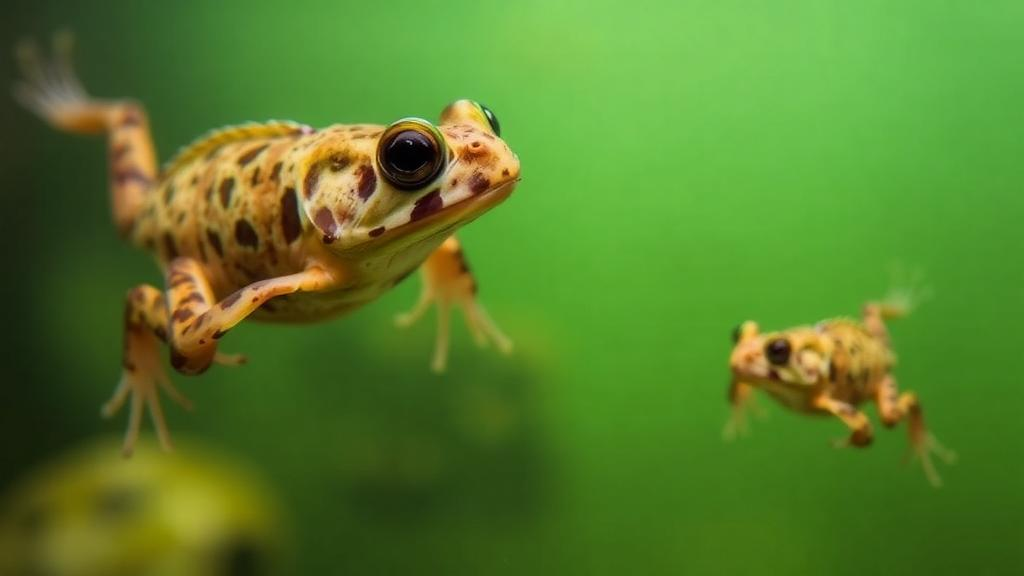
A quiet arms race is unfolding in the ephemeral ponds of suburban Florida, and the unlikely defenders are small, aggressive fish barely a few centimetres long. New research published in the journal NeoBiota reveals that the eastern mosquitofish, a native predator often maligned as a nuisance elsewhere in the world, may hold the key to controlling one of the region’s most surprising amphibian invasions: the tropical clawed frog, Xenopus tropicalis. The study demonstrates that biotic resistance, the capacity of resident species to repel invaders, is not a uniform shield but a stage-specific weapon that strikes hardest at an invader’s most vulnerable life stages.
The tropical clawed frog, an ephemeral pond-breeder from west-central Africa, was discovered reproducing in a Florida wetland in 2016, marking the first documented invasion of this species anywhere outside its native range. Its congener, the African clawed frog, is a notorious global invader implicated in spreading chytrid fungus, driving declines in native frogs, and consuming protected fish species on four continents. The prospect of another Xenopus establishing a foothold in North America has therefore alarmed invasion biologists. Field surveys following the initial discovery found larval stages in up to sixteen ponds, all of them ephemeral and largely fishless, a pattern that hinted the tadpoles might be defenceless against predatory fish.
That observation inspired a team of researchers to test a refined version of Elton’s classic biotic resistance hypothesis, which posits a negative relationship between biodiversity and invasibility. Rather than treating resistance as a diffuse community-level effect driven mainly by competition, the researchers focused on a single strongly interacting native predator and asked how its impact varies across the frog’s complex life history. Their central hypothesis was straightforward: the strength of predatory biotic resistance would depend on the life stage of the invader, with eggs and larvae bearing the brunt of the attack while metamorphosed juveniles and adults escape largely unscathed.
To test this, the team ran a series of controlled laboratory and mesocosm experiments using wild-caught frogs from the invasion site in Riverview, Florida, together with tadpoles produced through hormonally induced spawning of captive stock. Six life stages were exposed to mosquitofish: eggs, hatchlings averaging 12.4 millimetres in total length, small tadpoles, large tadpoles, metamorphs with forelimbs visible, and fully metamorphosed juveniles and adults. Each trial paired treatment tanks containing four mosquitofish, two males and two females to account for sex differences in aggression, with fish-free controls. Observers recorded chases and bites during a twenty-minute window, then monitored survival for a week, noting tail damage on any casualties.
The results were stark. Mosquitofish consumed all but one egg within a single hour, while control tanks lost only a single egg. No hatchling survived exposure to the fish, and mortality reached 86 percent among small tadpoles and a complete 100 percent among large tadpoles, every one of which showed characteristic tail damage inflicted by fin-nipping fish. Mortality dropped to 65 percent for metamorphs, whose tails are being reabsorbed as limbs take over locomotion, and vanished entirely for juveniles and adults. The pattern reveals a vulnerability window that closes abruptly at metamorphic climax, when functional limbs and a reduced reliance on the tail remove the very structure mosquitofish exploit.
Tail damage emerged as the signature of mosquitofish attack. Although direct chases and bites were rarely witnessed during observation periods, with only 32 interactions recorded across 32 tanks, the injuries on survivors told a different story. Damaged tails impair swimming, hindering a tadpole’s ability to reach the surface to breathe, find food, or flee predators. The researchers suggest that many fatal attacks occurred outside the observation window, and that sub-lethal harassment may be as important as outright predation in driving mortality.
The team then probed three factors that might modify this resistance: predator density, cannibalism by adult frogs, and habitat complexity. Stocking densities of 5, 11, and 25 fish per square metre, comparable to wild mosquitofish densities, all produced devastating tadpole losses in outdoor concrete vats. The two higher densities killed 99.7 percent of tadpoles within a week, while even the lowest density caused mortality far exceeding the 8 percent seen in fish-free controls. Contrary to expectations, structural complexity in the form of artificial vegetation at stem densities up to 246 stems per square metre offered no refuge; tadpoles, which filter-feed in the water column and must surface to breathe, remained easy targets regardless of how much cover was available.
The most unexpected finding came from the cannibalism experiment. Adult tropical clawed frogs alone caused almost no tadpole mortality, but when adults were combined with mosquitofish, tadpole deaths soared to an average of 96 percent, frequently exceeding the mortality caused by fish alone. This points to a rare multi-predator facilitation effect, in which mosquitofish fin-nipping likely cripples tadpole mobility, making them easier prey for cannibalistic adults. Facilitation between predators is uncommon in ecological literature, and facilitation of cannibalism by another predator is rarer still, making this observation a notable addition to invasion ecology.
From a theoretical standpoint, the study underscores that biotic resistance acts differentially across the full life cycle of an organism and at different stages of the invasion process itself, potentially blocking establishment or spread before reproduction succeeds. From an applied standpoint, the implications are tantalising. Stocking mosquitofish into ephemeral wetlands that lack natural fish colonisation could function as a stage-based biocontrol, eliminating TCF eggs and tadpoles before metamorphosis and thereby cutting off recruitment. The researchers caution, however, that mosquitofish have their own history of global invasion and can harm native amphibians, so deployment must be restricted to their native range and to situations where threatened species are not breeding.
Field trials are now underway to determine whether laboratory results translate to the patchwork of Florida ponds where the invasion is unfolding. If they do, the humble mosquitofish, a species routinely condemned as an invader on other continents, may earn an unlikely redemption as a home-grown guardian, demonstrating that the strongest barriers to invasion are sometimes written not in species richness but in the precise timing of a predator’s appetite.
Subject of Research: Stage-specific predatory biotic resistance by eastern mosquitofish against invasive tropical clawed frogs
Article Title: Stage-based biotic resistance to a non-native species
Article References: Everett, K. M., Hill, J. E., & Tuckett, Q. M. (2026). Stage-based biotic resistance to a non-native species. NeoBiota, 105, 47-65. https://doi.org/10.3897/neobiota.105.165389
Image Credits: AI Generated
DOI: 10.3897/neobiota.105.165389
Keywords: biotic resistance, invasive species, tropical clawed frog, mosquitofish, Florida, amphibian conservation, predation, metamorphosis, biocontrol, invasion ecology, tadpole survival, habitat complexity
Cite Scienmag News
Gavin Prescott. (October 19, 2026). Native Fish Deliver Stage-Based Biotic Resistance Against Invading Tropical Clawed Frogs. Scienmag. https://scienmag.com/native-fish-deliver-stage-based-biotic-resistance-against-invading-tropical-clawed-frogs/
Gavin Prescott. "Native Fish Deliver Stage-Based Biotic Resistance Against Invading Tropical Clawed Frogs." Scienmag, 19 October 2026, https://scienmag.com/native-fish-deliver-stage-based-biotic-resistance-against-invading-tropical-clawed-frogs/. Accessed 19 October 2026.
Gavin Prescott. "Native Fish Deliver Stage-Based Biotic Resistance Against Invading Tropical Clawed Frogs." Scienmag. October 19, 2026. https://scienmag.com/native-fish-deliver-stage-based-biotic-resistance-against-invading-tropical-clawed-frogs/


